
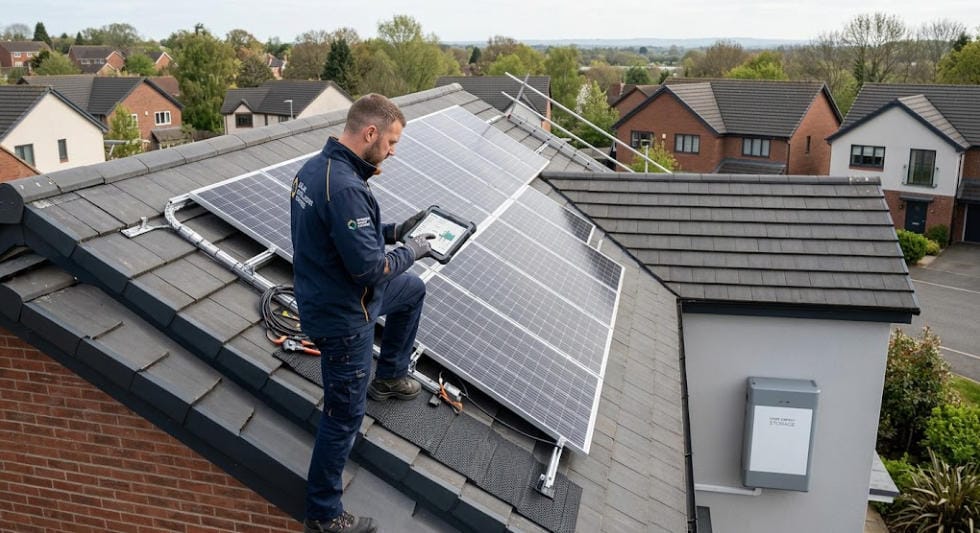
MCS Certification Explained: The Complete Guide to the UK’s Microgeneration Certification Scheme
MCS certification is the UK’s benchmark for quality in small-scale renewable energy. Since 2007, it has set the standards for solar panels, battery storage, and heat pumps. A product or installer must meet those standards to earn the MCS mark. For homeowners, that mark is often the difference between a government grant and no grant at all.
| Quick Answer MCS certification is the UK’s quality mark for small-scale renewable energy. It covers solar PV, battery storage, heat pumps, solar thermal, biomass, and wind. MCS certifies both the products and the installers who fit them. Most UK government incentives, including the Smart Export Guarantee and Boiler Upgrade Scheme, require it. |
What Is MCS Certification?
MCS stands for Microgeneration Certification Scheme. It is a UKAS-accredited quality scheme. It covers small-scale, low-carbon energy technologies in UK homes and small businesses.
The scheme works on two levels at once. First, it certifies products, while also certifying the businesses that install them. A solar panel, battery, or heat pump must pass independent testing first. Only then can it carry the MCS mark. Second, it certifies installers. The business that fits the system must also meet set technical and consumer-protection standards.
Both halves matter together. A certified product fitted by an uncertified installer will not earn an MCS certificate. Nor will a certified installer using an uncertified product.
The scheme is owned by the MCS Charitable Foundation, a registered charity. It is run day to day by The MCS Service Company Ltd. Independent certification bodies carry out the actual assessments. These bodies hold UKAS accreditation to ISO 17065.
A Brief History of the Scheme
MCS launched in 2007, backed by the UK government. At the time, the microgeneration market was growing fast but had little oversight. The scheme brought a common set of rules to that market.
Early adoption came from the Feed-in Tariff and Renewable Heat Incentive. Both required MCS-certified equipment and installers to qualify for payments.
Although those two schemes have since closed, the certification framework has grown alongside the newer incentives that replaced them. Battery storage joined the scheme in 2020, with its own dedicated installation standard. That change reflects how central storage has become to UK home energy.
Through 2026 and into 2027, MCS is rolling out its biggest change since launch. This is a redeveloped installer scheme, covered later in this guide.
What Technologies Does MCS Certification Cover?
MCS certification spans seven core technology groups. Together, they cover most of the low-carbon systems a UK household is likely to install.
- Solar PV — rooftop and ground-mounted panels that generate power
- Battery storage — electrical energy storage systems (EESS) that store solar or grid power for later use
- Air and ground source heat pumps — low-carbon heating and hot water
- Solar thermal — panels that heat water directly from sunlight
- Biomass — wood-fuelled boilers and stoves
- Wind turbines — small-scale wind power for homes and small firms
- Micro-hydro — small water-driven electricity generation
How MCS Certification Works
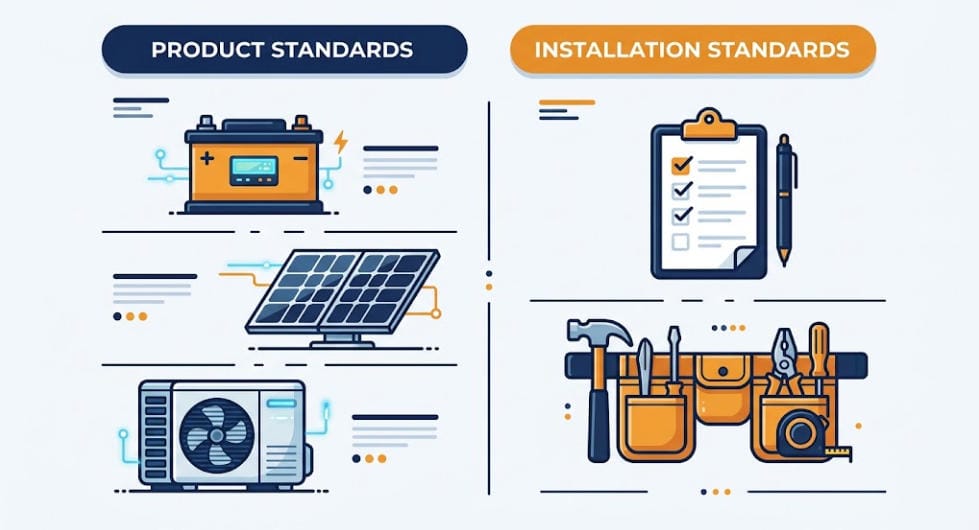
Every technology under the scheme follows two linked sets of rules. One is a product standard. The other is an installation standard. Together, they explain why both the equipment and the company fitting it need to carry the mark.
Product Standards
Product standards set out performance and safety tests for a given technology. MCS 005, for example, covers solar PV modules. On top of that, every manufacturer must also meet MCS 010, a shared factory quality-control standard that applies across all product types. Consequently, a manufacturer submits its product for independent testing first. Only then does it appear on the MCS certified products list.
Installation Standards
Installation standards are published as MCS Installation Standards (MIS) documents. They define how an installer must design, size, and commission a system on site. They cover everything from electrical safety to customer handover paperwork.
An installer’s work is checked in several ways. Certification bodies run technical checks, sample audits, and site visits. Most of this happens on a rolling annual cycle.
MCS Certification for Battery Storage
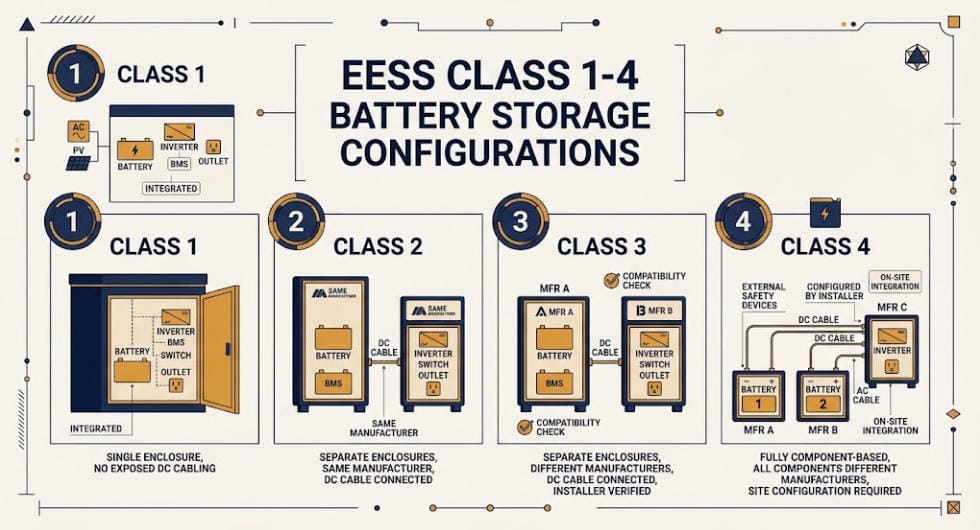
Battery storage sits inside the same certification framework as solar and heat pumps. It has its own installation standard, though: MIS 3012. First piloted in 2020, and updated since, it covers residential and small commercial systems up to 50kW.
MIS 3012 sorts battery installations into four classes. MCS calls these Electrical Energy Storage System (EESS) classes. The class depends on how the battery, inverter, and safety devices are packaged. It also depends on how many manufacturers supplied them. This classification decides which compatibility checks an installer must run before commissioning.
For a broader look at how storage certification standards work outside the UK residential market, see our guide to BESS certifications.
MIS 3012 also adds UK-specific requirements on top of general battery safety practice. These cover DC isolation, fire and ventilation guidance, and mandatory customer documentation at handover.
Why MCS Certification Matters for Homeowners and Installers
MCS certification is not a legal requirement. You can install a solar panel, battery, or heat pump without it. In practice, though, it is very hard to access UK government incentives without the certificate.
Smart Export Guarantee
The Smart Export Guarantee pays households for electricity they export to the grid. To qualify, an MCS certified installer must install the system. The products used must also be MCS certified. A smart meter that records exports is required too.
Boiler Upgrade Scheme
The Boiler Upgrade Scheme is run by Ofgem on behalf of DESNZ. It offers grants of up to £7,500 towards an air or ground source heat pump. Biomass boilers can get up to £5,000. Both the installer and the heat pump must carry MCS certification for the grant to pay out.
Other Incentives and Protections
The certificate also underpins eligibility for ECO4 and the Home Energy Scotland Grant and Loan, sitting alongside 0% VAT benefits on qualifying installations. Beyond the money, certified installers owe customers real protections. These include a written quote, a minimum workmanship warranty, and free access to dispute resolution if something goes wrong.
The Redeveloped MCS Installer Scheme
MCS is in the middle of its biggest overhaul since launch. Consultation began in 2022 and 2023. The redeveloped installer scheme then started rolling out to installers in early 2026. MCS has set a target completion date of 31 March 2027.
The new scheme shifts focus. It moves away from paperwork-heavy quality management systems. Instead, it looks at the quality of the finished installation on site. Three named business roles now sit at the centre of every certified installer. A Licensee holds ultimate responsibility for meeting scheme requirements. The Main Contact handles day-to-day contact with MCS and the certification body. A Technical Supervisor then signs off that each job meets the relevant installation standard.
Track record now shapes how often an installer gets checked. Installers with a strong, consistent record face fewer site assessments. Those with more issues get checked more often. Every installer must also buy an MCS-approved financial protection product for each customer. This gives homeowners a safety net if an installer cannot fix a problem itself.
How to Check MCS Certification
Checking a company’s MCS certification takes under a minute, and it is free. Search the public installer database on the MCS website. Or look up a specific job on the MCS Installations Database, at certificate.microgenerationcertification.org.
Before signing a contract, confirm three things. First, check the installer’s certification is current. Second, check the exact product model sits on the MCS certified products list. Third, check the installer’s certification covers the technology you are buying. An installer certified for solar PV is not automatically certified for battery storage. Each technology sits under its own installation standard.
Key Takeaways
- MCS certification is the UK’s main quality mark for solar PV, battery storage, heat pumps, solar thermal, biomass, and wind.
- It certifies products and installers separately. A valid MCS certificate needs both.
- It is not a legal requirement, but it is required for the Smart Export Guarantee, Boiler Upgrade Scheme, and ECO4..
- Battery storage has its own installation standard, MIS 3012, covering systems up to 50kW.
- A redeveloped installer scheme is rolling out through 2026 and 2027, with new business roles and mandatory financial protection.
Frequently Asked Questions
Is MCS certification a legal requirement?
No. You can install a solar panel, battery, or heat pump without it. You will not, though, qualify for the Smart Export Guarantee, the Boiler Upgrade Scheme, or related regional grants.
How long does certification last?
It is ongoing, not a one-off event. Certification bodies run regular audits, usually once a year. An installer can lose certification for failing to meet the standard.
Does MCS cover standalone battery storage?
Yes. MIS 3012 covers battery storage added to an existing solar system. It also covers battery-only installations with no solar panels at all.
What happens with a non-MCS installer?
The work may still be safe and good. It will not, though, generate an MCS certificate. Without that certificate, the property cannot access MCS-linked grants or export payments, even later.
Learn More From MCS
For the full list of current standards, certified installers, and certified products, see the official MCS website, which maintains the live installer and product databases referenced throughout this guide.
Further Reading


Leave a Reply
Want to join the discussion?Feel free to contribute!