

Advanced SOH Estimation for BESS: Kalman Filtering and Machine Learning Methods
Every BESS needs a trustworthy answer to one question. How much capacity is left? That answer is state of health, or SOH. So what advanced SOH estimation BESS platforms rely on goes well beyond those basics. Instead, it moves past simple counting into methods that update continuously and catch what simpler tools miss.
Still, the basics matter too. Capacity counting, incremental capacity analysis, and resistance tracking cover the fundamentals well elsewhere. So this guide picks up where those leave off. Instead, it focuses on the model-based and data-driven methods that power modern, production-grade BMS platforms.
| Quick Answer Advanced SOH estimation for a BESS relies mainly on two approaches. Model-based methods, led by the Extended Kalman Filter, combine a battery model with real-time data to estimate SOH continuously. Data-driven methods train on historical data to predict SOH directly from patterns. Most production systems layer these with basic methods rather than using either alone. |
Why Basic Methods Fall Short: The Case for Advanced SOH Estimation BESS Tools
Capacity counting is accurate. But it takes the asset offline for hours. Incremental capacity analysis needs slow, steady charge rates. A hard-cycling BESS rarely gets those conditions. Resistance tracking is fast. But it does not always move in step with capacity fade.
So each basic method has a real gap that advanced SOH estimation BESS tools are built to fill. First, it runs continuously. Then, it does not need a dedicated test cycle. Also, it can fuse multiple weak signals into one stronger estimate.
For the full detail on capacity counting, incremental capacity analysis, and resistance-based tracking, see our guide on BMS Algorithms Explained. It covers those foundational methods in depth. Our guide on DCIR and BESS Performance covers resistance-based tracking specifically. So the rest of this guide builds on that foundation.
Advanced SOH Estimation BESS Method: Kalman Filtering
How the Extended Kalman Filter Works
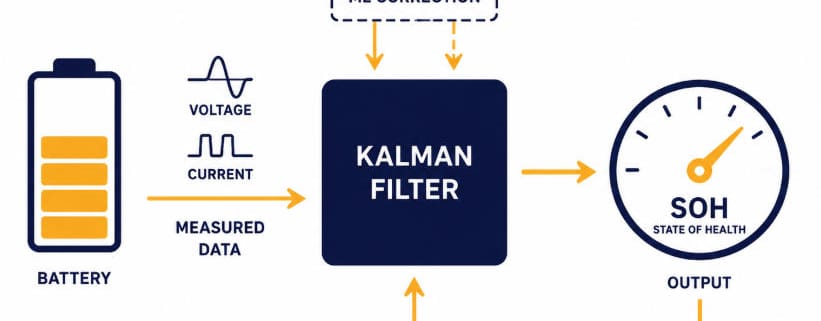
Model-based methods take a different approach entirely. Instead of measuring capacity directly, they combine a mathematical battery model with real-time voltage and current data. Then SOH comes out as one of several hidden values inside that model.
The Extended Kalman Filter, or EKF, is the most common tool here. So it treats SOH as a state that evolves slowly over time. Then SOC, by contrast, is a state that evolves quickly. So both get updated together as new voltage and current readings arrive. This is the core mechanism behind what advanced SOH estimation BESS platforms rely on for continuous tracking. No dedicated test cycle is needed at all.
So this is where advanced SOH estimation BESS platforms really separate from basic tracking altogether. Instead, an EKF does not wait for a full cycle or a clean charge curve. So it updates with every new data point, all day, every day. So that is a fundamentally different operating mode than periodic testing.
Still, the catch is model dependency. An EKF is only as good as the battery model feeding it. A model that misses LFP’s flat voltage curve and hysteresis will shake. Its SOH estimate will wobble too. This is the same modeling challenge that shows up in SOC estimation too. See our guide on BMS SOC Estimation Methods Explained for the deeper dive. The underlying model quality issue is shared between SOC and SOH filtering.
Kalman Filter Variants Worth Knowing
Beyond the standard EKF, several variants push accuracy further still. First, the Unscented Kalman Filter handles the battery’s nonlinear behavior more directly, at higher computational cost. Dual and joint Kalman filters estimate SOC and SOH together, side by side. Each one helps the other. They do not run as separate, disconnected calculations. Adaptive Kalman filters go further still. They adjust their own noise settings as the battery ages. So the filter does not quietly get worse as the cell drifts from its original model.
So research comparing filter types generally finds Kalman-based approaches outperform simple coulomb counting or raw voltage lookups on accuracy. But that accuracy gain depends entirely on getting the underlying model right first. A poorly tuned EKF can do worse than a well-calibrated simple method. That is why checking the model matters as much as picking the filter.
Advanced SOH Estimation BESS Method: Data-Driven and Machine Learning
How Data-Driven SOH Estimation Works
The newest category skips chemistry modeling almost entirely. So this data-driven approach is a growing part of advanced SOH estimation that BESS platforms increasingly adopt as fleets scale up. Instead, a data-driven system trains on historical voltage, current, resistance, and temperature data. It learns to predict SOH straight from patterns in that data. No engineer needs to hand-build the physics behind it.
Still, these methods can be very accurate once trained on enough data from similar cells. Some published results report SOH prediction errors under 1%. But they carry a real cost. So training requires a large, representative dataset covering realistic aging conditions. A model trained on one usage pattern may not work on a very different one. So data-driven methods work well for fleet-scale operators with lots of historical data. They work less well for a single small system starting from scratch.
Common Model Types
So a few model types show up again and again in this space. Neural networks handle battery data well, since it comes in sequence. Recurrent architectures like LSTMs work especially well here, since today’s SOH depends heavily on yesterday’s usage pattern. Then gradient-boosted tree models offer a lighter option. They need less training data, at some cost to peak accuracy. Gaussian process regression adds something useful. It gives a confidence range around each prediction. That matters for operators who need more than just a number. They need to know how much to trust it.
So hybrid approaches are increasingly common as a middle ground here too. A model might combine a physics-based EKF core with a machine learning correction layer. Then that layer is trained to catch what the physics model misses. So this blends two strengths. It keeps the clarity of model-based methods, and it gains some of the accuracy of data-driven ones. So for many fleet operators, this hybrid path offers the best of both without committing fully to either extreme.
How Advanced SOH Estimation Layers with the Basics in a Real BMS
So no single advanced SOH estimation BESS method covers every need on its own. Real BMS platforms typically layer several of these together, basic and advanced alike.
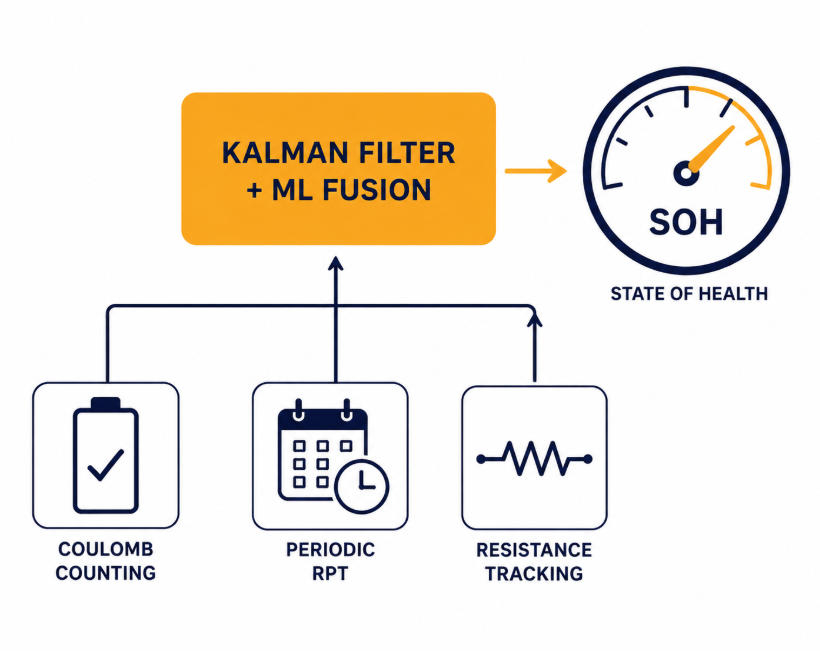
Coulomb counting runs continuously in the background. It is cheap, and it is always available. Periodic Reference Performance Tests reset the drift that coulomb counting accumulates over time. Resistance tracking via pulse tests adds a second, faster signal between full tests. Then a Kalman filter or similar model-based layer fuses all of that input together. Often, a machine learning correction sits on top. The result is one continuously updated SOH number the operator can actually act on.
This is the real payoff of advanced SOH estimation that BESS teams invest in. First, it is not about replacing the basics. Instead, it is about fusing them into something more reliable than any single input alone. The Kalman filter or ML layer acts as the integration point. It weighs each incoming signal by how much it should be trusted at that moment.
This layered approach connects directly to the Equivalent Full Cycle concept. That concept is used to separate calendar and cycle aging in field data. Both concepts feed the same underlying goal. That goal is a trustworthy, continuously updated picture of how much life a BESS has left. For more on how EFC-based tracking fits into the bigger degradation picture, see our guide on Calendar Aging vs Cycle Aging in LFP Batteries. It covers the full framework.
Reporting and Version Drift in Advanced SOH Systems
Still, however sophisticated the method, reporting matters as much as the calculation itself. A single SOH number without context can mislead. Is it a raw Kalman filter output, an ML prediction, or a blend of both? Was it measured fresh off a full Reference Performance Test, or purely interpolated by a model between tests? Advanced SOH estimation BESS dashboards that surface this context help operators trust the number instead of just reading it.
So version drift is a real risk for advanced SOH estimation BESS platforms running model-based and ML systems specifically. If a BMS updates its underlying model, the SOH number can jump. This holds true even when the battery itself has not changed. So it helps to log which method and model version produced each SOH reading, not just the number alone. That log becomes valuable later. It matters most when comparing degradation trends across a fleet of systems built at different times.
Choosing the Right Advanced SOH Estimation BESS Approach
The right level of advanced SOH estimation that BESS operators actually need depends on two things. System size is one. How the asset gets used is the other. A small residential or commercial system may get by fine with basic coulomb counting. Occasional full-capacity tests can fill the gap. Model-based methods can wait.
A large utility-scale asset generating revenue around the clock is a different story. It needs more from advanced SOH estimation BESS platforms. There, the added complexity of a full Kalman-filter or hybrid ML approach usually pays off. Even small SOH estimation errors translate into real dispatch and warranty costs at that scale. Fleet operators with many similar systems get the most value from data-driven methods. They have the training data those methods need to perform well.
Whatever the advanced SOH estimation BESS approach is chosen, the underlying goal stays the same. Accurate SOH tracking is what turns raw degradation into something an operator can actually plan around. For the broader mechanisms behind that degradation, see our guide on Battery Degradation in BESS: Causes, Mechanisms & Mitigation. It lays out the full picture.
Advanced SOH Estimation Methods: Quick Comparison
| Method | Speed | Accuracy | Best Fit |
| Kalman filter (EKF/UKF) | Continuous | High, if model is accurate | Real-time production systems |
| Dual/adaptive Kalman filter | Continuous | Higher, self-corrects over time | Long-life assets with aging models |
| Neural network / LSTM | Continuous | High, with enough training data | Fleet-scale operators with data |
| Gaussian process regression | Continuous | High, with confidence intervals | Operators needing uncertainty estimates |
| Hybrid physics + ML | Continuous | Highest, blends both strengths | Large fleets wanting best-in-class accuracy |
Frequently Asked Questions
What is the most accurate advanced SOH estimation BESS method available?
No single method wins universally. Hybrid approaches often report the best accuracy. They combine a physics-based Kalman filter with a machine learning correction layer. That combination captures known battery physics and the patterns pure physics models miss.
Do I need machine learning for SOH estimation, or is a Kalman filter enough?
For most single-site systems, a well-tuned Kalman filter is enough. Machine learning methods earn their added complexity mainly at fleet scale. That is where enough historical data exists to train a model well.
Why does a Kalman filter sometimes perform worse than simple coulomb counting?
So this happens when the underlying battery model is poorly calibrated. An EKF is only as good as the model feeding it. So a mismatched model can produce worse results than a simple, well-calibrated basic method.
Does advanced SOH estimation replace basic methods like coulomb counting in a BESS?
No. Advanced methods almost always layer on top of basic ones instead of replacing them. They fuse coulomb counting, periodic tests, and resistance signals into one stronger estimate.
Further Reading
Battery Degradation in BESS: Causes, Mechanisms & Mitigation
Calendar Aging vs Cycle Aging in LFP Batteries
BMS SOC Estimation Methods Explained: OCV vs Coulomb Counting vs Kalman Filter
BMS Algorithms Explained: SOH Estimation, SoP, SoE, Cell Balancing, and Safety Diagnostics
The Power Test: Why DCIR Is the True Measure of BESS Performance