


Mixed-Age String Design: Managing a BESS String After Augmentation Adds New Cells
Mixed-age string design is the problem every DC-shuffled augmentation eventually runs into. New modules and years-old modules end up sharing hardware.
The BMS then has to make that mix actually work. Our BESS augmentation guide and our AC block addition vs. DC shuffling comparison cover whether to augment and whether to add capacity on the AC or DC side.
This article picks up after that decision. Once new and old modules are physically on site together, mixed-age string design becomes the question that matters.
It’s narrower and more technical: how do you run a string that mixes cells at very different points in their degradation curve? And how do you do it without dragging new capacity down to old capacity’s level?
What is Mixed-Age String Design in BESS?
Mixed-age string design means managing a BESS string where old and new modules share hardware after augmentation. A series string’s weakest module caps its capacity, so mixing ages often pulls new capacity down. Segregating old and new modules into separate strings usually preserves more capacity than mixing them.
Key Takeaways for BESS Mixed-Age String Design
- Weakest-Link Capacity Cap: A series string’s total usable capacity is limited by its most degraded module, preventing newly added modules from delivering full rated power.
- Impedance & Degradation Mismatch: Resistance differences between old and new cells create uneven electrical and thermal stress, accelerating divergent degradation under load.
- Module Segregation Strategy: Grouping modules into separate strings by State of Health (SOH) preserves significantly more capacity than mixing old and new cells within a single string.
- Joint Constraint Sorting: Multi-variable assembly algorithms (matching capacity, impedance, and self-discharge) reduce cell mismatch by 76–87% compared to single-metric sorting.
- String-Level BMS Control: BMS and EMS logic must manage cutoffs and dispatch priorities at the string level rather than the whole-pack level to protect new capacity.
Why Mixed-Age String Design Is a Real Engineering Problem
Augmentation sounds simple on paper. Add new modules, restore lost capacity, move on.
The DC-shuffling path makes mixed-age string design harder than it sounds. New modules added this way often end up wired into the same series string as modules that have already lost real capacity.
Years of cycling and calendar aging cause that loss. However, it doesn’t happen evenly across a fleet.
In a series-connected string, the weakest module caps total usable capacity. The string can’t deliver more than its most degraded member allows before hitting a cutoff. Peer-reviewed research on active balancing for serially connected battery packs confirms this constraint directly: without balancing, the lowest-capacity cell in a series string limits the capacity the whole string can deliver.
A brand-new module wired into an old string doesn’t contribute its full rated capacity to the pack. It gets pulled down to whatever the weakest module in that same string can still deliver.
Mixed-age string design is the discipline of avoiding that outcome. It works through physical string assembly, BMS cutoff logic, or both.
The Weakest-Link Problem: How New Capacity Gets Dragged Down
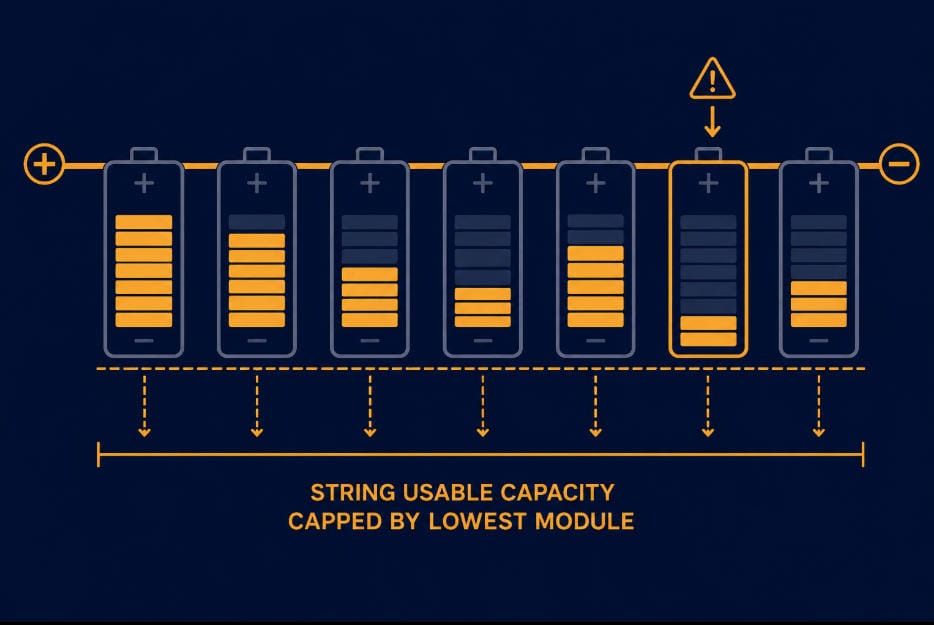
The mechanism is straightforward once you see it. Cells or modules in series all carry the same current. Voltage, not current, is what varies between them.
As the string discharges, the most degraded module reaches its low-voltage cutoff first. It has the least remaining capacity. The BMS has to stop the whole string there.
That happens regardless of how much charge the newer modules still have left. The same happens in reverse on charge.
The weakest module hits its upper voltage limit first. The whole string stops charging there too, even if the new modules could still accept more.
Impedance mismatch compounds the problem. A 2014 study on parallel-connected lithium-ion cells found that a 20% internal-resistance difference between two cells led to roughly a 40% reduction in cycle life.
While parallel sets suffer from uneven current sharing, this mechanism directly impacts series strings as well: higher-impedance modules in series generate greater localized heat under load, creating thermal hotspots that accelerate degradation across the entire string.
Separate experimental work on parallel-connected cells under thermal gradients found a related pattern: a 30°C thermal gradient across a pack roughly doubled the degradation rate and produced 50% more capacity loss after 1,000 cycles.
Both results are from parallel-connected cells specifically, not a series-string augmentation case. But the underlying mechanism generalizes.
Impedance mismatch between old and new modules creates uneven electrical and thermal stress. That stress tends to widen the gap between them, not close it.
BMS and EMS Strategies for Mixed-Age String Design
Matching Modules Before They Go Into a String
The first lever is physical: which modules actually get grouped into which string.
A 2026 optimization study on assembling heterogeneous battery packs from repurposed cell inventories tackled this directly. The study targeted second-life EV packs, not BESS augmentation, but used the same string-assembly logic.
It used a mixed-integer linear program to jointly minimize capacity spread, internal resistance spread, and self-discharge spread across a string, rather than sorting by one metric alone.
That joint approach cut mismatch by 76-87% compared to simple single-metric sorting — grouping modules by capacity alone, or resistance alone, and hoping the rest lines up.
The practical takeaway for mixed-age string design: sorting new and old modules by one number, like nameplate capacity, leaves real mismatch on the table. Impedance and self-discharge rate matter just as much.
Segregating Strings by Health Instead of Mixing Them
The second lever is architectural: don’t mix ages within one string at all.
Research on heterogeneous reconfigurable battery systems notes that prior SoH-aware reconfiguration studies show grouping cells of similar health within the same series string improves delivered pack capacity.
The logic holds because a string’s usable capacity is still constrained by its weakest member either way. Grouping by health just keeps that weakest member from dragging down modules that don’t belong with it.
Applied to mixed-age string design, this points toward keeping new modules in their own dedicated strings. Therefore, they should remain separate from the legacy fleet, wherever the site’s busbar and rack layout allow it.
Each string can then run its own SOH-appropriate cutoffs. The new string isn’t held back by the old one. The old string isn’t pushed harder trying to keep pace with modules it can no longer match.
Mixed-Age String Design: Setting Cutoffs and Dispatch at the String Level
Whichever physical layout a site ends up with, the BMS and EMS configuration has to follow it.
A single pack-wide cutoff voltage, sized for the newest modules, risks over-discharging or over-charging the old ones.
A cutoff sized for the oldest modules protects them. But it wastes real capacity sitting unused in the new modules every single cycle.
Per-string or per-block SOH tracking, feeding into a shared control layer, avoids that trade-off. It’s the same shared-state pattern covered in our integrated BMS control architecture guide — mixed-age string design is one more reason that architecture earns its complexity.
On the EMS side, operators can also set dispatch priority deliberately. Favoring the newer string during high-stress events — fast frequency response, high-C-rate calls — protects its cycle life.
Reserving the older string for gentler duty does the same in reverse, instead of averaging stress evenly across mismatched hardware.
Mixed-Age String Design: Segregated Strings vs. Mixed Strings
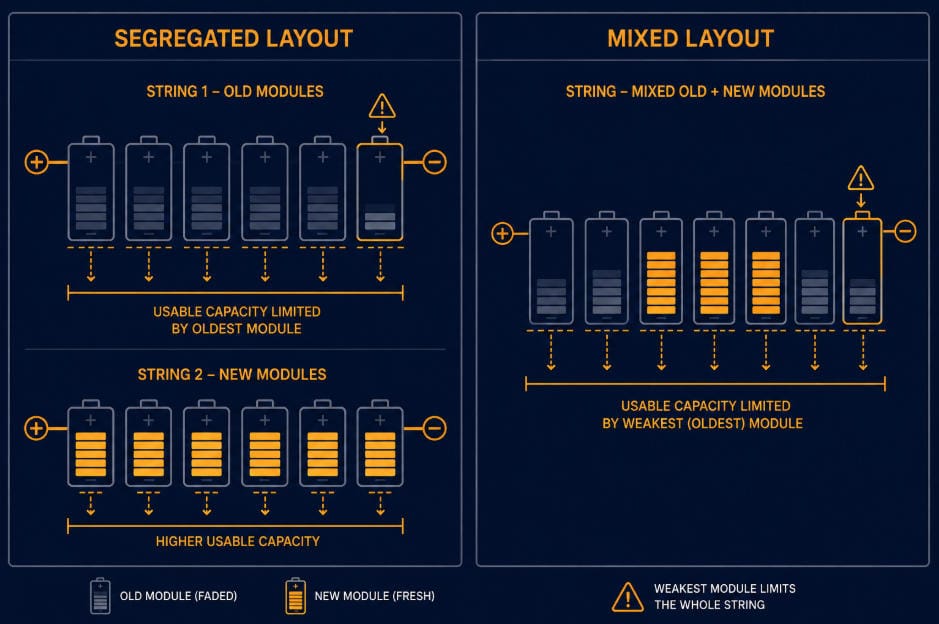
Neither approach is free. Segregation asks more of the site’s electrical layout; mixing asks more of the BMS.
| Factor | Segregated Strings (old and new separate) | Mixed Strings (old and new combined) |
| Delivered new-module capacity | Close to full rated capacity | Reduced — capped by the weakest module in the shared string |
| BMS/EMS complexity | Lower per string; needs per-string SOH tracking at the control layer | Higher — cutoffs must reconcile two very different degradation states in real time |
| Physical/electrical requirement | Needs spare busbar/breaker capacity for a genuinely separate string | Fits within existing string wiring, easier where space is tight |
| Best fit | Sites with layout headroom, or where preserving new capacity matters most | Sites with hard busbar/space constraints and modest capacity mismatch |
This decision sits downstream of the AC-vs-DC augmentation choice covered in our AC block addition vs. DC shuffling guide. AC block addition sidesteps mixed-age string design entirely, since the new block runs on its own inverters.
It never shares a string with the old fleet. DC shuffling is where this problem actually shows up.
Frequently Asked Questions
Does mixed-age string design apply to AC block addition too?
Not directly. AC block addition installs a new, self-contained power block with its own inverters. The new modules never share a DC string with the old fleet.
Mixed-age string design is specifically a DC-shuffling problem, since that path reuses the existing DC bus and wiring.
How much capacity is actually lost by mixing old and new modules in one string?
It depends on how degraded the old modules are relative to the new ones. A series string’s weakest module caps its usable capacity, so the loss scales with that gap.
A small gap between oldest and newest modules costs little. A large gap can waste a meaningful share of the new capacity added.
Can a BMS correct for mixed-age imbalance with active balancing alone?
Active balancing helps with cell-level SOC drift within a string. It doesn’t remove the underlying capacity or impedance gap between old and new modules.
Balancing hardware and string-level design address different parts of the same problem — see our active balancing topologies guide for how the hardware itself works.
Is segregating strings always the better choice?
Not always. It preserves more new capacity, but it needs spare busbar and breaker headroom the existing site layout may not have.
Where space is tight, a mixed string with carefully matched modules and string-appropriate cutoffs can still be the more practical choice.
Further Reading
BESS Augmentation: The Complete Guide to Restoring Capacity Lost to Degradation
BESS Augmentation: AC Block Addition vs. DC Shuffling
In-Service Cell Imbalance in LFP BESS
Integrated BMS Control Architecture
Active Balancing Hardware Topologies Compared
Sources
- Optimal Assembly of Repurposed Lithium-Ion Battery Packs under Cell Heterogeneity and Screening Uncertainty. arXiv:2607.12951 (2026)
- Target-Mean State-of-Charge Control for Maximum Utilization of Heterogeneous Reconfigurable Battery Systems Under Constant-Bus Constraints. Batteries 2026, 12, 221. MDPI (peer-reviewed, open access)
- Degradation in parallel-connected lithium-ion battery packs under thermal gradients. Communications Engineering (Nature), 2024
- Gogoana, R.; Pinson, M.B.; Bazant, M.Z.; Sarma, S.E. Internal resistance matching for parallel-connected lithium-ion cells and impacts on battery pack cycle life. Journal of Power Sources 252 (2014), 8-13
- A novel active cell balancing topology for serially connected Li-ion cells in the battery pack for electric vehicle applications. PMC (peer-reviewed, open access)