


Supplier Response Time: What One-Line Replies and Silence Reveal
Supplier response time is not only about speed. The bigger issue is a salesperson who starts a conversation, disappears, and returns later with “Sorry, I was busy.”
You ask a real question about price, specifications, lead time or certification. Then you get one line, such as “Will check.” Then nothing.
Hours or days later, the message arrives: “Sorry, we are very busy.” Nobody expects instant answers. But busy with what?
Also, as a new buyer, you are left wondering whether your inquiry has an owner at all.
What Does Supplier Response Time Tell Buyers?
What Supplier Response Time Looks Like in Practice
Supplier response time is more than how fast the first reply arrives. It is also whether the supplier keeps the conversation moving.
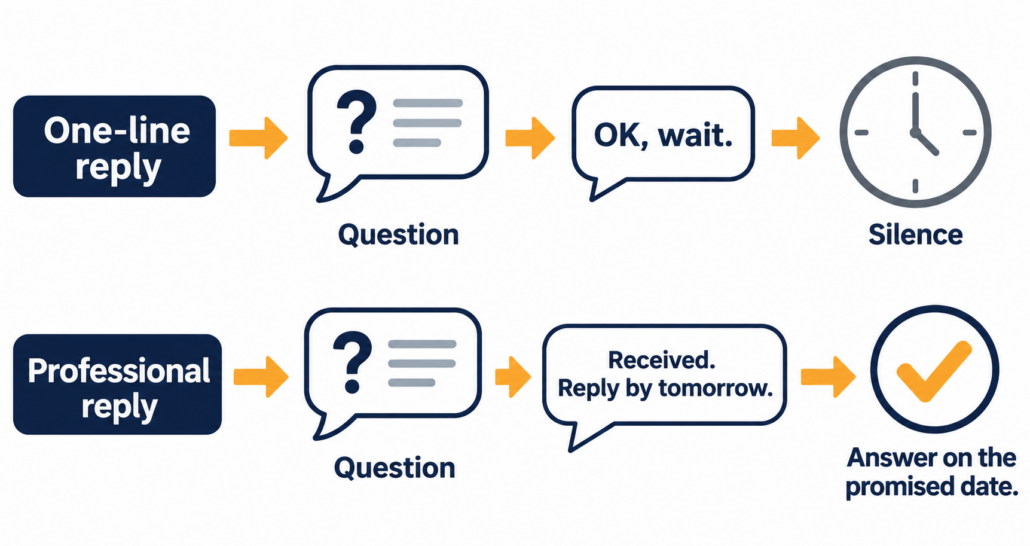
Buyers often describe the same pattern in four steps:
- First, you send a detailed question about specifications, price or lead time.
- Next, the salesperson replies with one line, such as “Will check.”
- Then the conversation stops without an explanation or a date, so you have to chase.
- Finally, the salesperson returns with “Sorry, busy” and a partial answer.
Each step looks small. But together they leave the buyer with no update and no clear owner.
Yet this is not only a China problem. A Harvard Business Review audit of more than 2,000 U.S. companies found that many were slow to answer web inquiries.
Some never answered at all. Because of this, judge each supplier by its own pattern, not by its country.
Why Disappearing Is Worse Than a Slow Reply
A slow reply that answers the question is a small problem. Still, you at least know the supplier engaged.
But a disappearing salesperson is different. You cannot tell whether the supplier is working on it, stuck, or has dropped your inquiry.
Because you cannot tell, you must chase. That puts the work on the buyer, which is the wrong way around.
Also, nobody expects 24-hour availability. A technical question may need input from engineering or production.
But needing time is different from leaving a buyer without an update. Good supplier response time means setting expectations, not answering instantly.
What Good Supplier Response Time Looks Like
A simple acknowledgment is enough:
Then the buyer knows the message arrived and when to expect an answer.
Compare that with “Sorry, busy.” Here the first reply sets an expectation, but the second does not.
Use this as your standard when you judge supplier response time.
Is This One Salesperson’s Problem or a Company Problem?
When the same behavior repeats, the question becomes bigger than one employee. Then supplier response time reflects how the company is run.
First, does management know inquiries go unanswered? Next, is anyone tracking open quotations?
Also, is there a backup contact when the salesperson is away? Can it support another customer without neglecting existing ones?
If the Company Is Always Busy, Where Is the Capacity for Your Order?
If demand keeps exceeding the team’s capacity, what is management doing about it? Hiring may be one answer.
But better coordination, clearer responsibilities and a workable follow-up process may be others. What matters to the buyer is whether the company closes that gap.
A company does not have to explain every internal decision. But “we are busy” does not show that it can handle your account.
Could the Team Be Busy With Existing Problems?
A full workload does not tell a buyer what is creating it. Instead, separate what you can observe from what you can only suspect.
What You Can Observe
- The conversation stops without an explanation.
- No date is given for the next reply, so you cannot plan.
- Nobody else steps in when the salesperson is away.
- Explanations change from one message to the next.
- Then the same pattern repeats.
What You Can Only Suspect
Possible causes include understaffing, poor coordination, delayed shipments, quality complaints, warranty claims or financial constraints. Some may indicate a product or business issue.
But these are possibilities, not conclusions. Slow communication alone does not establish a production problem, a quality failure or cash-flow trouble.
Whatever the cause, supplier response time leaves the buyer with one question: who will take responsibility for this account?
For a new buyer, this matters. Also, communication habits before the order are often the best evidence of how a supplier will handle problems after payment.
Questions That Replace Guesswork
- Who will manage the account, and who provides backup?
- What delivery commitments can the company realistically make?
- How do technical questions and quality complaints get escalated?
- What happens if the main contact is unavailable?
- Can the company also provide relevant customer references?
Also, our supplier red flags guide lists 30 warning signs to check.
Supplier Response Time Before You Pay
If getting a quotation already needs constant chasing, what will communication look like later? Think about these situations:
- A shipment is late: how fast will the supplier respond?
- A quality problem appears, but who takes responsibility?
- Your team needs urgent technical support: will anyone be available?
- You file a warranty claim: will the supplier handle it professionally?
- A contract or delivery dispute appears: will management step in?
That is a question to test, not a prediction. But supplier response time before the order is one of the few signals you can see early.
Since warranty terms matter too, our C&I BESS warranty guide shows how to read them.
How to Test Supplier Response Time Before You Order
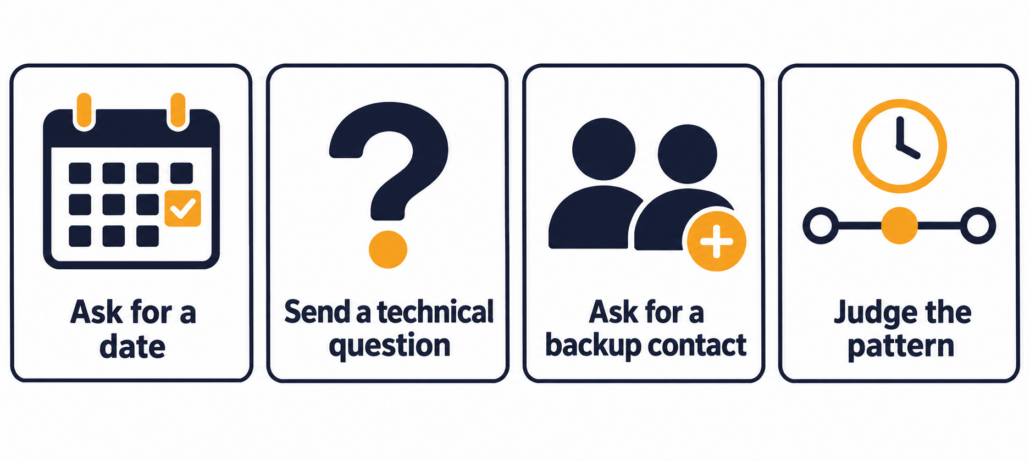
Testing supplier response time takes little effort, and four habits cover most of it.
Ask for a Date, Not a Promise
When a salesperson says “Will check,” reply with one polite line. For example: “Thank you. Can you confirm the date I will receive the answer?”
Then track whether the supplier keeps that date.
Send One Technical Question Early
Choose a question that needs a specific answer, such as cycle-life test conditions or lead time. Then note how fast and how clearly the supplier replies.
Ask Who Owns Your Account
Request a named contact and a backup, such as a sales manager or technical lead. A supplier with a real process will name both.
Judge the Pattern, Not One Delay
One late reply means little. But repeated late replies with no explanation mean a lot.
Check the quality of the answer too. A fast but vague reply is not a good one.
Questions Suppliers Should Ask Themselves
Owners can use the same lens on their own business, because supplier response time affects every inquiry they receive.
- How long does your team take to answer a new inquiry?
- Today, how many buyers are waiting for a quote or technical answer?
- How many inquiries are lost because nobody follows up?
- Does anyone review response times each week?
- If the team is always busy, who has capacity for a new customer?
Then the answers show whether the company is organized to grow.
Frequently Asked Questions About Supplier Response Time
These answers cover common buyer questions about supplier response time.
What Is a Good Supplier Response Time?
A reasonable target is a first reply within one business day. But if the full answer takes longer, the supplier should confirm receipt and name a date.
Does a Slow Reply Mean the Supplier Is Bad?
Not by itself. A holiday or a technical check can cause a delay. But those delays come with an explanation and a date. Repeated silence does not.
Does Being Busy Mean the Supplier Has Problems?
Not necessarily, since busy can mean healthy demand. But it does not show capacity for your order, so ask for a date and a named contact.
How Many Follow-Ups Are Too Many?
If you must chase twice for a basic answer, note it. Then, if it happens again, treat it as a pattern.
Should Poor Supplier Response Time End the Conversation?
Not always. First, send a polite message asking for a date and a backup contact. If the supplier still goes quiet, look elsewhere or limit your risk with a small trial order.
Final Thoughts on Supplier Response Time
Being busy is understandable. Repeatedly leaving a buyer without an update is the issue.
A new customer should not have to discover a company’s capacity problems after placing an order.
Also, if a company is too busy to develop new business today, how will it manage your business tomorrow?
Supplier response time is one signal, but not the whole picture. For the full check, see our Chinese supplier verification guide.
Have you ever dropped a supplier after a one-line reply and silence? Share your experience in the comments.
Need Help Checking a Supplier?
Are you sourcing batteries, BESS, inverters or PCS from overseas? Supplier response time is one check, but not the only one. Contact SunLith Energy to talk through the rest.
Further Reading
These guides also add context on supplier response time and supplier risk.