
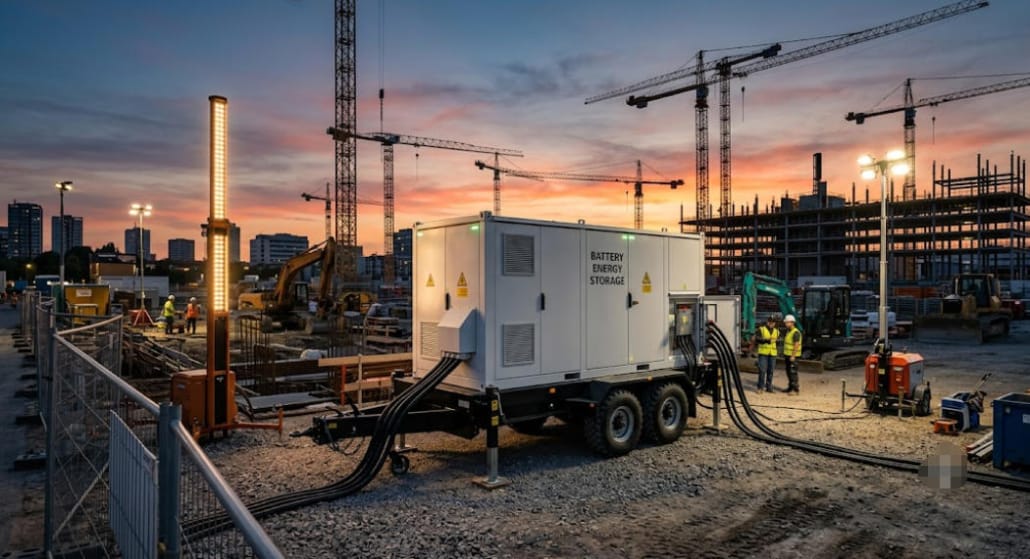
Mobile BESS: The Complete Guide to Trailer-Mounted Battery Storage
| ⚡ Quick Answer A Mobile BESS is a battery energy storage system built onto a trailer, truck bed, or skid. It stores electricity and discharges it on demand, so it can power a site with no fuel, no exhaust, and almost no noise. |
What Is a Mobile BESS?
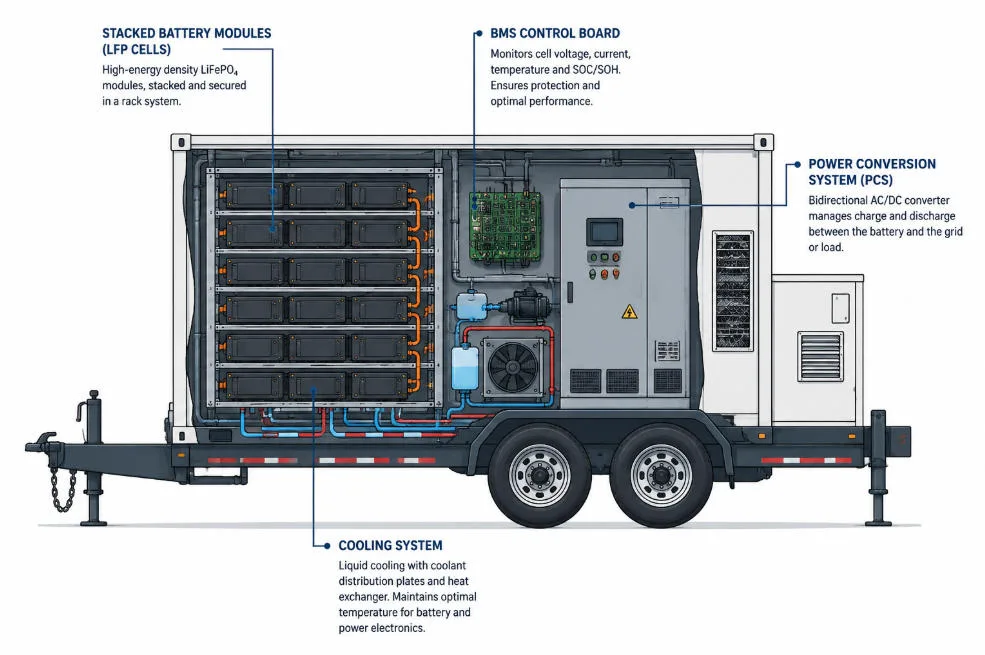
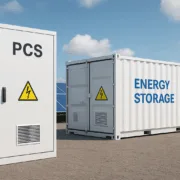
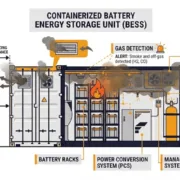
A Mobile BESS packs the same core parts as a fixed installation into a towable unit. Battery modules sit inside a weatherproof enclosure. Meanwhile, a power conversion system (PCS) turns stored DC energy into usable AC power, and a battery management system (BMS) tracks voltage, temperature, and charge level in real time.
In some designs, manufacturers split the battery pack and the PCS into separate trailers. As a result, an operator can pair several battery trailers with one shared PCS unit and add capacity without buying a new inverter each time.
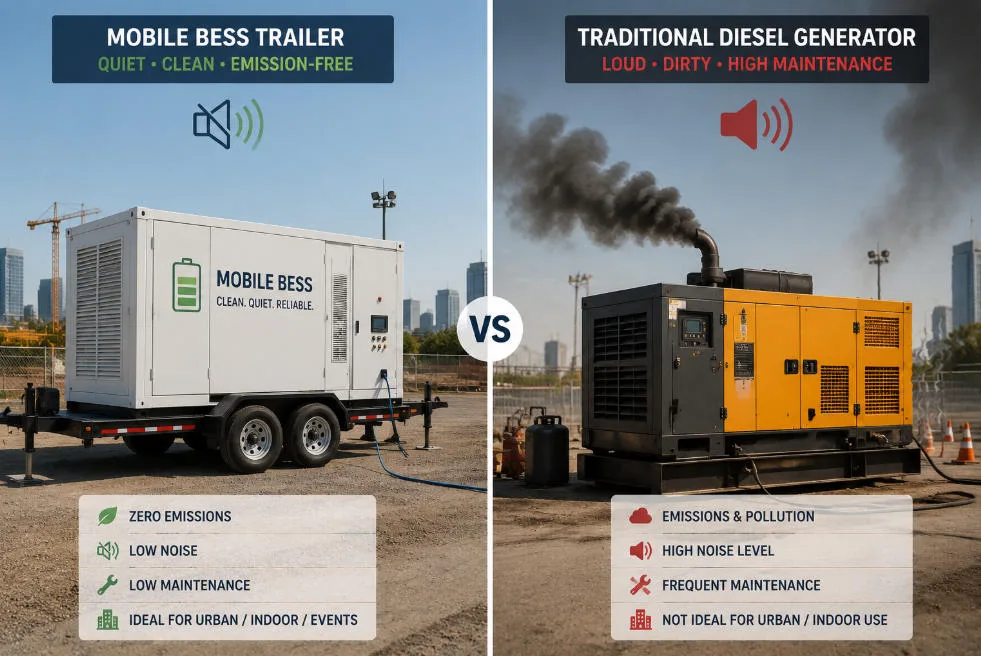
Mobile BESS vs. Diesel Generators
Diesel generators have powered temporary sites for decades. Today, though, a Mobile BESS competes for many of the same jobs. Since it works in a very different way, the table below compares the two side by side.
| Factor | Mobile BESS | Diesel Generator |
| Emissions | Zero exhaust during discharge | Combustion exhaust, particulates, NOx |
| Noise | Near-silent operation | 60-90+ dB at typical load |
| Fuel logistics | None during discharge; recharges from grid or solar | Ongoing diesel delivery and storage |
| Response time | Instant power, no warm-up | Seconds to minutes to reach stable output |
| Runtime | Fixed by battery capacity, then needs recharge | Runs as long as fuel supply lasts |
| Best fit | Short-duration, indoor, or noise-restricted sites | Long, continuous loads with no grid access |
In practice, many sites pair the two instead of choosing one. First, a generator recharges the battery at its most efficient load point. Then it steps back while the Mobile BESS carries the load alone.
Because of this, the hybrid pattern can cut diesel use by roughly half. A generator that idles at partial load burns fuel poorly, so shifting the everyday load onto the battery saves real money over a multi-week job.
Mobile BESS Use Cases
Mobile BESS units solve an old problem in a new way. They provide temporary power where the grid hasn’t arrived yet, isn’t reliable, or isn’t allowed. Overall, six use cases account for most deployments today.
Construction Sites
Construction is the largest single market for mobile storage. Grid interconnection applications often take three to nine months, so a Mobile BESS closes that gap right away.
It can power tower cranes, welding gear, site offices, and electric machinery from day one. Because it makes no exhaust, crews can also run it in tunnels and basements, where diesel fumes would be unsafe.
Events and Film Production
Concerts, festivals, and film sets need power that stays out of the way. A Mobile BESS delivers clean sine-wave output and stays under roughly 55 dB, so it won’t hum in a live recording or flicker a sensitive light rig.
Simply put, a generator can’t match that at the power levels these shoots need.
Mobile BESS for Disaster Relief
When storms or wildfires knock out power lines, crews can truck in units within hours. They power emergency radios, medical gear, and temporary shelters, often arriving before utility crews finish permanent repairs.
Data Center Maintenance Windows
Data centers sometimes need to take a UPS or switchgear segment offline for maintenance without losing backup coverage. A Mobile BESS can stand in during that window, then leave once the permanent system is back online.
Mobile BESS for Grid Support
Utilities and developers increasingly use these units for temporary grid services: voltage support, short-term capacity, or bridging power for a solar or wind project still waiting on its permanent interconnection agreement. As a result, a finished generation asset keeps earning instead of sitting idle.
EV Charging Support
Pop-up EV charging is one of the fastest-growing uses. Because a Mobile BESS can buffer a weak grid connection, it can still deliver fast-charging bursts at events or in areas the grid hasn’t fully reached.
Mobile BESS Sizing and Chassis Configurations
Capacity varies widely, and the right size depends entirely on the job. Understanding a few typical bands makes it much easier to spec the right unit.
Chassis Types and Capacity
Compact truck-mounted units typically sit around 90 kWh. Power Up Connect’s Green Grid trailer is a good example: it carries UL 9540 and UL 9540A certification, and operators can daisy-chain up to 10 units for bigger jobs.
Meanwhile, mid-size trailer units generally run from about 250 kWh to 650 kWh. This band covers most construction and event work.
Utility-scale trailers sit at the top end. They often exceed 800 kWh and sometimes reach 2 MWh per unit. These usually ride on a 20-foot container platform or a dedicated semi-trailer, so teams can string several together for multi-megawatt-hour jobs.
| Chassis Type | Typical Range | Best Fit |
| Compact flatbed / skid | ~90 kW – 300 kWh | Small job sites, single-piece equipment, light-load events |
| Drawbar trailer | ~250 kW – 650 kWh | Mid-size construction sites, festivals, multi-generator replacement |
| Container semi-trailer | 800 kWh+ up to ~2 MWh | Utility-scale temporary power, large events, grid-support deployments |
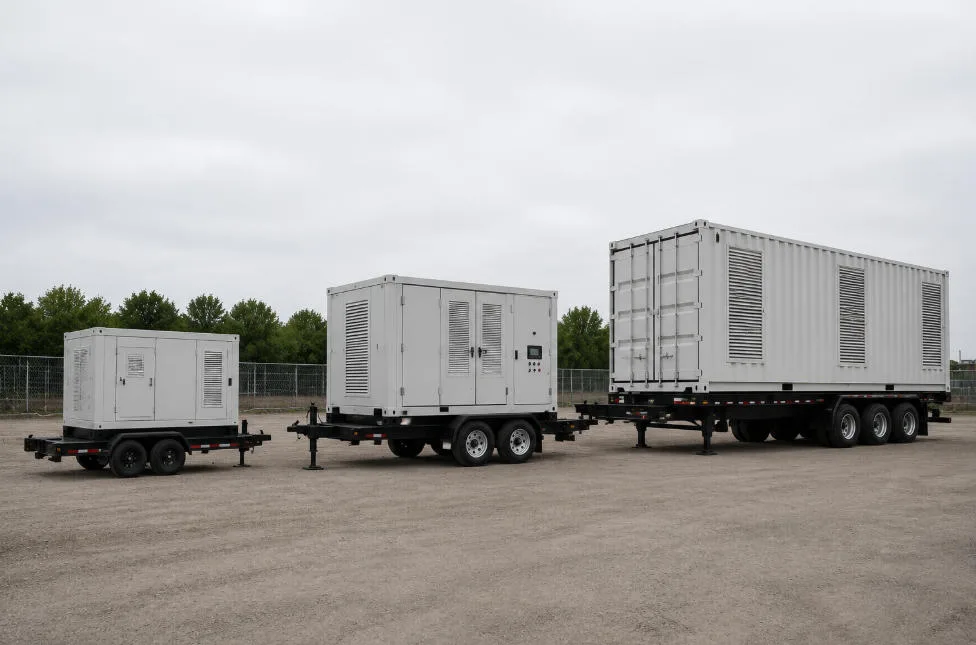
Road weight limits usually cap a single trailer’s size, not the battery technology itself. So past roughly 1-2 MWh, it’s typically easier to deploy multiple units side by side than to push one chassis larger.
Battery Chemistry and Cooling
LFP (lithium iron phosphate) leads this segment for good reason. It handles the shaking and heat swings of repeated transport well. Plus, its long cycle life (commonly rated 6,000-8,000+ cycles) suits frequent redeployment far better than higher-energy but less forgiving chemistries.
Smaller units, roughly under 300 kWh, typically use air cooling. It keeps the system light and easy to fix in the field.
Larger, higher-power trailers, however, generally switch to liquid cooling instead, since it manages heat better. This is the same crossover point used in stationary BESS design.
Chassis engineering: Dual-axle running gear, mechanical braking, and vibration-dampening brackets protect the battery pack through highway travel and rough job-site terrain. The chassis itself needs proper axle load ratings, DOT-compliant lighting and braking, and secure tie-down points.
Mobile BESS Safety and Compliance
A Mobile BESS still has to meet the same fire-safety and transport rules as any lithium battery system. However, it does earn a few specific carve-outs because it moves.
NFPA 855 Rules
NFPA 855, the Standard for the Installation of Stationary Energy Storage Systems, defines mobile ESS in Section 3.3.9.5. It then sets installation rules in Section 4.5. The most important carve-out is this: wheeled or trailer-mounted units don’t need to meet the seismic and structural load rules that apply to permanent installations.
Even so, standard separation distances still apply. Deployments need at least 10 ft (3 m) from public ways, stored combustibles, and hazardous materials. They also need 50 ft (15 m) from tents or seating areas holding 30 or more people.
That said, an Authority Having Jurisdiction (AHJ) can reduce these distances if large-scale UL 9540A fire test data backs it up. Regardless, deployed mobile ESS still can’t go indoors, in covered parking garages, on rooftops, below grade, or under building overhangs.
UL 9540 Listing for Mobile BESS
Mobile units still need UL 9540 listing, the core safety standard for energy storage systems. They typically undergo UL 9540A large-scale fire testing too, just like a stationary installation.
In short, mobility doesn’t exempt the battery system from certification — it only changes the foundation and seismic rules. For the full installation breakdown, see our NFPA 855 guide.
Transport Testing Under UN 38.3
Before a Mobile BESS can ship, its cells and battery packs must pass UN 38.3. This set of eight tests simulates real transport conditions: altitude, thermal cycling, vibration, mechanical shock, short circuit, impact, overcharge, and forced discharge.
The vibration test alone runs a sweep from 7 Hz to 200 Hz for three hours. Next, a shock test simulates a 150g/6ms or 50g/11ms impact. That’s a tough bar, since this system gets driven over real roads again and again, not installed once and left in place.
Road Transport Rules
In the US, moving an assembled lithium battery system by highway falls under 49 CFR 173.185, part of the DOT’s Hazardous Materials Regulations. Since it classifies lithium batteries as Class 9 dangerous goods, compliance means UN-spec packaging, correct labels, and proper shipping papers.
A good provider keeps UL 9540 listing documents and UN 38.3 test summaries ready on request. You shouldn’t have to wait while a provider scrambles for paperwork after a jurisdiction asks for it.
Certification Varies by Export Market
It’s also worth noting that certificates differ by market, not just by product. US and Canadian buyers look for UL 1973, UL 9540, and UL 9540A. EU buyers need CE marking plus IEC 62619 or IEC 62933. China requires CCC, Korea requires KC, India requires BIS, and Japan requires PSE. UN 38.3 applies everywhere, since it covers transport rather than installation. For the full regional breakdown, see our BESS certifications guide.
Mobile BESS vs. Stationary BESS
| Factor | Mobile BESS | Stationary BESS |
| Installation | Deployed in hours; no permanent foundation | Weeks to months; foundation and permitting |
| Relocation | Built to move between sites | Fixed for the life of the asset |
| Typical use case | Temporary power, events, emergency response | Long-term grid support, solar firming |
| Seismic requirements | Exempt when on a wheeled chassis | Full seismic design required |
| Capacity ceiling | Practical limit near 1-2 MWh per trailer | Scales to tens or hundreds of MWh |
| Cost structure | Often rented per deployment | Capital asset with long depreciation |
Choosing a Mobile BESS Provider
Providers increasingly sell Mobile BESS as a service rather than as a capital purchase. Because of that, the ownership model matters just as much as the hardware spec sheet.
- Rental / deployment-based pricing — pay per project or per month, and the provider handles maintenance and recharge logistics
- Battery-swap service — the provider delivers a fully charged replacement unit and takes the depleted one away, so on-site recharging is never your problem
- Hybrid generator pairing — for sites where full battery replacement isn’t practical yet, running the BESS alongside a generator can still cut fuel use by roughly half
- Outright purchase — makes sense when your organization deploys often enough that utilization beats rental economics
Before committing, it’s worth asking any provider a few direct questions:
- Is the unit UL 9540 listed and UN 38.3 tested, with documentation available on request?
- What is the actual site commissioning time, door-to-power-on, not just “rapid deployment” marketing language?
- What is the noise rating at rated load, and is it independently measured or a vendor estimate?
- Is the enclosure rated for indoor or enclosed-space use, or is it outdoor-only?
- What happens if the unit needs service mid-deployment? Is there a swap or backup unit guarantee?
- What’s included in the rental rate: transport, commissioning, decommissioning, and recharge, or are these billed separately?
- Does the chassis carry standard DOT lighting, braking, and axle certifications for your transport route?
Mobile BESS Market Outlook
Fortune Business Insights values the mobile energy storage system market at $58.28 billion in 2025, and projects it will reach $207.03 billion by 2034. That’s a compound annual growth rate above 15%.
Several trends are driving this growth. For one, utilities and developers are swapping out diesel generators to cut emissions and noise complaints. At the same time, falling LFP battery costs make the switch more affordable each year.
Longer grid interconnection queues are pushing more projects toward temporary bridging power, too. And a growing rental and battery-swap model is lowering the barrier for construction and events firms that don’t want to own the asset outright.
So for project developers, the takeaway is simple. Mobile BESS has moved from a niche disaster-relief tool to a mainstream option, one worth considering any time a site needs power before, instead of, or alongside a permanent grid connection.
Mobile BESS Key Takeaways
| Aspect | Key Point |
| Definition | A Mobile BESS is a trailer-, truck-, or skid-mounted battery storage system built for temporary deployment. |
| Chemistry | LFP dominates for thermal stability and 6,000-8,000+ cycle life. |
| Cooling | Air cooling under ~300 kWh; liquid cooling for larger, high-power units. |
| Sizing | Ranges from ~90 kWh truck units to 2 MWh utility-scale trailers. |
| Safety code | NFPA 855 Section 4.5 governs mobile ESS; seismic rules are waived on wheeled chassis. |
| Listing | UL 9540 listing and UL 9540A fire testing still apply. |
| Transport | Cells must pass UN 38.3 testing; US highway moves follow 49 CFR 173.185. |
| Market | Projected to grow from $58.28B (2025) to $207.03B (2034), a 15%+ CAGR. |
Frequently Asked Questions
What Is a Mobile BESS Used For?
A Mobile BESS gives temporary, emission-free power for construction sites, live events, film sets, disaster relief, data center maintenance, EV charging, and short-term grid support. In short, it fits anywhere a diesel generator would normally go, but noise, exhaust, or setup speed favor a battery instead.
How Long Does a Mobile BESS Run Before Recharging?
Runtime depends on the battery’s energy capacity relative to the connected load, not a fixed number. Typically, a mid-size unit in the 250-650 kWh range can run critical loads for several hours to a full day before it needs recharging.
Providers usually size the system to match the job’s load profile. Many also offer battery-swap or hybrid generator support for jobs that need power longer than a single charge allows.
Is It Safe to Transport on Public Roads?
Yes, as long as the system carries the right certification. Cells and battery packs must pass UN 38.3 testing before they ship. In the US, road transport then falls under 49 CFR 173.185, which classifies lithium batteries as Class 9 hazardous material.
The chassis itself also needs standard DOT lighting, braking, and axle certifications. A reputable provider keeps this paperwork ready on request.
Does NFPA 855 Apply to a Mobile BESS?
Yes. NFPA 855 defines and regulates mobile energy storage systems directly in Section 4.5. It exempts wheeled, trailer-mounted units from seismic and structural load rules, but UL 9540 listing, minimum separation distances, and site-specific electrical rules still apply.
What Battery Chemistry Do Most Units Use?
Lithium iron phosphate (LFP) leads this segment. It handles the shaking and heat swings of repeated transport well, and its long cycle life suits frequent redeployment better than most alternatives.
Further Reading
C&I vs. Utility-Scale Solar and BESS — how deployment scale shapes technology and economics.
Fast Frequency Response (FFR) — how BESS delivers grid ancillary services.
NFPA 855 Guide — full breakdown of the stationary and mobile ESS installation standard.
Understanding BESS Specifications — how to read capacity, power, and cycle-life ratings.
BESS PCS Functions and Features — what the power conversion system does inside any BESS, mobile or fixed.
BESS Certifications Guide — how UL, IEC, CE, and other regional certifications compare across export markets.




Trackbacks & Pingbacks
[…] more in our guide to mobile BESS, a uniquely flexible type of BESS built for temporary […]
Leave a Reply
Want to join the discussion?Feel free to contribute!