
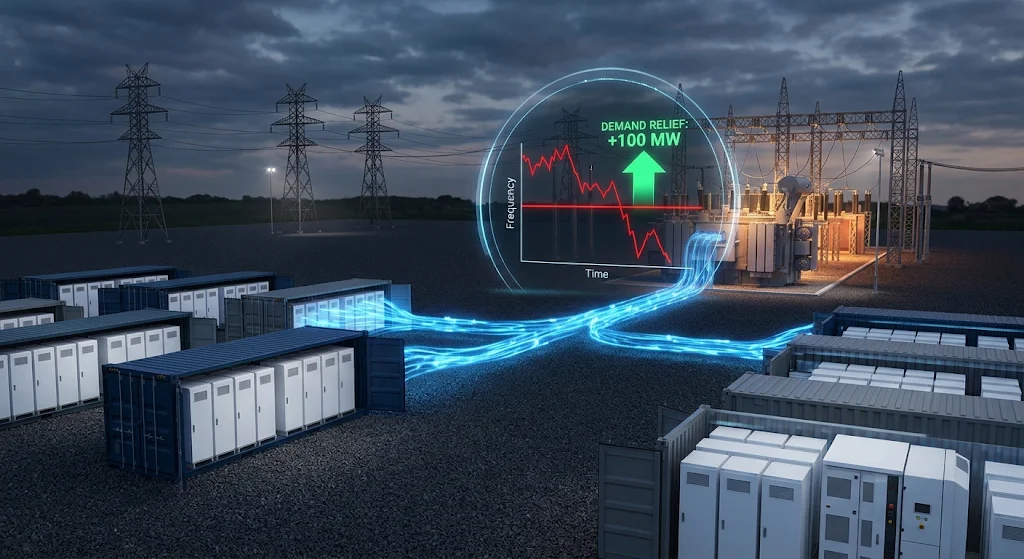
When a BESS Stops Charging in an Under-Frequency Event
When a BESS stops charging during an under-frequency event, it immediately removes grid demand and eases the supply gap. However, the required grid response is not uniform: a BESS may stay connected at reduced or zero power, reverse to discharge, or disconnect entirely under an approved scheme.
Recent grid events highlight why these distinctions matter. On May 13, 2026, India lost 8,963 MW of generation, causing frequency to fall from 49.953 Hz to 49.398 Hz in 19 seconds, according to reporting on NRPC findings. During the incident, plants in charging mode remained connected until dispatchers issued specific stop instructions.
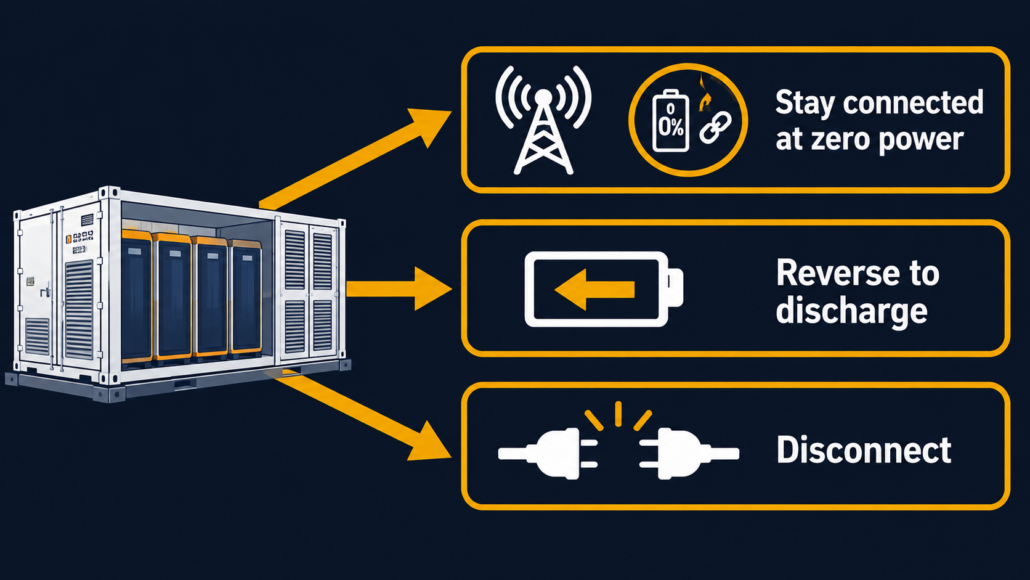
Three Possible Responses When a BESS Stops Charging
Frequency shows whether supply and demand match. When a BESS stops charging, reverses or disconnects, the grid sees a different power flow at the connection point.
Why Charging Counts as Grid Load
A grid holds 50 or 60 Hz only when supply equals demand. If a large plant trips, supply falls below demand and frequency drops.
A large BESS charging at full power looks like a big factory to the grid.
Operators already shed load by relay as a last resort. However, a battery that stops charging removes load without cutting off a customer.
Stop, Reverse or Disconnect
- Reduce or stop charging: the BESS stays connected while drawing less power, potentially reducing charging power to zero.
- Reverse to discharge: the BESS injects power. It needs stored energy, and the code and controls must allow it.
- Disconnect: a breaker or feeder opens. The charging load is removed, but the disconnected BESS cannot provide power support through that connection.
These are alternatives, not stages that every installation follows.
Worked Example: A 100 MW BESS
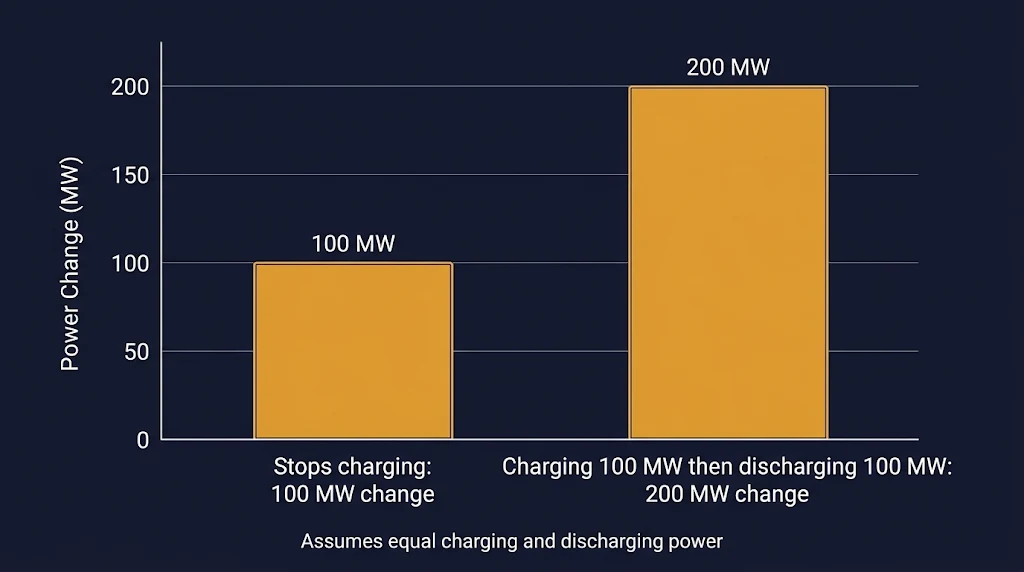
The 200 MW figure assumes equal charging and discharging power.
Reversal needs stored energy. A battery near its minimum state of charge can stop charging, but it cannot discharge much.
What Happens Inside a BESS During the Event
Three control layers shape the response, and each can enable or block it.
First, the power conversion system (PCS) measures grid frequency. Once it crosses a configured threshold, the PCS can reduce charge current.
A bidirectional PCS can reverse power flow through its current command. Ride-through and trip settings sit in the same controls, as our fault ride-through guide explains.
Next, the energy management system (EMS) runs the charging schedule. The plant controls must define how frequency response and the schedule interact.
Charging restarts only when recovery, reconnection and dispatch conditions are met.
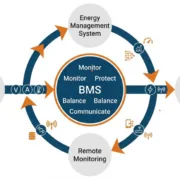
Then the battery management system (BMS) sets current and voltage limits, including limits on discharge at low state of charge.
Grid-Code Rules: When a BESS Stops Charging by Region
Rules differ by region, and the wording matters. Some require disconnection, some require reduced charging, and some allow a switch to discharge.
Rules at a glance
| Region / source | Trigger | Requirement or response described |
|---|---|---|
| India, IEGC 2023 clause 29(12) | Before the first under-frequency relay stage | Storage in charging mode disconnects automatically |
| India, reported implementation instructions | 49.6 Hz (northern report); 49.5 Hz (western report) | Disconnect (northern report); switch to discharge or disconnect (western report); confirm the governing scheme |
| Texas (ERCOT) Operating Guide section 4.5.3.3 | Energy Emergency Alert Level 3 declaration | Suspend charging, subject to dispatch, frequency-response and co-located-generation exceptions |
| FERC Order 842 framework / CAISO LGIA example | Frequency outside the droop deadband | Reduce charging rate per droop; no required flip to discharge unless droop requires it and the battery can; SOC range and operating conditions apply |
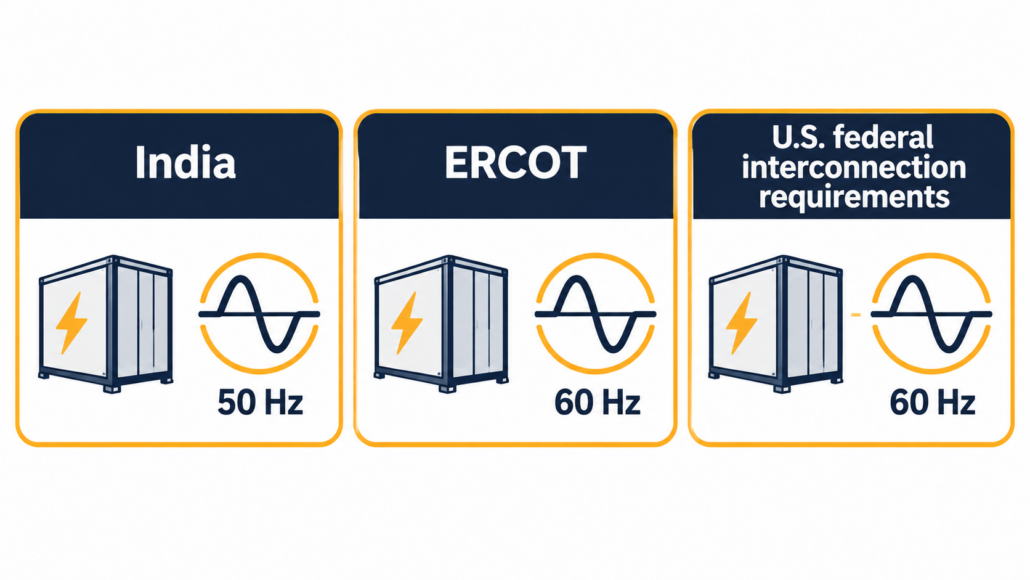
India: Disconnection Is the Stated Requirement
India’s 2023 grid code, in clause 29(12), requires storage in charging mode to disconnect automatically. It must act before the first stage of under-frequency relays operates.
In the May 2026 event, reporting says that first stage sat at 49.4 Hz and the batteries stayed connected. Operators then gave manual instructions, which produced about 650 MW of load relief.
India: Reported Instructions Cite Different Thresholds
Published reports describe northern-region disconnection instructions at 49.6 Hz and western-region guidance requiring reversal or disconnection at 49.5 Hz.
That western report also references a National Power Committee-approved scheme. Confirm the governing scheme and approved settings for the individual project.
Northern reporting says the dispatch center advised tripping the 33 kV feeders by relay. Western reporting says reconnection may follow once frequency settles within 50.00 ± 0.2 Hz.
A June 2026 northern instruction, as reported, also named a 50 ms delay. That delay belongs to that instruction, not to Indian rules in general.
Texas: Emergency-Level Charging Suspension
This ERCOT charging-suspension requirement is tied to an emergency declaration rather than a frequency-relay threshold. During Energy Emergency Alert (EEA) Level 3, ERCOT generally requires storage to suspend charging.
The Nodal Operating Guides, section 4.5.3.3, list exceptions. They cover a charging dispatch instruction, active frequency response, and some co-located generation setups.
U.S. Interconnection: Droop Sets the Direction
FERC Order 842 requires new generating facilities, including storage, to be able to give primary frequency response. The final rule sets that requirement.
A CAISO presentation shows the pro forma interconnection language for a charging storage resource. Under-frequency deviations make it decrease its charging rate according to its droop parameter.
The same language says the resource need not switch between charging and discharging. It must switch only where droop and deadband require it and the battery is technically capable.
Each interconnection agreement also defines the state-of-charge operating range and operating conditions under which primary frequency response is required. These terms apply to new interconnections, so existing resources and other regions may differ.
Other Reasons Why a BESS Stops Charging in Frequency Events
Grid code is not the only cause. Hardware, protection, and control limits can also explain why a BESS stops charging, sometimes by accident.
First, some sites sit on a feeder that load-shedding relays trip. The breaker opens, and charging stops with everything else on that feeder, which also removes any chance of discharge support.
Second, the PCS has set protection for low frequency. Coordinate it with the required charging response and applicable ride-through obligations.
Use the project’s approved thresholds and delays rather than assuming a universal sequence. Grid codes define these trip thresholds and delays by region.
Third, grid-following inverters track the grid with a phase-locked loop. On weak grids or in fast swings, that tracking can slip and force a trip.
Last, state of charge matters. A full battery stops charging on its own, and an empty battery cannot discharge.
Commissioning Checklist
Since settings differ by project, the checklist starts with the rules, not a number.
- Find the grid code, protection, dispatch and reconnection rules that apply.
- Confirm the required action: reduce charging, stop charging, reverse, or disconnect.
- Record the approved thresholds, delays and operating logic for the project.
- Define how frequency controls work with charging schedules and battery limits.
- Specify when recovery, reconnection and charging restart may happen.
- Test the full control and protection sequence against the approved rules during commissioning.
For the wider compliance picture, read our BESS grid codes and compliance guide.
Key Takeaways: When a BESS Stops Charging
- Charging is demand, and removing it helps reduce the supply and demand imbalance.
- Reducing charging, reversing and disconnecting are different responses, and the applicable code decides which one applies.
- India's 2023 code requires charging storage to disconnect before the first relay stage.
- Reported implementation instructions cite different thresholds; confirm the scheme and approved settings that apply to the project.
- Texas generally suspends storage charging in EEA Level 3, with listed exceptions.
- Treat reported delays and thresholds as project settings, not universal values.
- Charging is demand, and removing it helps reduce the supply and demand imbalance.
- Reducing charging, reversing and disconnecting are different responses, and the applicable code decides which one applies.
- India’s 2023 code requires charging storage to disconnect before the first relay stage.
- Reported implementation instructions cite different thresholds; confirm the scheme and approved settings that apply to the project.
- Texas generally suspends storage charging in EEA Level 3, with listed exceptions.
- Treat reported delays and thresholds as project settings, not universal values.
Frequently Asked Questions
These answers cover common questions about when a BESS stops charging in an under-frequency event.
When a BESS Stops Charging, Does It Also Disconnect?
No, not always. It may stay connected while drawing less power, reverse, or disconnect, depending on the code and plant controls.
Should a BESS Discharge Instead of Just Stopping?
Discharge gives additional relief, but it needs available energy and a code and control setup that allow it. Some rules require disconnection instead.
Which Frequency Triggers the Response?
The applicable code or approved scheme decides. Reported Indian instructions cite 49.6 Hz and 49.5 Hz, so confirm the scheme and approved settings for your project.
Does Battery Health Suffer When a BESS Stops Charging?
Stopping a charge is a normal control action, and the BMS enforces current and voltage limits. For repeated switching, check the battery maker’s guidance.
When Does Charging Resume?
Charging restarts only when recovery, reconnection and dispatch conditions are met. Reported western Indian guidance ties reconnection to frequency settling in the normal band, and your operator may add approval steps.
Further Reading
These SunLith guides and outside sources go deeper on frequency response and grid compliance.
Sources:
- Power Peak Digest: BESS units failed to auto-disconnect during Gujarat grid frequency event (July 8, 2026)
- Power Peak Digest: NRPC mandates BESS disconnection at 49.6 Hz grid frequency
- Power Peak Digest: WRPC clarifies mandatory BESS action at 49.5 Hz after Khavda event
- ERCOT Nodal Operating Guides, October 29, 2026
- FERC Order No. 842, Federal Register, March 6, 2018
- CAISO presentation on primary frequency response, May 2024
- IEEE paper: Effect of Fast Acting Power Controller of BESS in the Under-frequency Load Shedding Scheme








Leave a Reply
Want to join the discussion?Feel free to contribute!