

SEI Layer Growth and Lithium Plating in LFP Cells
Every LFP cell carries two chemistry problems that quietly shape its whole life. Together, these two problems make up SEI layer growth and lithium plating, the pairing this whole guide covers. First, one is slow and mostly unavoidable. Then the other is fast and mostly preventable. So understanding how each one works is the difference between managing degradation and just watching it happen.
So this guide explains both mechanisms from the ground up. First, it covers what the SEI layer actually is and why it keeps growing. Then it covers how lithium plating happens, and why it is so much more damaging. Along the way, it links to the operating guidance that follows from the chemistry.
| Quick Answer SEI layer growth is the slow, ongoing thickening of a protective film on the anode, driven mainly by time and high state of charge. Lithium plating is the sudden deposit of metallic lithium on the anode surface, triggered by fast charging in cold conditions. SEI growth is a normal aging process. Lithium plating is largely avoidable damage. |
SEI Layer Growth: What the Film Actually Is
Every lithium-ion cell forms a thin film on the anode surface early in its life. Understanding SEI layer growth and lithium plating starts here, with this first film. That film is the solid electrolyte interphase, or SEI. It is not a flaw. Instead, it is a necessary part of how the cell works at all.
The SEI forms when electrolyte comes into contact with the anode and partially decomposes. That reaction consumes a small amount of lithium and electrolyte. But in exchange, it builds a protective layer. This layer lets lithium ions pass through while blocking further direct contact between the anode and electrolyte. Without it, the electrolyte would keep breaking down uncontrollably.
So a stable SEI is good news, up to a point. It settles into a thin, mostly fixed layer during the cell’s first few cycles. That initial formation consumes some capacity, which is normal and expected. Manufacturers account for it before the cell ever reaches a customer.
SEI Layer Growth: Why It Keeps Going After That
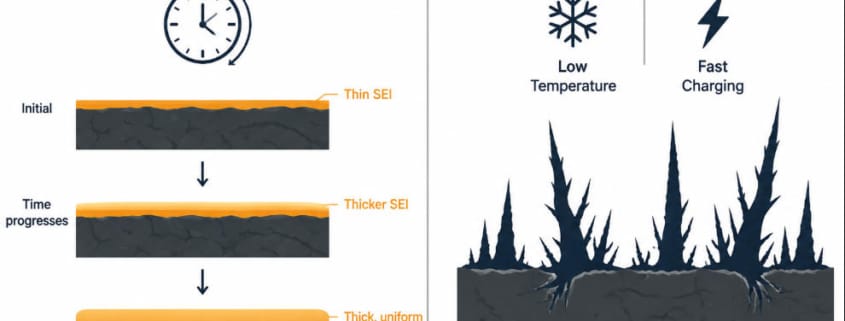
Here is the problem. But the SEI does not stay fixed forever. Instead, it keeps growing, slowly, for the entire life of the cell. Each time it thickens, it consumes a little more lithium and electrolyte. That lithium never comes back.
Two conditions speed this up. State of charge is the biggest one. Then temperature is close behind. A cell held at high state of charge sees faster SEI growth than one kept in a mid-range window. This is especially true near 100%. Heat accelerates the same underlying chemical reactions too. A hot cell ages faster than a cool one, even at the same state of charge.
This slow growth is exactly what shows up as calendar aging at the system level. It is the quiet, background half of SEI layer growth and lithium plating. For the full picture on how SEI growth connects to calendar and cycle aging together, see our guide on Calendar Aging vs Cycle Aging in LFP Batteries. It covers the aging side of SEI layer growth and lithium plating in more depth.
The growing SEI layer also raises internal resistance. Instead, lithium ions have to pass through a thicker barrier to reach the anode. That barrier resists ion flow more with every passing month. This is why aging cells run measurably hotter and less efficiently than new ones. This shows up even before capacity loss becomes obvious.
Lithium Plating: What It Actually Is
Lithium plating is a different problem entirely, and a more dangerous one. Of the two halves of SEI layer growth and lithium plating, this is the fast, event-driven one. Instead of lithium ions intercalating cleanly into the anode’s graphite structure, they deposit on the surface as metallic lithium. That metallic lithium does not behave like the lithium safely stored inside the graphite. Much of it becomes permanently unusable.
The trigger is specific. Lithium plating happens when the anode cannot absorb lithium ions fast enough to keep up with the charging current. Researchers have shown this occurs once the graphite electrode’s potential drops to roughly zero volts versus lithium metal. Below that point, the physics favors plating over intercalation.
Two conditions push a cell toward that threshold. First, fast charging is one. Then cold temperature is the other, and the two compound each other badly. Cold slows lithium-ion mobility inside the electrolyte and the anode. The same charge current that is safe at room temperature can trigger plating in the cold. This risk kicks in once the cell drops below roughly 0°C. That is why charging below freezing gets treated as a hard BMS cutoff on LFP systems. It is not just a soft warning.
SEI Layer Growth vs Lithium Plating: Why One Is So Much Worse
SEI growth is slow and largely unavoidable. But lithium plating is different on both counts. This contrast is the core of why SEI layer growth and lithium plating get treated so differently in BMS design.
First, plated lithium is mostly unrecoverable. Once metallic lithium deposits on the anode surface, only a portion of it can re-intercalate on the next discharge. The rest becomes what researchers call dead lithium, permanently disconnected from the working electrochemistry. Every plating event removes real capacity that never returns.
Second, plating creates a safety risk that SEI growth does not. Repeated plating can build up as dendrites, needle-like structures that grow with each cycle. In the worst case, a dendrite can pierce the separator between the anode and cathode. That can cause an internal short circuit. This is why lithium plating gets treated as a hard safety limit in BMS design. It is not just a performance concern.
Third, plated lithium accelerates SEI growth on top of everything else. Fresh metallic lithium is highly reactive with the electrolyte. It forms its own new SEI layer directly on the plated lithium. That consumes even more lithium and electrolyte than normal SEI growth alone would. One plating event can trigger a small cascade of additional degradation beyond the initial capacity loss.
How SEI Layer Growth and Lithium Plating Interact
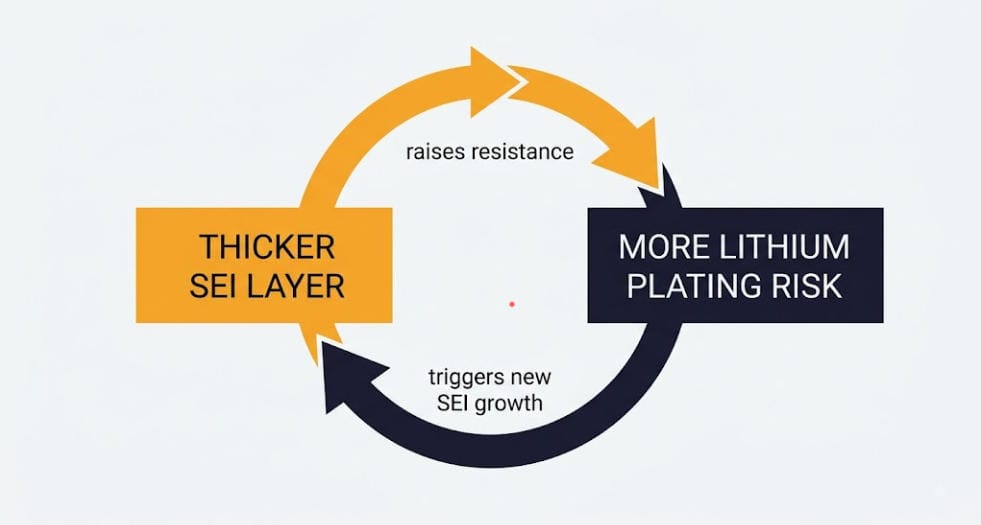
SEI layer growth and lithium plating are not fully separate stories. Instead, they feed into each other in both directions.
A thick, resistive SEI layer makes plating more likely at a given charge rate. As the SEI grows over a cell’s life, it adds resistance the charging current has to overcome. An older cell with a thicker SEI can start plating sooner. Charge rates and temperatures that were once safe stop being safe. This is one reason charge current limits often get more conservative as a system ages. It is not just a fixed spec on day one.
In the other direction, any lithium plating event accelerates SEI growth, as covered above. A single cold-weather charging mistake does not just cost the plated capacity directly. It also leaves behind a thicker SEI layer that keeps consuming a little more capacity on every cycle afterward.
This two-way relationship is part of why temperature management matters so much for LFP systems overall. It is the practical payoff of understanding SEI layer growth and lithium plating together, not as two unrelated topics. For the operational side of managing SEI layer growth and lithium plating, including BMS charge cutoffs and derating strategies, see our guides on Charging Temperature and Battery Datasheets and BESS C-Rate Explained. Still, both cover how real systems protect against plating in the field.
SEI Layer Growth and Lithium Plating: Detecting Damage Before It Spreads
Lithium plating does not always announce itself obviously in real time. That makes prevention more important than detection. Still, a few signals can flag it after the fact.
A sudden, disproportionate capacity drop following a cold-weather fast charge is one warning sign. So is a voltage plateau or dip during the charge itself. Either one can signal the anode potential crossing into plating territory. Post-mortem analysis using incremental capacity analysis can also reveal plating-related changes in a cell’s charge curve. These changes look distinct from the gradual shifts caused by ordinary SEI growth and cycle aging.
For the full detail on incremental capacity analysis and other degradation-tracking methods, see our guide on Advanced SOH Estimation for BESS. It covers how operators track these effects in a live system.
SEI Layer Growth and Lithium Plating: Practical Takeaways for BESS Operators
None of this SEI layer growth and lithium plating chemistry requires a battery science degree to manage well. A few operating habits cover most of the risk.
Keep resting state of charge out of the high extreme when possible, since that slows SEI growth directly. Respect temperature-based charge cutoffs strictly, especially near freezing, since that is the single biggest lever against plating. Avoid unnecessarily aggressive fast charging in cold weather, even when a system technically allows it. Allowed and optimal are not the same thing. Also, expect charge limits to tighten somewhat as a system ages. A thicker SEI layer genuinely does lower the safe charging threshold over time.
For the bigger picture on how SEI layer growth and lithium plating fit into overall battery degradation, see our guide on Battery Degradation in BESS: Causes, Mechanisms & Mitigation.
SEI Growth vs Lithium Plating: Quick Comparison
| Factor | SEI Layer Growth | Lithium Plating |
| Speed | Slow, continuous | Fast, event-driven |
| Trigger | Time and high state of charge | Fast charging in cold temperatures |
| Avoidable? | Mostly not, but can be slowed | Largely, with correct charge limits |
| Reversibility | Permanent but gradual | Largely permanent, some immediate loss |
| Safety risk | Low | Higher, dendrite/short-circuit risk |
| Main mitigation | Avoid high resting SOC, manage heat | Respect cold-temperature charge cutoffs |
Frequently Asked Questions
Does SEI layer growth ever stop?
No. It continues for the entire life of the cell, though the rate slows somewhat after the initial formation period. It never fully stops.
Can lithium plating be reversed?
Mostly no. A portion of plated lithium can re-intercalate on the next discharge. But the rest becomes permanently disconnected dead lithium. Prevention is far more effective than any recovery after the fact.
Why is lithium plating worse in cold weather specifically?
Cold temperatures slow lithium-ion mobility. This happens in both the electrolyte and the anode. That makes it harder for ions to intercalate quickly. The anode potential gets pushed toward the threshold where plating occurs instead.
Does a thicker SEI layer make lithium plating more likely?
Yes. A thicker, more resistive SEI layer adds to the overpotential during charging. That can push an aging cell toward plating conditions at charge rates that were once safe.
Further Reading
Battery Degradation in BESS: Causes, Mechanisms & Mitigation
Calendar Aging vs Cycle Aging in LFP Batteries
Advanced SOH Estimation for BESS
Charging Temperature: Why Battery Datasheets Often Miss Critical Charge Limits