

314Ah vs 587Ah LFP Cells: Which Format Fits Your Project?
The 314Ah vs 587Ah question is not a choice between old and new. A 587Ah cell holds about 87% more energy, but the finished system sets cost, cooling, service and safety.
The 587Ah cell is one of several large LFP prismatic cells that challenge the 314Ah format. It is also part of a wider move to bigger cells in containerized storage.
Capacity also changes string energy and current at a given C-rate. Research on parallel-connected grid storage modules examines how resistance differences affect current and temperature imbalances in directly paralleled LFP cells.
This guide first compares both capacities on engineering grounds. Then it shows how to judge each format for different projects.
Quick answer: Consider 587Ah systems for utility projects that value density and fewer parts. Compare 314Ah systems where modular sizing, fleet fit and operating history matter. Neither capacity alone sets cost or safety. So judge the whole system on usable energy, power, test evidence, warranty and lifecycle cost.
Key Takeaways: 314Ah vs 587Ah at a Glance
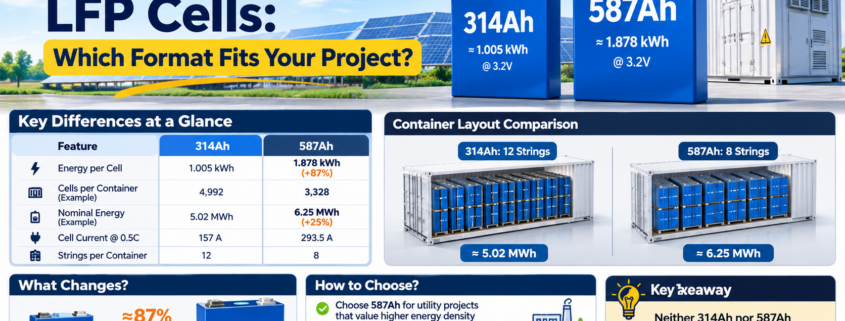
- At 3.2 V nominal, a 314Ah cell stores about 1.005 kWh. A 587Ah cell stores about 1.878 kWh, roughly 87% more.
- In the layouts below, twelve 314Ah strings give about 5.02 MWh. Eight 587Ah strings give about 6.25 MWh.
- That means one-third fewer cells and about one-quarter more nominal energy.
- At 0.5C, current is 157 A per 314Ah cell and 293.5 A per 587Ah cell. But real connection losses also depend on resistance.
- More energy per cell does not fix a heat-release ratio for thermal runaway. Instead, compare the tested cell, module and container designs.
- In the 314Ah vs 587Ah choice, project fit depends on the full product. Do not assume every 587Ah system costs less, or that 314Ah cells cannot serve homes.
What Changes in a 314Ah vs 587Ah Comparison?
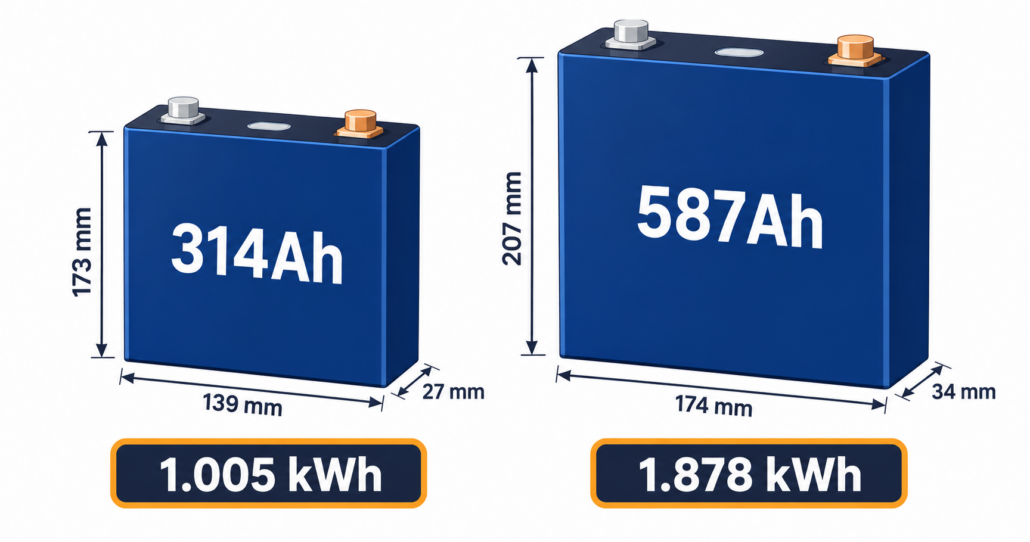
Since both cells share a 3.2 V nominal voltage, cell energy scales with amp-hour capacity. Also see our Ah vs Wh guide for the basic conversion.
Ecell = Vnominal × Q
Where Ecell is nominal cell energy in Wh, Vnominal is nominal voltage in V, and Q is rated capacity in Ah.
First, a 314Ah cell holds 314 × 3.2 = 1,004.8 Wh. Next, a 587Ah cell holds 587 × 3.2 = 1,878.4 Wh.
In short, the 314Ah vs 587Ah energy ratio is about 1.87. But this compares electrical energy only, not usable AC energy, cycle life or heat behavior.
For a 314Ah example, see our 314Ah cell product page. Also buy against the exact datasheet and revision for the cell supplied.
An Illustrative Container Layout Comparison
First, the table uses strings of 416 cells in series, with no directly paralleled cells (1P416S). Then it compares twelve 314Ah strings with eight 587Ah strings.
But these are electrical examples, not specifications for a named container.
| Parameter | 314Ah layout | 587Ah layout |
| Assumed nominal cell voltage | 3.2 V | 3.2 V |
| Nominal energy per cell | 1.005 kWh | 1.878 kWh |
| Cells in series per string | 416 | 416 |
| Nominal string voltage | 1,331.2 V | 1,331.2 V |
| Nominal energy per string | 418.0 kWh | 781.4 kWh |
| Strings per container | 12 | 8 |
| Cells per container | 4,992 | 3,328 |
| Nominal container energy | 5.016 MWh | 6.251 MWh |
| Cell/string current at 0.5C | 157 A | 293.5 A |
| Aggregate DC current at 0.5C (common bus) | 1,884 A | 2,348 A |
| Nominal DC power at 0.5C | 2.508 MW | 3.126 MW |
In this layout, cell count falls 33.3% while nominal energy rises about 24.6%.
Now, at equal nominal energy, the cell-count cut is about 46.5% before rounding to whole strings. That is a different comparison, so do not mix the two.
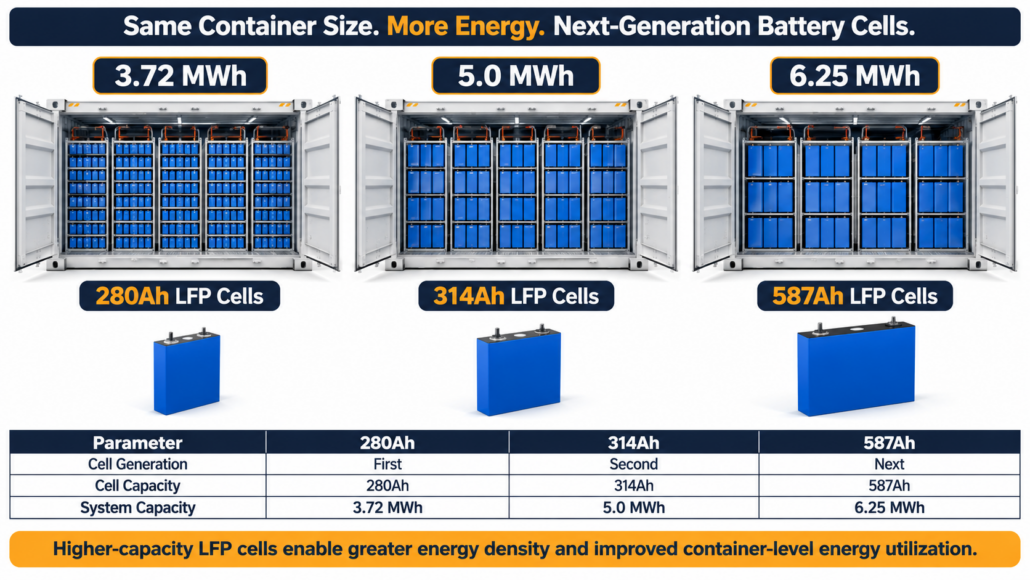
Also, industry coverage links 314Ah cells to roughly 5 MWh containers and 587Ah cells to roughly 6.25 MWh containers. Still, those are supplier designs, not proof that every design uses this layout.
[Image 2 placement: After the container comparison table — see Image Specifications]
Check Maximum Voltage, Not Just Nominal Voltage
A 1,331.2 V nominal string does not prove fit with every 1,500 V part. But the charge limit matters too.
Next, our 314Ah product page lists a 3.65 V maximum charge voltage per cell. Multiplied by 416, that then gives 1,518.4 V.
As a result, check cell limits, BMS settings, PCS input limits and part ratings together. Since the real ceiling must fit all of them, no single limit is enough.
Also, IEC 63056 covers battery systems within a 1,500 V nominal DC scope. Yet it does not pick a series count for you, and our IEC 62619 guide compares it with related standards.
Seven Engineering Differences in 314Ah vs 587Ah Cells
These seven differences matter most when you weigh 314Ah vs 587Ah cells. Also, each one ties back to the complete system, not the cell alone.
1. Component Count and Balance-of-System Cost
Larger cells can cut the cell count per MWh. As a result, a design may need fewer links and less assembly work.
Still, do not assume every part count falls in step with cell count. In fact, sensor layout, compression hardware, protection devices and service limits are design choices.
Now, the useful question is simple. Does the complete system give a lower installed cost per usable kWh at the required power and warranty?
That said, fewer parts are a possible edge, not a sure saving. For the wider cost picture, see our BESS CAPEX calculation guide.
2. Current per Cell, Terminals and Busbars
At the same C-rate, current rises with capacity. A 314Ah cell at 0.5C carries 157 A, while a 587Ah cell carries 293.5 A.
If connection resistance stays the same, heating follows this rule:
Ploss = I2 × R
Where Ploss is resistive heating in W, I is current in A, and R is connection resistance in ohms.
However, larger cells may use different terminals, welds and busbars. Current alone does not show which connection runs hotter.
Also, the study’s sensitivity analysis identifies cell and contact resistance variation as strong contributors to temperature differences between paralleled cells. Instead, check connection design and build quality, not just amp-hour capacity.
3. Heat Generation and Cooling
Capacity alone does not show how heat travels from a cell’s core to its cooled faces. Size, internal build, cooling direction and contact quality all matter as well.
Studies of prismatic-cell cooling use shape-based heat parameters for this reason. Thus, a fair comparison needs more than nominal capacity.
Ask each supplier for this data:
- Heat rejection at the stated charge and discharge duty
- Maximum cell temperature and temperature spread
- Ambient-temperature assumptions
- Cooling auxiliary power use
- Derating limits and operating limits
For more, read cell temperature gradients in BESS and 0.5C vs 1C cycle life in liquid-cooled BESS.
4. Parallel Cells and Parallel Strings
At a fixed series count, a larger-capacity cell raises nominal energy per string. Then fewer strings may reach a target energy.
But this is an energy-sizing relationship, not evidence of better current sharing. Three different layouts exist:
- Cells connected directly in parallel within a module
- Complete strings connected to a shared DC bus
- Strings connected through separate, independently controlled PCS channels
The layouts in this article use 1P416S strings. Thus they have no directly paralleled cells within a string.
A study of parallel-connected grid-storage modules tested four directly parallel-connected 280Ah LFP cells. Added connection resistance produced large differences in cell currents and temperatures during discharge.
The researchers then used a model fitted to the test data. It explored how differences in cell resistance and capacity affect current sharing.
The paper explains that LFP’s flat open-circuit-voltage curve can let SOC differences persist through the middle of the SOC range.
In the two resistance-fault experiments, rapid rebalancing at low SOC produced high individual cell currents. Each test stopped when a cell reached its current limit.
These were deliberately introduced fault conditions, not evidence that every parallel module behaves this way.
The study does not compare 314Ah with 587Ah cells. So it does not show that either capacity shares current better.
Its quantitative results should not be applied directly to complete parallel strings or independently controlled containers without more analysis.
Ask each supplier to name the actual topology. Then ask how branch-current distribution, isolation, protection and monitoring work.
5. Stored Energy and Single-Cell Failure
A 587Ah cell stores about 87% more nominal energy than a 314Ah cell at the same voltage. But that does not mean it releases exactly 87% more heat in thermal runaway.
A lower cell count also does not prove a lower failure chance. Yet the evidence here does not show that either capacity is safer by nature.
Instead, compare the exact product’s test evidence, including setup, state of charge and operating conditions. Then ask for cell, module and unit-level reports, not a capacity or chemistry claim.
For related reading, see UL 9540A, NFPA 855, IEC 62619 and UL 1973.
6. Cycle Life and Efficiency Claims
Do not compare headline cycle counts unless the test conditions match. Ask the supplier to state:
- Test temperature
- Charge and discharge rates
- Depth of discharge and operating SOC window
- End-of-life capacity threshold
- Compression and cooling conditions
- Whether the result is measured, projected or warranted
Also split cell efficiency, DC system efficiency and AC round-trip efficiency. Then ask for guaranteed results on the same measurement boundary and duty cycle.
See battery cycle standards explained, how to read a LiFePO4 spec sheet and BESS round-trip efficiency.
7. Energy Granularity, Integration and Replacement
Take 16 cells in series at 3.2 V nominal. Then a 314Ah pack holds about 16.1 kWh, and a 587Ah pack holds about 30.1 kWh.
But these figures show low-voltage pack energy only. Also, they do not set the growth steps of every high-voltage C&I cabinet.
Instead, for the real product, compare module size, handling mass, compression needs, service steps and spare availability.
Now, for augmentation, keep two cases apart. Swapping cells inside a string is not the same as adding new engineered strings or containers.
A different capacity is not a drop-in swap just because chemistry and voltage match. See BESS augmentation and mixed-age string design.
Which Fits Which Project: 314Ah vs 587Ah by Application
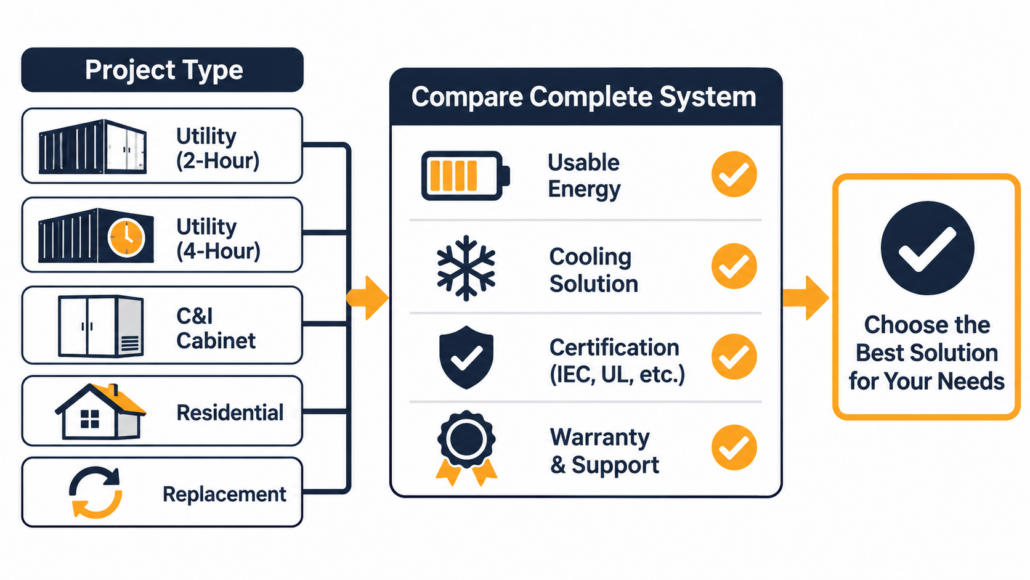
Use this table as a framework for 314Ah vs 587Ah, not as a capacity-only rule.
| Project type | Starting point | What should decide |
| Utility-scale, two-hour storage | Include 587Ah-based systems | Usable energy, power, container count, installed cost, thermal performance and warranty |
| Utility-scale, four-hour or longer | Compare both capacities and other formats | Cost per usable kWh at the required duration, efficiency, degradation and augmentation |
| C&I cabinets, about 100–500 kWh | Include 314Ah-based cabinets as a baseline | Actual cabinet increments, footprint, power, serviceability and certification |
| Residential and small commercial | Product-dependent; do not exclude 314Ah | Required energy and power, installation limits and complete-system suitability |
| Replacement within an existing string | Follow the OEM-approved specification | Electrical and mechanical fit, matching and warranty |
| Added strings or containers at an existing plant | Assess separately | PCS, controls, protection, operating strategy and warranty fit |
| Projects that prioritize operating history | Request model-specific evidence | Commissioning dates, operating fleet, duty cycles and documented performance |
| Remote or lifting-constrained sites | Compare complete equipment | Shipping mass, lifting arrangements, transport limits and service access |
For example, our 314Ah product page lists home backup and off-grid use. As a result, a blanket claim that this capacity suits no homes would contradict it.
Next, for operating history, use dated, model-specific evidence. One manufacturer reported mass production and first deliveries of its 587Ah cell on August 28, 2025. The same release covered a 6.25 MWh two-hour system.
But that is a useful milestone for one product, not a start date for every 587Ah cell. Also, for duration logic, see our 0.25C battery storage guide and C&I vs utility-scale BESS.
Worked Example: 100 MWh Using 314Ah vs 587Ah Containers
First, this 314Ah vs 587Ah example reuses the container energies from the table above. Next, at 5.016 MWh per container, 100 MWh needs 20 containers after rounding up.
Then at 6.251 MWh per container, the same target needs 16. As a result, the larger-cell layout uses four fewer containers in this nominal-energy case.
Still, this is not yet a comparison of guaranteed usable AC energy, or of 50 MW for two hours. Before any commercial call, also ask both bidders to quote:
- Usable energy at the same measurement boundary
- Guaranteed discharge power and duration
- Auxiliary power use
- Round-trip efficiency
- Ambient conditions and derating
- Beginning-of-life and end-of-warranty performance
Only then does the container-count cut become a real project comparison.
Questions to Ask Before Choosing Between 314Ah vs 587Ah
Put these twelve questions into your RFQ for any 314Ah vs 587Ah system.
- Which exact cell model, datasheet revision, factory and production status apply?
- Which dimensions, mass, rated capacity and voltage limits does the cell have?
- How was cycle life tested, and which figures are warranted?
- How much continuous current is allowed across the temperature and SOC range?
- Which compression force and swelling allowance does the module need?
- Which heat rejection and cooling load apply at the project duty cycle?
- Do test reports and certificates cover the exact supplied configuration?
- Are cells paralleled directly, are strings paralleled, or does each string run on its own?
- Which usable energy and power are guaranteed at the point of connection?
- Is there a replacement and augmentation plan if the cell model is discontinued?
- Will batch traceability and incoming inspection records come with the order?
- Which service work can happen on site, and which needs module or container replacement?
Also use the C&I BESS quote checklist, the C&I BESS warranty guide and our Chinese supplier verification guide.
Frequently Asked Questions About 314Ah vs 587Ah Cells
These answers cover what buyers ask most about 314Ah vs 587Ah cells.
Can I mix 314Ah and 587Ah cells in one series string?
Do not treat them as interchangeable. Instead, use the OEM-approved cell and module specification for swaps inside an existing string.
But adding separate engineered strings or containers is a different question. It then needs a system-level fit review.
In 314Ah vs 587Ah, is the larger cell safer?
Yet the evidence here does not show that either capacity is safer by nature. Also, more energy per cell is not a full safety review.
Instead, judge the tested design and the exact configuration supplied.
Is a 587Ah-based container always cheaper?
No. Fewer cells per MWh can create savings. But total cost also depends on cell price, cooling, electrical parts, installation, service and warranty.
Then compare cost per usable kWh under the same conditions.
Does running a 587Ah cell at 0.25C waste its power capability?
Not always. The project may instead need a longer discharge time rather than top power.
Also, a lower C-rate eases current and heating demands on terminals and busbars.
Which capacity should a C&I project choose in the 314Ah vs 587Ah decision?
First, compare whole cabinets against the power, usable energy, footprint and duty profile you need. Then use real product steps and guarantees, not cell capacity alone.
Bottom Line: 314Ah vs 587Ah Is a System Decision
Moving from 314Ah to 587Ah lifts nominal energy per cell by about 87%. As a result, it can cut the cells and strings needed for a given energy target.
But it also changes current at a given C-rate and what the surrounding design must handle.
In short, choose through the system the cell enables. Then compare usable energy, power, cooling, safety evidence, serviceability and lifecycle cost.
Further Reading
These guides expand on the topics behind the 314Ah vs 587Ah decision.
- 0.25C Battery Storage vs 0.5C — why some markets favor four-hour systems.
- 0.5C vs 1C Cycle Life in Liquid-Cooled BESS — how C-rate shapes LFP wear.
- Cell Temperature Gradients in BESS — safe ΔT limits and uneven heating.
- BESS CAPEX Calculation — how to build the total investment cost.
- BESS Augmentation: The Complete Guide — restoring capacity lost to degradation.
- Mixed-Age String Design — old and new modules in one string.
- How to Read a C&I BESS Warranty — what to check before you buy.
- UL 9540A Test Method — how thermal runaway spread is tested.