


How to Read a C&I BESS Warranty Before You Buy
A C&I BESS warranty is not just a number of years. It is a contract that guarantees performance only inside a defined operating envelope.
That envelope covers capacity, throughput, depth of discharge, C-rate, and temperature. However, operating outside a stated limit may reduce coverage or affect a claim, depending on the contract terms and the documented cause of the issue.
First, this guide shows how to read each term before you sign. It also ties the warranty back to your peak-shaving BESS sizing, so the system can still meet your kW and kWh needs late in life.
⚡ Quick Answer: A C&I BESS warranty is more than a number of years. It is a set of performance promises that apply only within defined operating limits. So check guaranteed capacity, throughput, depth of discharge, C-rate, temperature, test method, exclusions, and the remedy before you compare suppliers.
What a C&I BESS Warranty Actually Covers
A C&I BESS warranty usually bundles several separate promises. Scope, duration, and exclusions vary by supplier and contract, so read each promise on its own.
- Product or defect warranty: covers faulty parts and manufacturing defects.
- Capacity-retention warranty: guarantees a minimum state of health (SoH) at set points in time.
- Throughput or cycle-life warranty: limits the total energy or cycles the system may process.
- Performance warranty: may add an efficiency commitment, depending on the contract.
- Workmanship warranty: covers installation quality when SunLith or an EPC provider supplies it.
- Subsystem coverage: identifies whether the PCS, EMS, BMS, HVAC, enclosure systems, and any supplied fire-detection or suppression equipment are covered, and for how long.
Also, each item can carry its own term, limits, and remedy. For example, a long cell warranty does not prove the PCS or cooling system is covered for as long.
C&I BESS Warranty Terms: Capacity Retention vs. Throughput
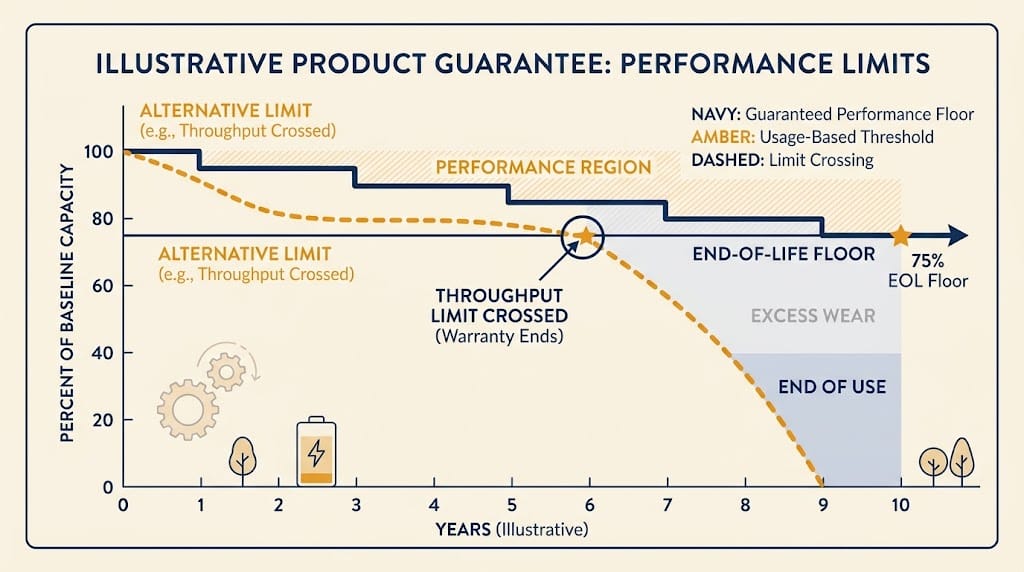
Most disputes over a C&I BESS warranty start with two terms. But capacity retention and throughput control very different things.
| Term | What it controls | Buyer question |
| Capacity retention / SoH | Remaining usable energy at a specified point in time | At what measurement boundary and operating conditions is capacity tested? |
| Throughput | Total permitted energy processed during the warranty | Is throughput counted one way, both ways, or as equivalent full cycles? |
| Equivalent full cycles | An accounting measure of throughput relative to capacity | What capacity denominator and counting method does the contract use? |
| End-of-life threshold | The contractual capacity floor at a stated year or throughput value | Does that floor still satisfy the project’s service obligation? |
Capacity Retention and State of Health
Capacity retention sets the minimum usable energy at a stated point in time. For example, a contract might guarantee 70% of baseline capacity at year 10 (illustration only).
First, the key issue is the measurement boundary. Capacity can be quoted at the cell, the DC bus, the PCS AC output, or the point of interconnection.
Because of this, each boundary gives a different number. Also confirm the beginning-of-life baseline, because a retention percentage means little without it.
Throughput and Equivalent Full Cycles
A throughput provision may limit the cumulative energy processed during the warranty. For example, some contracts count discharge only, while others count charge and discharge together.
Then equivalent full cycles convert that energy into a cycle count. The result depends on the capacity used as the denominator, so ask for the exact formula.
An open-access review in Energies discusses degradation models based on cumulative energy throughput. It also covers models that account for cycling conditions such as depth of discharge, state of charge, and temperature.
But contracts often use the simpler count. Your dispatch pattern still decides how fast the cells age, so learn how equivalent full cycles and throughput records are tracked in the BMS.
End-of-Life Thresholds
An end-of-life threshold is the contractual capacity floor a supplier agrees to support, subject to the stated terms. It applies at the year or throughput value that the contract names.
Then check that this floor still meets your service obligation. As a result, a battery can meet its warranty floor and still miss your load requirement.
Capacity fades on two clocks, time and use. See calendar and cycle aging for how each one works.
In addition, see SunLith’s battery degradation in BESS guide for the mechanisms and mitigation options behind capacity loss.
The Operating Envelope Behind Every C&I BESS Warranty
Every C&I BESS warranty rests on assumed operating conditions. As a result, if the site operates outside those conditions, coverage may be limited or a claim may be disputed under the contract.
A warranty can be technically valid but commercially unsuitable if the operating limits do not match the intended dispatch plan.
Charge, Discharge, and Depth Limits
First, list every electrical limit the contract sets. Typical items include:
- Maximum and minimum state of charge
- Permitted depth of discharge
- Charge and discharge C-rate
Throughput terms often carry a maximum C-rate clause as well. Then compare your peak discharge power against the BESS C-rate limit in the contract.
Time, Temperature, and Throughput Limits
Next, check the limits tied to time and environment:
- Temperature and humidity requirements
- Calendar limits versus cycling limits
- Annual or cumulative throughput limits
For example, many contracts specify that coverage ends when the first applicable limit is reached. So look for the phrase “whichever occurs first.”
Controls, Data, and Maintenance Duties
Finally, review what the owner must do to keep coverage intact:
- Follow the approved EMS settings and dispatch behavior
- Complete the required maintenance
- Keep connectivity, monitoring, and event logging active
However, missing data can make a claim hard to win. Our guide to evaluating a supplier’s BMS also explains SOH and throughput logging.
Why C&I BESS Warranty Terms Affect Peak-Shaving Design
Sizing sets your first kW and kWh requirement. The C&I BESS warranty then decides whether the system can keep meeting it.
Take the 100 kW / 278 kWh preliminary configuration in the peak-shaving guide. It illustrates how first-year power and energy requirements can be estimated for one defined peak event.
However, whether it can meet repeated events or retain enough capacity late in life depends on the operating plan and the warranty’s limits.
Next, here is a simple, hypothetical check. If a contract permits 3,000 equivalent full cycles, and the site uses one equivalent full cycle on each day it operates, daily cycling would reach that limit in about 8.2 years (3,000 ÷ 365).
But if the system uses one equivalent full cycle on only 150 days each year, it would take about 20 years to reach the same limit. Calendar limits may then determine when coverage ends.
Also, an equivalent full cycle is an energy measure, not a single dispatch event. These figures are illustrations, not market terms.
So check size and dispatch strategy against the warranted envelope, not just first-year savings. Warranty terms also feed your BESS OPEX and CAPEX vs LCOS assumptions, because lost throughput raises the cost of each delivered kWh.
C&I BESS Warranty Checklist for RFQs
First, use this C&I BESS warranty checklist in every request for quotation. Ask each supplier the same questions so the answers compare cleanly.
Capacity and Baseline Questions
- Is capacity measured as nameplate, usable DC, PCS AC, or energy at the point of interconnection?
- Which beginning-of-life capacity baseline applies?
- How much retained capacity is guaranteed at each year or throughput checkpoint?
- Which testing method verifies capacity, and under what site conditions?
Throughput and Operating Limit Questions
- Is there a calendar limit, cycle limit, throughput limit, or a “whichever occurs first” condition?
- How is throughput counted: charging, discharging, both directions, or equivalent full cycles?
- What DoD, C-rate, temperature, SOC range, and dispatch pattern does the warranty assume?
- How is an equivalent full cycle calculated and logged?
Scope, Exclusion, and Remedy Questions
- Which components are included: cells, modules, racks, BMS, PCS, HVAC, EMS, enclosure systems, and any supplied fire-detection or suppression equipment?
- Which exclusions can reduce or invalidate coverage?
- What data must the owner retain to support a claim?
- If the system misses a warranted value, what is the remedy: repair, replacement, payment, capacity augmentation, or another remedy? Who pays for labor, logistics, downtime, testing, and recommissioning?
Also, pair this list with our guide on how to compare BESS specifications for datasheet items.
Since the remedy may be added capacity, plan that work early. Our guide to BESS augmentation planning explains how lost capacity is restored.
Common Mistakes When Comparing Warranty Bids
Buyers often repeat the same errors when they compare bids. Next, avoid these five:
- Comparing years alone: two bids with equal terms can carry very different limits.
- Ignoring the measurement boundary: a DC figure and an AC figure are not the same promise.
- Assuming equal throughput counting: one bid may count discharge only, another both directions.
- Skipping the dispatch check: the warranty may not fit your real duty cycle.
- Accepting a vague remedy: insist on clear timing, cost, and responsibility.
Frequently Asked Questions About a C&I BESS Warranty
These answers cover the questions buyers ask most about a C&I BESS warranty.
What does a C&I BESS warranty cover?
It usually covers defects, a capacity or state-of-health guarantee, and sometimes a throughput limit. Also, scope and duration vary by supplier and contract.
How do capacity retention and throughput differ?
Capacity retention sets a minimum usable energy at a point in time. Meanwhile, throughput caps the total energy the system may process during the warranty.
Can a C&I BESS warranty be valid but still unsuitable?
Yes, because if its limits on depth, C-rate, or throughput do not match your dispatch plan, the system can reach a contract limit early.
What is a BESS performance warranty?
A BESS performance warranty defines measurable commitments, such as usable capacity, capacity retention, energy throughput, availability, or efficiency, under specified test conditions and operating limits. The exact scope and remedy depend on the contract.
What is end of life in a BESS warranty?
It is the contractual capacity floor at a stated year or throughput value. Then confirm that it still covers your required kWh.
Who should review a BESS warranty before signing?
Your engineer, procurement lead, and legal counsel should each review it. SunLith can provide a preliminary specification review, but contract terms need qualified legal review.
Need a Preliminary Warranty Review?
Send us your datasheet and draft warranty terms. Then we will flag the limits that matter for your dispatch plan.
Request a preliminary BESS specification and warranty review
SunLith can provide a preliminary assessment. Final system design and contract terms require site-specific electrical, tariff, interconnection, safety, and legal review.
Further Reading on the C&I BESS Warranty and Related Costs
Also, use these guides alongside this C&I BESS warranty guide.
- How to Size a Battery for Peak Shaving
- Battery Degradation in BESS: Causes, Mechanisms & Mitigation
- BESS C-Rate Explained
- Calendar Aging vs. Cycle Aging in LFP Batteries
- Understanding BESS Specifications
- BESS Augmentation: The Complete Guide
- BMS Cycle Counting Explained
- How to Evaluate a BESS Supplier’s BMS
- BESS CAPEX vs LCOS
- BESS OPEX and Operating Cost Model