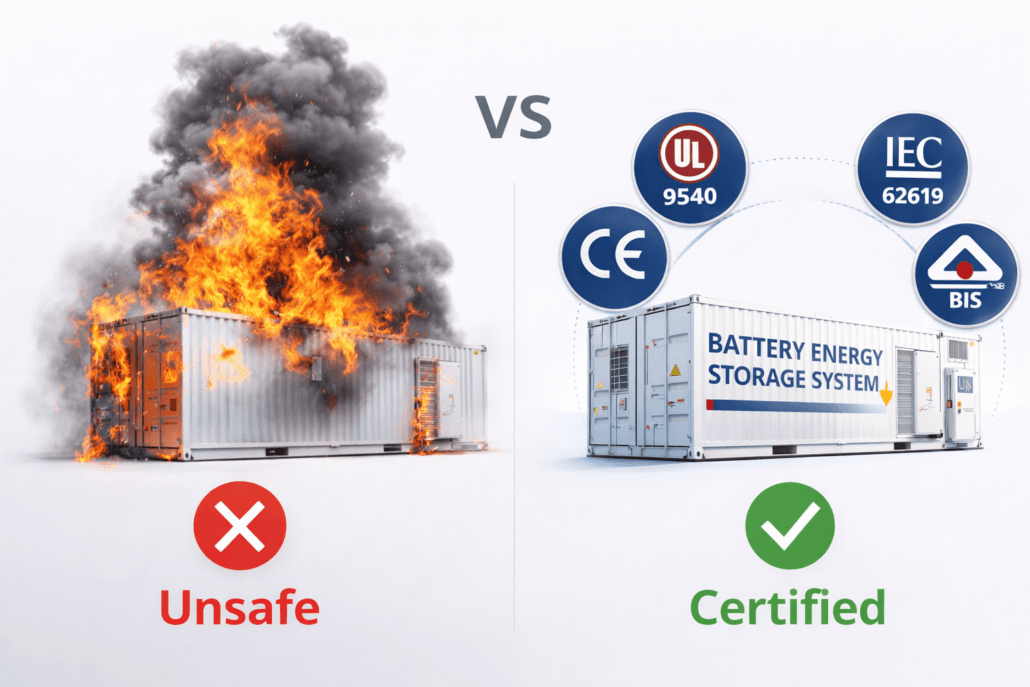
Battery Energy Storage Systems (BESS) are critical to the clean energy transition, but ensuring their safety and compliance requires more than just good engineering. Certifications like CE for BESS is one of the most recognized marks in Europe, confirming that a product meets essential health, safety, and environmental standards. However, while CE is necessary for entering the EU market, it does not always guarantee complete system-level safety. To build global trust, manufacturers often combine CE with other certifications such as UL and IEC, ensuring stronger compliance, reliability, and market acceptance.
What Does CE Certification Mean for BESS?
The CE mark (Conformité Européenne) is a mandatory certification for products entering the European Economic Area (EEA). For BESS, CE shows compliance with EU directives and harmonized standards.
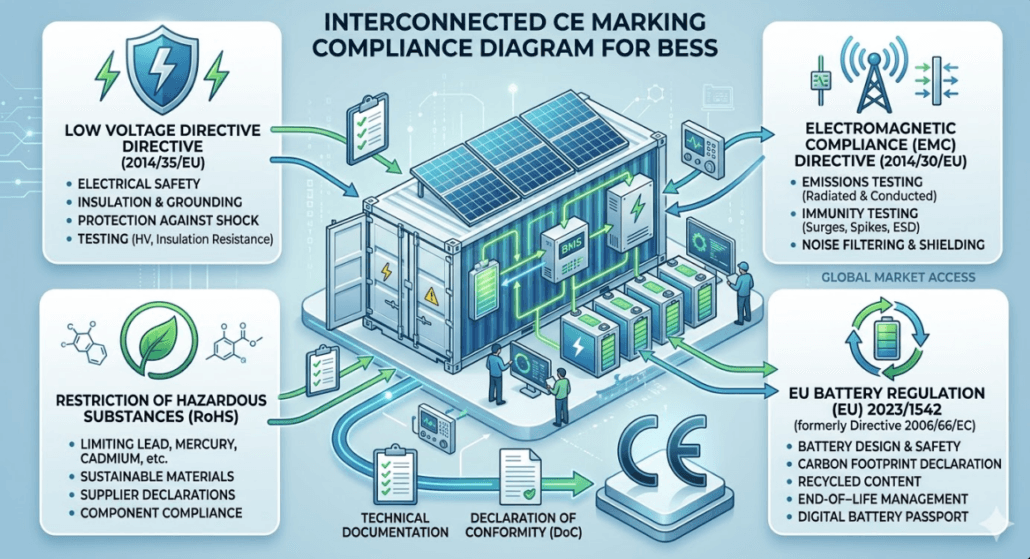
When a BESS carries the CE mark, it declares conformity with the following directives:
Low Voltage Directive (LVD) – Protects against electrical hazards.
Restriction of Hazardous Substances (RoHS) – Limits toxic chemicals in batteries and components.
General Safety Directives – Cover risks related to machinery and consumer use.
In essence, CE for BESS confirms that the system has met basic EU safety and environmental requirements, allowing it to be legally marketed and installed in Europe.
What Does CE for BESS Cover?
CE certification for BESS evaluates multiple aspects of product safety. These include:
Electrical Safety – Preventing risks of electric shock, short circuits, and overheating.
Thermal Safety – Assessing insulation, cooling design, and fire prevention.
Electromagnetic Compatibility (EMC) – Ensuring the BESS does not emit disruptive signals.
Environmental Safety – Controlling hazardous substances and ensuring recyclability.
However, CE certification for BESS is primarily based on a self-declaration of conformity. Manufacturers test the product internally or through a notified body, then issue a Declaration of Conformity (DoC).
This process makes CE less complex compared to third-party certifications like UL or IEC, which require independent validation and rigorous lab testing.
Why Do Most Companies Choose Only CE Certification for BESS?
Many BESS companies stop at CE certification instead of pursuing more demanding approvals. The main reasons include:
Lower Costs: CE testing is more affordable than UL or full IEC certification, which involve expensive third-party audits.
Faster Market Entry: CE certification is quicker, often taking weeks instead of months.
Simpler Process: CE allows self-declaration, reducing reliance on external labs.
Minimum Requirement: Since CE is mandatory in the EU, many companies view it as the lowest barrier to entry.
In other words, CE is often seen as the easiest, fastest, and cheapest way to access the European market. But relying on CE alone raises important safety concerns.
Is CE Alone Enough for BESS Safety?
The answer is no. While CE for BESS ensures legal entry into the EU market, it does not fully address the complex safety risks of modern energy storage systems.
BESS involves large-scale lithium-ion batteries, which can pose hazards like:
Thermal Runaway – Fire and explosion risk if cells fail.
High Voltage Risk – Danger of electric shock during installation or maintenance.
System-Level Failure – Risks from inverters, converters, or control systems.
To mitigate these risks, global safety standards go far beyond CE. Manufacturers often need UL, IEC, or national certifications depending on their target markets.
Key International Standards Beyond CE for BESS
Here are the most important certifications that complement CE for BESS:
This table shows why CE is the easiest to achieve but IEC and UL carry higher safety credibility.
Why BESS Needs Multiple Certifications
Unlike small electronics, BESS operates at industrial-scale energy levels, which makes multi-layer certification essential.
CE ensures compliance in Europe, but it does not evaluate system-level fire safety.
UL validates complete system safety and is trusted in North America.
IEC sets a global benchmark, especially for grid integration.
National standards guarantee local approval, allowing sales in markets like India, Japan, or Korea.
Therefore, CE should be seen as the foundation, while UL, IEC, and national approvals are the reinforcements. Together, they create a safe and credible BESS product.
Why Companies Should Go Beyond CE for BESS
Although CE is attractive for cost and speed, relying on it alone can lead to challenges:
Limited Market Reach: CE only works in Europe, not globally.
Lower Buyer Confidence: Utilities and large clients often demand UL or IEC reports.
Safety Risks: CE’s self-declaration model may overlook thermal runaway or fire propagation risks.
Regulatory Pressure: More countries are adopting stricter BESS safety laws.
Companies that invest in full certification portfolios gain stronger market access, brand reputation, and customer trust.
Conclusion: CE is Essential but Not the Final Step
CE for BESS is a mandatory starting point for European market access. It ensures compliance with basic safety, EMC, and environmental standards. However, CE is not enough to prove the full safety of complex battery energy storage systems.
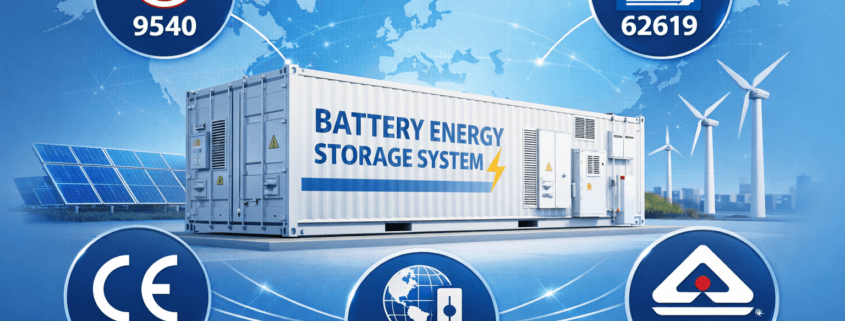
Most companies choose CE because it is fast, affordable, and easy, but long-term success requires additional certifications like UL 9540, IEC 62619, and BIS. These provide independent validation, global acceptance, and higher safety assurance.
In the evolving energy landscape, BESS manufacturers and project developers must go beyond CE certification to build trust, reliability, and international growth opportunities.
❓ Frequently Asked Questions About CE for BESS
1. What is CE certification for BESS?
CE certification for Battery Energy Storage Systems (BESS) is a European conformity mark that shows the product meets essential EU safety, health, and environmental requirements. It’s a legal requirement for selling BESS in the European Economic Area (EEA).
2. Does CE certification cover fire safety in BESS?
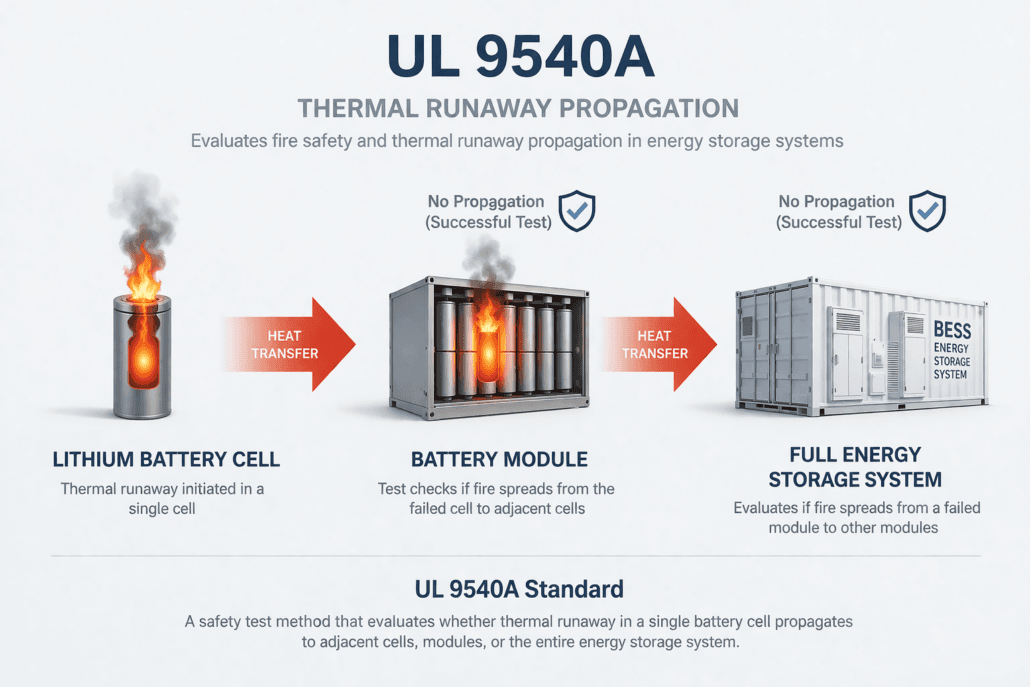
No. CE certification ensures compliance with core directives but does not specifically address thermal runaway or fire safety risks. For complete system safety, manufacturers often pursue additional certifications like UL 9540A (fire safety) or IEC 62619 (battery cell safety).
3. How is CE different from UL or IEC certification?
CE Certification: Mandatory for the EU market, focuses on regulatory compliance.
UL Certification: Recognized mainly in North America, emphasizes product safety and fire prevention.
IEC Standards: Internationally accepted, providing detailed technical guidelines for testing and performance.
Using CE alone may open EU markets, but UL and IEC certifications build global trust and credibility.
4. Can I sell CE-certified BESS outside Europe?
Not necessarily. While CE certification allows access to EU markets, other regions like the US, Middle East, and Asia-Pacific often require local standards such as UL, BIS, or GB/T. Companies targeting global markets usually combine CE with additional certifications.
5. How long does CE for BESS take?
The timeline depends on the complexity of the BESS and the scope of testing. In general:
Large, complex systems: 3–6 months Working with an accredited testing lab or certification body can speed up the process.
Simple systems: 4–8 weeks
6. Why is CE certification alone not enough for BESS safety?
Because BESS safety risks go beyond basic compliance. Issues like thermal runaway, grid stability, and fire containment need deeper testing. That’s why CE is often just the starting point, with UL, IEC, and country-specific certifications adding the necessary system-level validation.
As renewable energy adoption grows, energy storage systems (ESS) have become critical for balancing supply and demand, improving reliability, and supporting grid resilience. To ensure safety, performance, and interoperability, the International Electrotechnical Commission (IEC) developed the IEC 62933 series, a set of globally recognized standards.
These standards guide manufacturers, developers, and policymakers in designing and deploying safe, efficient, and sustainable storage solutions.
Focuses on environmental assessment of energy storage technologies.
Considers carbon footprint, material use, and recycling practices.
Encourages sustainable deployment of large-scale ESS.
7. IEC 62933-4-4 – End-of-Life Management
Provides guidelines for decommissioning, recycling, and disposal of EES.
Promotes circular economy practices in the storage industry.
Reduces environmental risks associated with battery waste.
8. IEC 62933-5-1 – General Safety Considerations
Covers general safety requirements for stationary energy storage.
Includes electrical, chemical, mechanical, and fire safety aspects.
Ensures system safety across all technologies (batteries, flywheels, etc.).
9. IEC 62933-5-2 – Safety for Large-Scale EES
Focuses specifically on large battery energy storage systems (BESS).
Addresses thermal runaway prevention, emergency response, and system protection.
Critical for utility-scale storage projects.
10. IEC 62933-5-3 – Grid Integration Safety
Examines safety aspects during grid connection and operation.
Ensures ESS does not destabilize or endanger grid infrastructure.
Supports secure deployment in smart grids and microgrids.
Importance of IEC 62933 for the Industry
The IEC 62933 series provides:
Global Standardization – unifies practices worldwide.
Risk Reduction – prevents failures in high-risk ESS installations.
Sustainability – ensures safe end-of-life handling.
Investor Confidence – promotes compliance and long-term reliability.
Innovation Support – enables safe integration of emerging technologies like solid-state and hybrid storage.
Conclusion
The IEC62933 standard family is the backbone of global energy storage deployment. From general guidelines (IEC62933-1) to detailed safety (IEC62933-5-2) and environmental sustainability (IEC62933-4-4), it ensures storage systems are safe, efficient, and future-ready.
Adopting these standards is essential for manufacturers, developers, and regulators who aim to accelerate the clean energy transition while ensuring safety and reliability.
EU Regulations for Battery Energy Storage Systems:Battery Energy Storage Systems (BESS) are at the heart of Europe’s clean energy transition. By storing renewable electricity, they stabilize grids, reduce fossil fuel dependency, and enable smarter energy management. But with great opportunity comes strict regulation.
The European Union (EU) has introduced comprehensive rules to ensure that battery systems are safe, sustainable, and ethically sourced. For manufacturers, developers, and operators, understanding these regulations is critical to avoid penalties and stay competitive.
In this guide, we break down the EU Regulations for Battery Energy Storage Systems, highlight key compliance requirements, and provide a practical roadmap for companies preparing for 2026 and beyond.
Why the EU Is Tightening Battery Regulations
Europe’s ambitious climate goals—cutting greenhouse gas emissions and reaching net-zero by 2050—require a rapid scale-up of renewable energy and storage solutions. BESS plays a central role in integrating solar and wind into the grid.
However, batteries also pose risks:
Environmental impact from mining and disposal
Fire hazards if improperly managed
Supply chain concerns around critical raw materials
That’s why the EU replaced the older Battery Directive (2006/66/EC) with the EU Battery Regulation (2023/1542), introducing stricter sustainability, safety, and transparency rules.
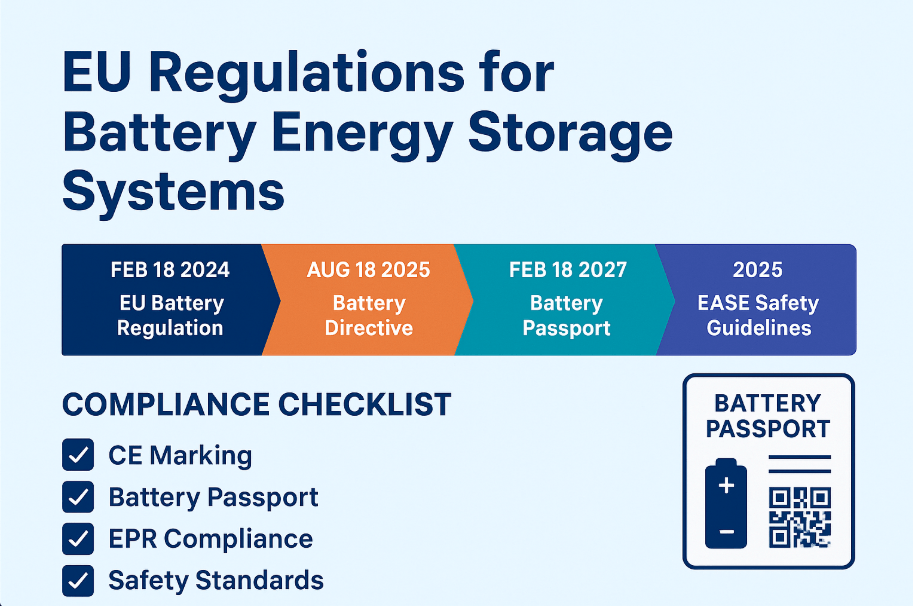
This regulation entered into force on February 18, 2024, and will fully replace the previous Battery Directive by August 2025. It applies to all batteries sold in the EU, including industrial batteries used in energy storage systems.
Main requirements include:
Substance restrictions: Limits on hazardous materials such as mercury, cadmium, and lead.
Labeling & QR codes: Clear labeling of capacity, hazards, and recycling information, along with a scannable QR code.
CE marking: Batteries must carry CE certification, showing compliance with EU directives.
Battery Passport: From February 2027, all industrial batteries >2 kWh must include a digital “Battery Passport” with details on composition, carbon footprint, and recyclability.
Due diligence obligations: Large producers (turnover > €40M) must implement supply chain policies to ensure responsible sourcing.
2. Extended Producer Responsibility (EPR)
The EU applies Extended Producer Responsibility (EPR) to all batteries, including BESS. This means that producers must finance:
Collection and recycling programs
End-of-life treatment
Safe disposal methods
To meet obligations, companies can join Producer Responsibility Organisations (PROs), which handle compliance on their behalf.
This ensures that batteries don’t end up in landfills but are reused or recycled into the supply chain.
3. Clean Energy and Market Integration Rules
BESS isn’t just about hardware—it’s also about market access. The EU’s Clean Energy Package (2019) gives storage systems fairer treatment in electricity markets.
Key highlights:
BESS can participate in wholesale, balancing, and capacity markets.
Grid operators must treat storage fairly, avoiding double charging.
Developers benefit from streamlined permitting under the Net-Zero Industry Act (2024).
The Critical Raw Materials Act (2024) introduces stricter monitoring of strategic materials like lithium and cobalt.
Together, these measures aim to create a level playing field for battery operators while ensuring Europe’s independence from risky supply chains.
4. Safety Standards and Best Practices
Safety is a top concern for utility-scale battery projects. In 2025, the European Association for Storage of Energy (EASE) published Guidelines on Safety Best Practices, covering product design, site management, and emergency response.
For compliance, BESS projects must consider:
Voltage thresholds: DC ≤ 1500 V, AC ≤ 1000 V.
Minimum capacity: Systems above 20 kWh fall under stricter rules.
System-level testing: Incorporating IEC and CE standards into project certification.
In short, regulatory compliance is now a competitive differentiator in the fast-growing BESS sector.
Conclusion: EU Regulations for Battery Energy Storage Systems Preparing for 2026 and Beyond
The EU has set a high bar for Battery Energy Storage Systems. From CE marking and Battery Passports to EPR obligations and safety guidelines, every stakeholder must act now to prepare for full enforcement in 2025–2027.
For BESS companies, compliance isn’t a box-ticking exercise—it’s the foundation for long-term growth in the European market.
⚡ Introduction: Why BIS Certification Matters for Lithium-Ion Batteries
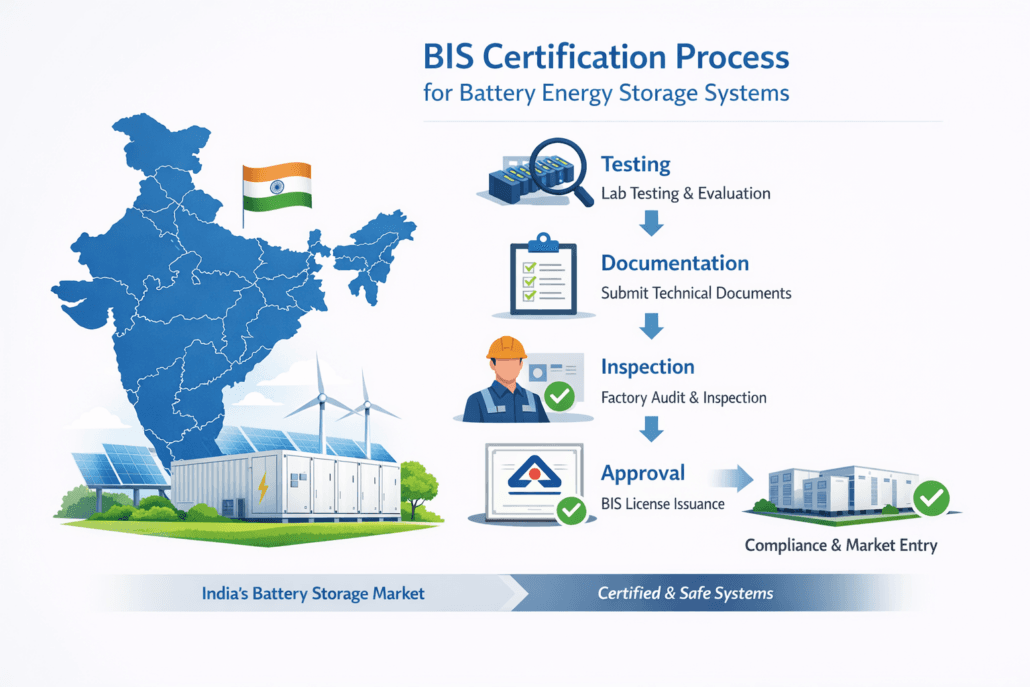
The demand for lithium-ion batteries in India is growing rapidly, driven by the electric vehicle (EV) boom and the expansion of energy storage systems (ESS). To ensure safety, reliability, and quality, the Bureau of Indian Standards (BIS) mandates BIS Certification under the Compulsory Registration Scheme (CRS).
BIS certification validates that batteries meet India’s strict safety and performance standards — protecting consumers and ensuring market trust.
In short: No lithium-ion battery can be legally sold in India without BIS registration.
🔍 What Is BIS Certification?
The Bureau of Indian Standards (BIS) operates under the Ministry of Consumer Affairs, Government of India, and oversees product safety across multiple categories, including electrical, electronics, and battery systems.
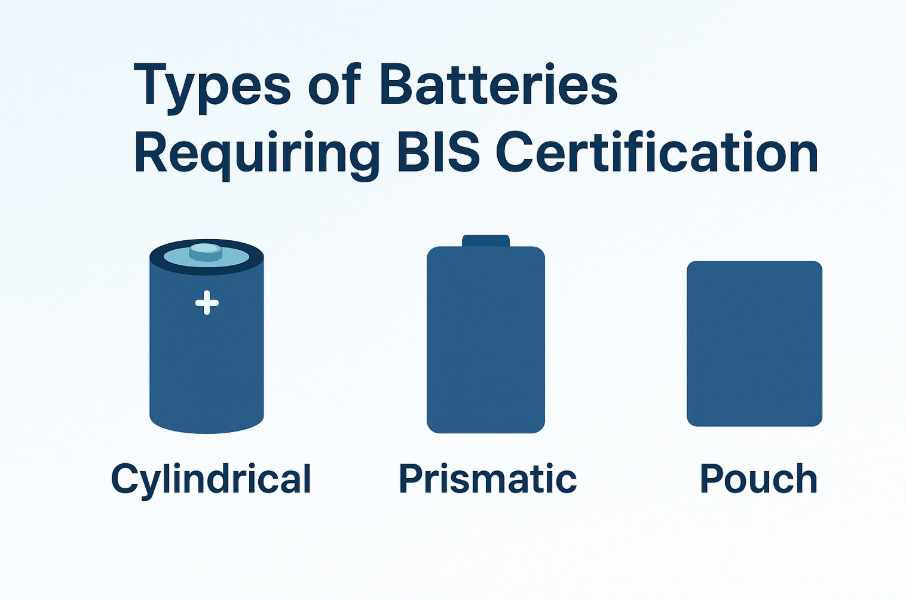
For lithium-ion batteries, the BIS certification is issued under IS 16046 (Part 1 and Part 2) standards, which align closely with IEC 62133-1 and IEC 62133-2.
Indian manufacturers of lithium-ion cells or packs.
Foreign manufacturers exporting batteries to India.
Importers or brand owners selling products that include lithium cells (like e-bikes, ESS, or power banks).
Foreign manufacturers must appoint an Authorized Indian Representative (AIR) to manage their application. You can learn about AIR responsibilities in the BIS Certification Process page.
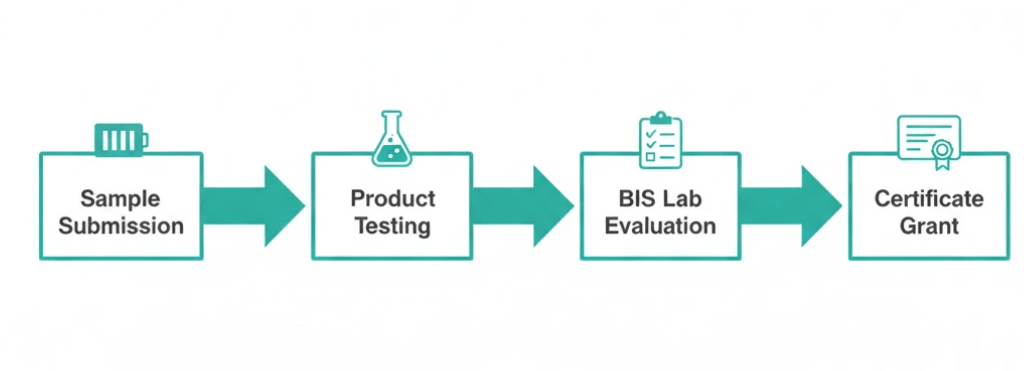
Step-by-Step Process for BIS Registration
1. Identify the correct product category Confirm your cell or pack falls under IS 16046 (Part 2): 2018.
2. Appoint an AIR (for foreign brands) The AIR acts as the legal point of contact in India.
3. Send samples to a BIS-approved lab Testing includes mechanical, electrical, and thermal safety tests.
4. Receive valid test reports Reports older than the allowed period (commonly 90 days) are not accepted.
5. Submit the BIS online application Upload your documents, test reports, and undertakings via the BIS Smart Registration portal.
6. BIS review and certification The Bureau reviews, queries if necessary, and grants registration once approved.
The average BIS certification timeline ranges from 6 to 12 weeks, depending on test readiness and documentation accuracy.
Testing Requirements under IS 16046 (Part 2)
BIS mandates several tests to ensure safety and reliability:
Overcharge and overdischarge tests
Short-circuit and thermal abuse tests
Vibration and mechanical shock tests
Drop, crush, and impact evaluations
Forced discharge and temperature cycling
Testing must be done at BIS-recognized Indian laboratories only. See the CRSBIS recognized labs list for current approvals.
Validity, Renewal, and Modifications
A BIS registration typically remains valid for two years and can be renewed before expiry. If your battery design, chemistry, or form factor changes, you may need inclusion or re-certification.
Component Traceability: Imported cells must show source compliance.
Frequent Standard Updates: IS 16046 revisions can impact timelines.
💡 Tip: Partnering with a certified integrator like SunLith Energy helps streamline compliance and ensure up-to-date certification.
⚡ BIS for EV, Solar, and Energy Storage Systems
BIS certification isn’t limited to small devices — it’s equally crucial for EV batteries, solar storage units, and industrial battery systems.
SunLith Energy’s advanced BESS solutions comply with BIS and other global standards, ensuring safe and efficient operation across commercial and industrial applications.
🔗 Read more here: Explore SunLith Energy’s C&I Battery Energy Storage Systems →
🧠 Future of BIS Certification in India
The Government of India continues strengthening its battery standardization policies, aligning with global frameworks like UN 38.3 and ISO 9001:2015.
In coming years, expect:
Expansion to cover solid-state and semi-solid lithium technologies.
Stronger testing oversight for EV safety and fire resistance.
❓ FAQ: BIS Certification for Lithium-Ion Batteries
Q1. Is BIS certification mandatory for lithium-ion batteries?
✅ Yes. All lithium-ion cells and packs must be BIS-certified before sale in India.
Q2. How long does the BIS certification process take?
⏱️ Typically 1–4 months, depending on testing queue and document accuracy.
Q3. Can imported batteries be sold without BIS?
❌ No. Even imported batteries must register under CRS before being marketed in India.
Q4. Does BIS certification cover EV batteries?
✅ Yes. All electric vehicle battery packs must comply with BIS standards.
Q5. Can I use a foreign lab test report?
❌ No. BIS accepts test reports only from BIS-recognized labs in India.
Q6. What happens if my battery design changes?
Major design or chemistry changes require re-certification or inclusion.
Q6. Do I need BIS if my battery already has UL or IEC certification?
✅ Yes. Indian BIS registration is mandatory, even if you hold foreign safety marks.
Q7. How often must BIS be renewed?
Renew every two years or as defined in your certificate terms.
📈 Conclusion: Ensuring Battery Safety Through BIS
BIS certification is the foundation of battery safety in India. It not only ensures compliance but also builds trust among consumers, EV manufacturers, and energy solution providers.
At SunLith Energy, we support clients from design to compliance — including UL, BIS, and IEC certifications — to accelerate product launch with confidence.
By staying ahead with SunLith Energy’s BIS-compliant battery systems, your products remain reliable, future-ready, and globally competitive.
IEC Certifications for BESS: Battery Energy Storage Systems (BESS) are at the heart of modern energy transition—bridging renewables with grid reliability, enabling peak shaving, and powering homes, businesses, and microgrids. However, with great power comes great responsibility—ensuring these systems are safe, reliable, and compliant. This is where IEC certifications become non-negotiable.
Whether you’re a manufacturer, developer, investor, or end-user, understanding IEC standards for BESS is essential. Let’s explore what they are, why they matter, and how they ensure your system meets international benchmarks.
What Is IEC?
The International Electrotechnical Commission (IEC) is a global organization that prepares and publishes international standards for all electrical, electronic, and related technologies. IEC standards are widely accepted across countries, making them a crucial part of certification for global markets.
Why IEC Certification Matters for BESS
IEC certifications ensure:
Safety: Protects people and infrastructure from battery-related risks like fire, explosion, and electric shock.
Performance: Verifies that the system delivers its rated capacity, efficiency, and lifespan.
Grid Compatibility: Confirms the system won’t disrupt power quality or stability.
Global Market Access: Required for entering many regulated markets in Europe, Asia, and the Americas.
Without proper IEC certification, your BESS project could face project delays, insurance issues, or legal penalties.
Key IEC Certifications for BESS
Here’s a list of the most important IEC standards applicable to BESS, from the cell level to the complete system level.
1. IEC 62619 – Safety of Secondary Lithium Cells and Batteries for Industrial Applications
Focuses on cell and battery safety for industrial use.
Covers thermal runaway, overcharging, short-circuit protection, and more.
Mandatory for Li-ion cells and packs used in BESS.
2. IEC 62933 Series – Electrical Energy Storage Systems (EESS)
IEC 62933 is the international framework governing grid energy storage systems (ESS). Developed by the International Electrotechnical Commission (IEC), it establishes requirements for design, safety, performance, and environmental impact. Its goal is to harmonize ESS deployment worldwide.
The standard applies to all types of storage technologies, including batteries, mechanical storage, and hybrid systems. By creating a unified baseline, IEC 62933 helps reduce risks and improve investor confidence in large-scale ESS projects.
Type Test Report of Full Battery Rack or Container
If these are unavailable, it’s a red flag. You might be dealing with an uncertified, risky product.
Common Pitfalls to Avoid
Assuming cell certificates are enough
Using self-built systems without third-party testing
Mixing components without system-level integration testing
Skipping fire protection compliance
✅ Final Thoughts: IEC Certifications for BESS Is Not Optional
In the rapidly growing energy storage market, shortcuts are tempting—but dangerous. IEC certifications are not just documents; they’re your first line of defense against accidents, project rejections, and long-term failure.
So whether you’re developing a grid-scale BESS or installing a home backup system, insist on IEC-certified solutions. Your safety, investment, and reputation depend on it.
Got Questions About IEC Certifications for BESS?
As a New Energy Consultant, I help clients source, validate, and inspect certified energy storage systems across Asia. If you’re unsure about your battery supplier’s documents or want help with third-party testing, feel free to reach out.
Quick Answer: BESS certifications are mandatory safety approvals for Battery Energy Storage Systems. You need UL 9540 for the USA, CE Marking for Europe, IEC 62619 globally, and BIS IS 17855 for India. Without valid BESS certifications, your system cannot be sold, insured, or grid-connected.
BESS certifications are the first thing you need when buying, selling, or installing a battery energy storage system. They decide whether your project gets permitted and financed — or blocked. As the global BESS market grows toward 500 GW by 2031, regulators everywhere are raising the bar.
This guide covers every major standard in 2026. Moreover, it explains what each certification tests, why it is required, and what it costs. Use it before you sign any BESS purchase agreement.
What This Guide Covers
To help you navigate this comprehensive 2026 compliance roadmap, use the quick-reference index below to jump directly to specific regional frameworks, testing criteria, or buyer requirements:
1. Why BESS Certifications Matter More Than Ever in 2026
BESS certifications are not just paperwork. They are your legal license to sell and operate in any serious energy market. High-profile BESS fires across the US, Europe, and Asia have pushed regulators to tighten standards. As a result, the compliance bar in 2026 is higher than at any point before.
Skipping BESS certifications leads to serious, immediate problems. Here is what happens when a system is not properly certified:
Safety failures: Fires from uncertified BESS have caused millions in damage globally
Market access blocked: Products without UL 9540 or CE Marking cannot legally be sold
Insurance denied: Most insurers reject claims involving uncertified systems
Grid connection refused: Utilities require valid certification before any interconnection
Tender disqualification: BIS (India) and CEC (Australia) are mandatory for public projects
Legal liability: Uncertified equipment leads to fines, recalls, and lawsuits
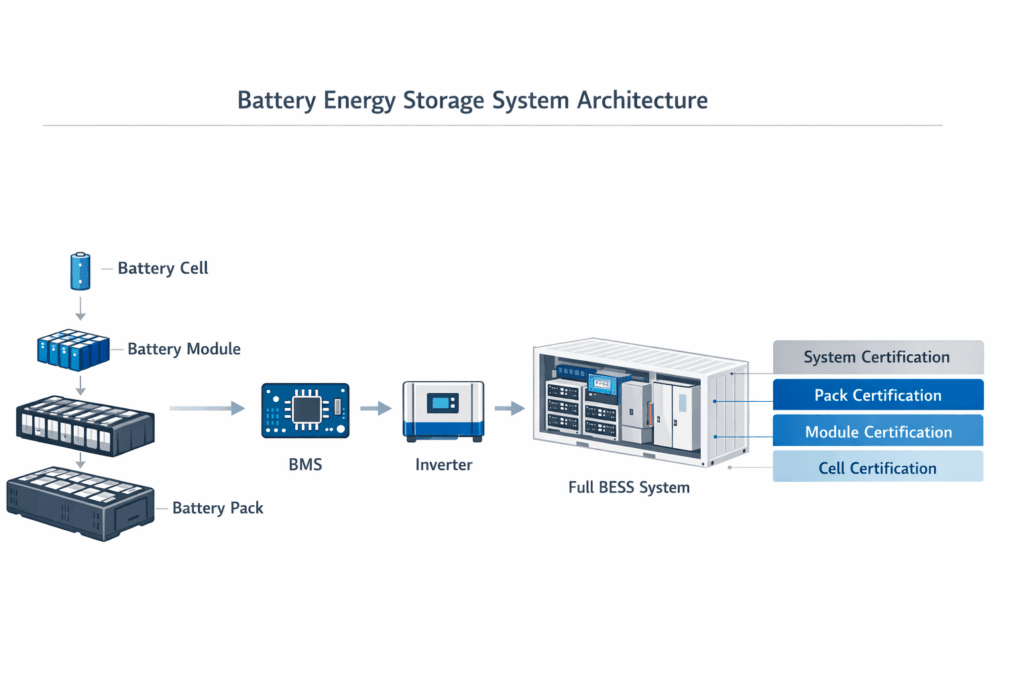
Key Rule: A certified cell does NOT mean the full BESS system is certified. The cell, BMS, PCS, enclosure, and complete assembled system each need their own independent certification. This is the most expensive mistake importers make.
2. All Major BESS Certification Standards by Region (2026)
Different markets require different BESS certifications. Below is a full breakdown of every standard you need to know. Each section explains what is tested, who issues it, and why it matters.
A. UL Standards — United States and Canada
Underwriters Laboratories (UL) issues the core BESS certifications for North America. These are enforced through state building codes, the NEC, and utility agreements. Without them, your product cannot be permitted or installed in most US states.
Standard
Full Name
Covers
Who Needs It
UL 9540
Safety for Energy Storage Systems
Full system safety — the master US standard
All BESS sellers and installers in USA/Canada
UL 9540A
Thermal Runaway Fire Propagation Test
Fire spread between battery modules
Required before UL 9540 listing
UL 1973
Stationary and Motive Battery Systems
Battery cell and pack safety
Battery pack manufacturers
UL 1741
Inverters and Power Converters
Grid-interactive inverter and PCS safety
PCS and inverter manufacturers
UL 1699B
Lithium-Ion Battery Protection
Arc fault protection in Li-ion systems
Residential and commercial BESS
UL 9540A must be completed at three levels: cell, module, and unit. Many suppliers, however, only show the cell-level report. Consequently, buyers accept incomplete documentation without knowing it. Always demand all three levels before you proceed.
B. IEC Standards & IEC 62933 Compliance — International and European Markets
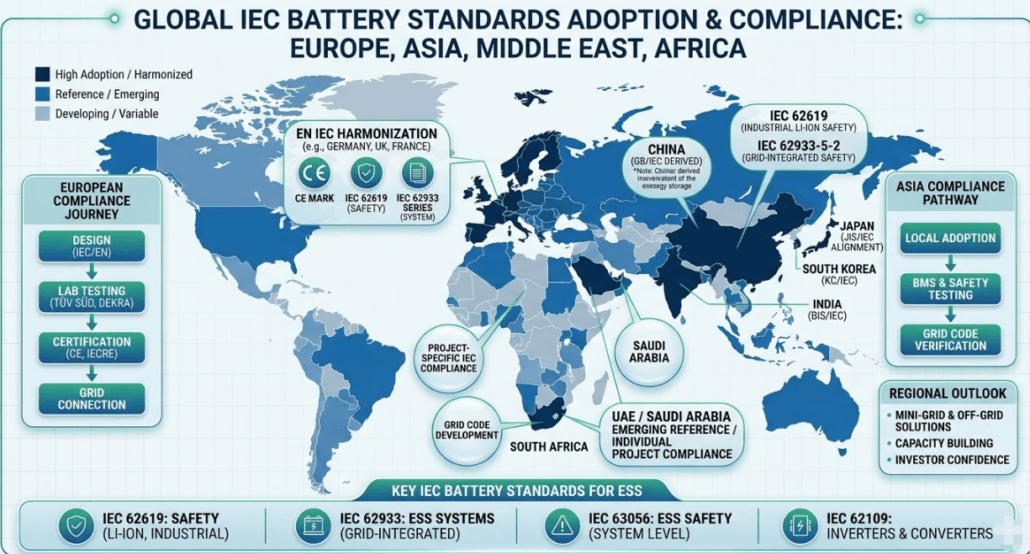
The International Electrotechnical Commission (IEC) sets globally accepted BESS certifications. As a result, IEC standards are referenced by regulators across Europe, Asia, the Middle East, and Africa. Furthermore, many utility tenders worldwide require specific IEC compliance as a minimum baseline.
Core safety: overcharge, short circuit, thermal abuse
IEC 62933-2-1
ESS unit parameters and test methods
Performance verification of a complete assembled system
IEC 62933-5-2
Safety for grid-integrated energy storage
Cybersecurity, functional safety, grid protection
IEC 61427-2
Batteries for off-grid renewables
Cycle life and performance for solar and wind storage
IEC 61508
Functional safety of electrical systems
Applies to BMS software and firmware safety logic
C. CE Marking — European Union and EEA
CE Marking is legally required for every battery product sold in the EU. It is not a single test. Instead, it is a Declaration of Conformity that proves compliance with several EU Directives at once. Without it, your product cannot enter the EU market legally.
Low Voltage Directive (LVD) 2014/35/EU — Electrical safety for equipment from 50V to 1000V AC
EMC Directive 2014/30/EU — Ensures BESS does not interfere with other devices
RoHS Directive 2011/65/EU — Restricts lead, mercury, cadmium, and other hazardous substances
EU Battery Regulation 2023/1542 — Adds carbon footprint declaration and Digital Battery Passport from 2024
Machinery Directive 2006/42/EC — Applies if the BESS includes any motorized or moving parts
2026 EU Update: The EU Battery Regulation adds a Digital Battery Passport for BESS above 2 kWh. From 2027, every qualifying battery needs a QR-code-linked passport with carbon footprint and supply chain data. Start compliance preparation now.
D. BIS Certification — India
In India, the Bureau of Indian Standards (BIS) manages mandatory BESS certifications under the Compulsory Registration Scheme (CRS). Without BIS registration, products cannot clear customs or qualify for government tenders. India is a fast-growing BESS market, so this certification is increasingly important.
IS 16270:2014 — Safety for lithium-ion cells, equivalent to IEC 62133
IS 17855:2022 — Stationary lithium battery safety, aligned with IEC 62619
IEC 62619 (adopted directly) — Required for large-scale utility and industrial BESS tenders
Testing must be done at BIS-approved labs or internationally accredited labs with a BIS agreement. Additionally, registration is model-specific and must be renewed. Typical timeline: three to six months.
E. CEC Approval — Australia
Australia’s Clean Energy Council (CEC) governs BESS certifications for the Australian market. CEC listing is required for grid connection and STC rebate eligibility. Without it, network operators will not approve the connection.
AS/NZS 5139:2019 — Australian standard for battery systems with power conversion equipment, updated by Amendment 1 in December 2025
CEC Approved Product List — Products must appear on this list before any grid connection; listing requirements themselves changed under AS/NZS 4777.2 Amendment 2 in 2025
Installer accreditation — CEC Battery Storage Accreditation is required for all installers
F. NFPA 855 — USA Fire Installation Standard
NFPA 855 governs how BESS certifications translate into safe real-world installations. While UL 9540 covers product safety, NFPA 855 covers how and where BESS is installed. Many US states have adopted it into local building codes.
Sets maximum energy capacity per room and building type
Requires fire suppression systems above defined energy thresholds
Mandates separation distances between battery racks and modules
Requires UL 9540A unit-level results as part of the permit application
Therefore, project developers must design installations to NFPA 855 from day one. Failing to do so results in permit denial — often after costly design work is already complete. For a deeper look into compliance steps, spacing rules, and permitting, read our Complete NFPA 855 Guide.
G. UN 38.3 — International Transport Certification
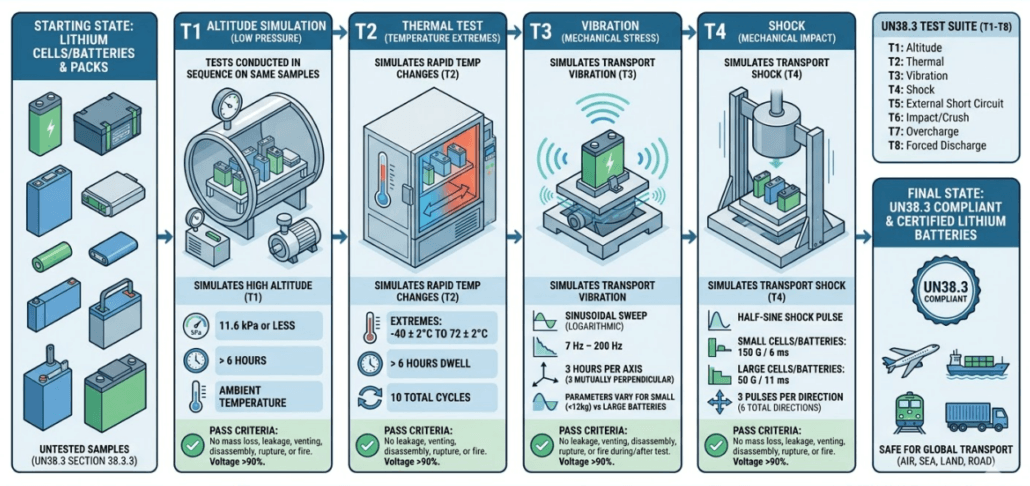
UN 38.3 is one of the most universally required BESS certifications — yet it is often overlooked. Simply put, it is the mandatory transport safety test for all lithium batteries shipped internationally. Without a valid UN 38.3 report, your shipment will be refused by airlines, shipping lines, and road carriers.
Tests include altitude simulation, thermal testing, vibration, shock, short circuit, and overcharge
Required under IATA (air), IMDG (sea), and ADR/RID (road) dangerous goods regulations
Cells, modules, and complete packs each need separate UN 38.3 documentation
Must be done at an accredited laboratory — self-certification is not accepted
Warning: Outdated or cell-only UN 38.3 reports are very common from lower-tier manufacturers. Any design change — including a new BMS version or different cell count — requires a fresh test. Check validity before every shipment.
4. System-Level vs. Component-Level BESS Certifications
Many buyers assume that a certified component means a certified system. In practice, this is wrong. Every level of a BESS assembly needs its own BESS certifications. Moreover, any change to a component — even a firmware update — can invalidate the existing system certificate.
Component
Relevant BESS Certifications
Why Independent Certification Is Required
Individual cells
UN 38.3, IEC 62133, UL 1973
Cell chemistry, abuse tolerance, and transport safety
Battery module
UL 9540A (cell level), IEC 62619
Module-level thermal runaway fire propagation
Battery pack / rack
UL 9540A (module level), IEC 62619
Pack-level fire propagation and structural safety
BMS
IEC 61508, UL 991
Software functional safety and fault detection logic
PCS / Inverter
UL 1741, IEC 62109, CE LVD
Grid interaction, isolation, and anti-islanding protection
Full assembled system
UL 9540, UL 9540A (unit), CE, IEC 62933
System integration, fire safety, and grid compliance
For this reason, always request the full system-level test report. It must list the exact model numbers, BMS version, cell supplier, and test configuration — matching the product you will actually receive.
5. Factory Certifications That Support BESS Certifications
Product BESS certifications are only part of the picture. The factory itself also needs to meet recognized management standards. Without factory certification, there is no reliable batch traceability — and no accountability when problems arise after delivery.
Certificate
What It Proves
Relevance to BESS Buyers
ISO 9001:2015
Quality Management System
Consistent production quality and batch traceability
ISO 14001:2015
Environmental Management System
Safe handling and disposal of hazardous battery materials
ISO 45001:2018
Occupational Health and Safety
Worker safety in battery manufacturing environments
IATF 16949
Automotive-grade quality standard
Relevant for BESS using automotive-grade LFP or NMC cells
ISO/IEC 27001
Information Security Management
Required for grid-connected BESS with SCADA or IoT systems
6. How to Spot Fake or Invalid BESS Certifications
Fraudulent BESS certifications are surprisingly common — especially in the Chinese supply chain. As a result, buyers who do not know what to check often accept invalid documents. Here are the key red flags to look for:
Cell-only report shown as a system cert: Supplier shows IEC 62619 for the cell but has no system-level UL 9540 or CE Declaration
Wrong model number: The certified model is different from the product being shipped to you
Expired documents: Check the issue date and validity period on every certificate — expired certs are invalid
Unknown test lab: Lab is not listed under ILAC mutual recognition — verify at ilac.org
Missing UL 9540A unit-level test: Only cell-level results are shown; module and unit levels are absent
No Technical Construction File for CE: Self-declaration is legal, but the Technical File must exist and be available
Supplier refuses to verify: UL certs are verifiable at iq.ul.com — refusal to verify is a serious warning sign
7. BESS Certifications Cost and Timeline Overview (2026)
Budgeting early for BESS certifications is essential. Costs vary by lab, system complexity, and region. Furthermore, any change to chemistry, BMS software, or module count after certification may trigger re-testing. These are approximate benchmarks for 2025 to 2026:
BESS Certification
Approx. Cost (USD)
Timeline
Key Notes
UL 9540 — full system
$80,000 – $200,000+
6–12 months
Includes UL 9540A at all three levels
UL 9540A — thermal runaway
$30,000 – $80,000
3–6 months
Cell, module, and unit tested separately
IEC 62619
$15,000 – $40,000
3–5 months
Available at TÜV, SGS, Intertek globally
CE Marking (LVD + EMC)
$10,000 – $30,000
2–5 months
Notified body fees vary by complexity
BIS India — IS 17855
$5,000 – $15,000
3–6 months
Testing at BIS-approved or linked labs
CEC Australia
$5,000 – $20,000
2–4 months
Requires ISO 17025 accredited lab report
UN 38.3
$3,000 – $8,000
4–8 weeks
Required per battery model and configuration
ISO 9001 factory cert
$5,000 – $20,000/yr
3–6 months
Annual surveillance audits required
8. BESS Certification Buyer’s Checklist — Before You Sign
Navigating a BESS purchase requires a structured phase-by-phase compliance review before signing any final purchase agreement or paying a deposit. The process begins at the fundamental component level, where buyers must verify cell and module abuse integrity under standards like UL 1973 and UL 2580. Ensuring your hardware meets EV-grade physical ruggedness standards heavily mitigates the risk of localized cell failures cascading into full-scale thermal runaway down the line.
Once component safety is established, the focus transitions directly to integration within the complete enclosure architecture. System developers must verify that the full assembly carries UL 9540 certification and that the manufacturer provides a comprehensive UL 9540A report detailing fire propagation limits across all three testing tiers: cell, module, and unit level. This step is critical for securing local installation permits and satisfying authority requirements.
The next milestone involves transitioning the physical hardware into an active electrical grid, which introduces strict performance and stability criteria. Developers should look to international frameworks like IEC 62933-2-1 to validate real-world parameters such as full-system round-trip efficiency (RTE) and step response time, while utilizing IEC 62933-5-2 to confirm that the internal battery management system (BMS) logic can safely handle external grid faults or sudden frequency shifts. For a complete deep dive into these electrical parameters, review our comprehensive breakdown of IEC Certifications for BESS.
For projects crossing international borders, distinct regional and maritime regulations must be cleared well before commissioning. Entering European markets requires a formal CE Marking Declaration of Conformity covering low voltage, electromagnetic compatibility, and the latest digital battery passport index mandates—detailed thoroughly in our guide to CE for BESS Certification. Concurrently, deployments targeting specific local markets must secure specialized domestic registrations, such as BIS Certification for Lithium-Ion Batteries for clearing Indian customs or Clean Energy Council (CEC) approved listing to grant grid connection and rebate eligibility in Australia.
Finally, logistics and long-term project lifecycles must be factored into the initial risk assessment. Every international lithium battery shipment—regardless of the target destination—legally requires a valid, model-specific UN 38.3 transport safety report covering severe vibration, altitude, and shock testing to prevent carrier rejection at port. Successfully validating these layers chronologically ensures that your asset arrives safely, passes inspection smoothly, and maintains accurate end-of-life calculations over its entire 10-to-15-year lifecycle.
9. Frequently Asked Questions About BESS Certifications
Here are the most-searched questions about BESS certifications, with direct and clear answers.
What certifications does a BESS need in the United States?
In the USA, BESS certifications include UL 9540 for the full system, UL 9540A at cell/module/unit levels, UL 1973 for battery packs, and UL 1741 for the inverter or PCS. Additionally, all US installations must comply with NFPA 855 and NEC Article 706.
Is UL 9540 mandatory for BESS in the USA?
Yes — in practice. UL 9540 is technically a voluntary standard. However, it is required by most state building codes, utility interconnection agreements, and insurance policies. Without it, your system will not be permitted or connected to the grid.
What is the difference between UL 9540 and UL 9540A?
UL 9540 is the full product safety standard for a complete BESS system. UL 9540A, however, is a specific test for fire propagation during a thermal runaway event. In other words, UL 9540A is a prerequisite test that must be passed before UL 9540 listing is granted.
Can I sell BESS in Europe without CE Marking?
No. CE Marking is a legal requirement for all electrical products in the EU and EEA. Products without it can be seized at the border. Furthermore, from 2024, the EU Battery Regulation adds extra compliance requirements beyond traditional CE directives.
Does IEC 62619 replace UL 9540?
No — they serve different purposes. IEC 62619 is a component-level standard for lithium battery safety. UL 9540, on the other hand, is a full system safety standard specific to the US market. For US sales you need UL 9540. For global acceptance, IEC 62619 is the recognized baseline.
What is UN 38.3 and is it required for BESS shipments?
UN 38.3 is the mandatory transport safety test for all lithium batteries. It is required for every international shipment of cells, modules, and packs — by air, sea, or road. Without a valid UN 38.3 report, freight forwarders and customs will reject the shipment.
How long does BESS certification take from start to finish?
Full UL 9540 certification takes six to twelve months. IEC 62619 takes three to six months. CE Marking can be completed in two to five months. UN 38.3 is the fastest at four to eight weeks. Most manufacturers apply for several certifications at the same time to reduce total time to market.
What is the EU Battery Passport and when does it apply?
The EU Battery Regulation (2023/1542) introduces a Digital Battery Passport for industrial BESS above 2 kWh sold in the EU. From 2027, each qualifying battery needs a QR-linked passport with carbon footprint and supply chain data. As a result, BESS manufacturers targeting Europe should start compliance preparation immediately.
Related Articles and Useful Links
Add these internal links when publishing on WordPress — they strengthen topical authority and support navigation:
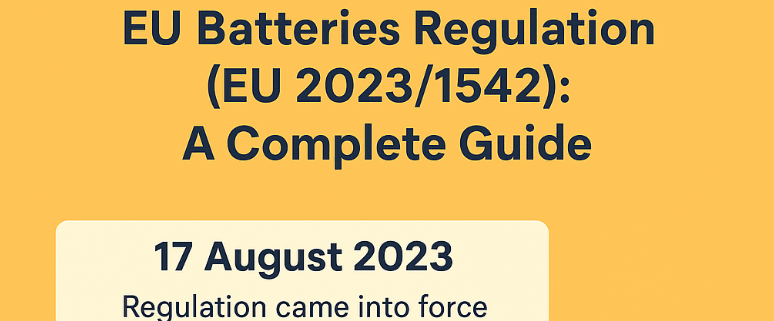
Comprehensive compliance requires mastering the standard Batteries Regulation (EU 2023/1542) framework. This legislation officially came into force in August 2023, replacing the old Battery Directive 2006/66/EC across all EU member states. It sets binding rules on carbon footprint, recycling targets, battery passports, and producer responsibility — with deadlines running from 2024 through to 2031. If you sell batteries or BESS into the EU market, this regulation applies to you directly.
1. Scope and Timeline of EU Batteries Regulation (EU 2023/1542)
This regulation applies to almost all types of batteries, including:
Portable batteries in electronics and appliances
Industrial batteries used in storage systems
Automotive batteries
Electric vehicle (EV) batteries
Light means of transport (LMT) batteries, such as e-bikes and e-scooters
Key deadlines to note:
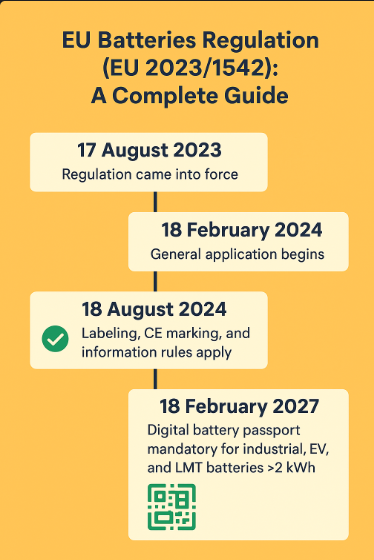
17 August 2023 – Regulation entered into force
18 February 2024 – General rules started to apply
18 August 2024 – Labeling, CE marking, and consumer information requirements
18 August 2025 – Waste battery management obligations
Click on any deadline phase below to view mandatory requirements for manufacturers, importers, and BESS operators.
February 2027: Digital Battery Passport & Repair Rules
Digital Battery Passport: Becomes strictly mandatory for all EV, LMT, and industrial batteries above 2 kWh. Must be accessible via an external QR code.
Right to Repair: Portable appliance batteries must be easily removable and replaceable by consumers or independent technicians.
Collection Targets: 63% collection efficiency path must be achieved for standard portable battery variants.
Applies to EV, LMT, and industrial batteries above 2 kWh
Accessible via QR code
Contains data on raw materials, lifecycle, recycling, and performance
This tool will increase traceability, reuse, and recycling efficiency.
d) EPR Rules in the EU Batteries Regulation
Producers must take back used batteries and ensure proper recycling.
Collection targets: 63% for portable batteries by 2027, rising further by 2030
Recycling efficiency goals:
Lithium: 50% by 2027, 80% by 2031
Cobalt, nickel, copper, lead: 90% by 2027, 95% by 2031
e) Removability & Repair Obligations
By 2027, portable device batteries must be easily removable by consumers.
LMT batteries must be replaceable by independent professionals. This ensures longer product lifespans and supports the right to repair movement.
f) Supply Chain Due Diligence
Battery manufacturers must assess and address environmental and social risks, especially concerning critical raw materials like lithium, cobalt, and nickel.
g) Enforcement & Penalties
EU member states must set effective and dissuasive penalties for non-compliance by 2025. Companies failing to meet obligations risk heavy fines and restricted market access.
4. Why the EU Batteries Regulation Matters
The EU Batteries Regulation 2023/1542 is a turning point for the industry:
The EU Batteries Regulation (EU 2023/1542) is more than just another piece of legislation. It sets the foundation for a sustainable battery market, from design and labeling to recycling and reuse. For businesses, early compliance is not optional—it’s the only way to remain competitive in Europe’s fast-changing energy landscape.
Frequently Asked Questions
Q1: What is EU 2023/1542?
EU 2023/1542 is the EU Batteries Regulation adopted in July 2023. It replaces the Battery Directive 2006/66/EC and sets binding rules on battery design, carbon footprint, labelling, recycling targets, and the digital battery passport. It applies directly across all EU member states without requiring national legislation.
Q2: Who does EU 2023/1542 apply to?
EU 2023/1542 applies to any manufacturer, importer, or distributor placing batteries on the EU market. This includes portable batteries, industrial batteries, EV batteries, LMT batteries such as e-bikes, and BESS above 2 kWh. If you sell into the EU market, the regulation applies to you regardless of where you are based.
Q3: What are the key deadlines under EU 2023/1542?
The main compliance deadlines are: August 2023 — regulation entered into force; February 2024 — general rules apply; August 2024 — CE marking and labelling requirements; August 2025 — waste battery management obligations; February 2027 — digital battery passport mandatory for industrial, EV, and LMT batteries above 2 kWh.
Q4: What is the digital battery passport under EU 2023/1542?
The digital battery passport is a QR-code accessible record that must accompany industrial, EV, and LMT batteries above 2 kWh from February 2027. It contains data on raw materials, carbon footprint, lifecycle performance, and recycling information. It is designed to improve traceability, support reuse, and increase recycling efficiency across the supply chain.
The battery management system is the primary data source for the passport — it logs SOH, cycle count, and temperature history throughout the battery’s life
Q5: What are the recycling targets under EU 2023/1542?
The regulation sets material-specific recycling efficiency targets. For lithium, the target is 50% recovery by 2027 rising to 80% by 2031. For cobalt, nickel, copper, and lead, the target is 90% by 2027 rising to 95% by 2031. Producers are also required to meet portable battery collection targets of 63% by 2027.
Q6: What happens if a company does not comply with EU 2023/1542?
Non-compliant companies face penalties set by individual EU member states, which must be effective and dissuasive under the regulation. Consequences include heavy fines and restricted access to the EU market. Member states were required to establish their penalty frameworks by 2025.
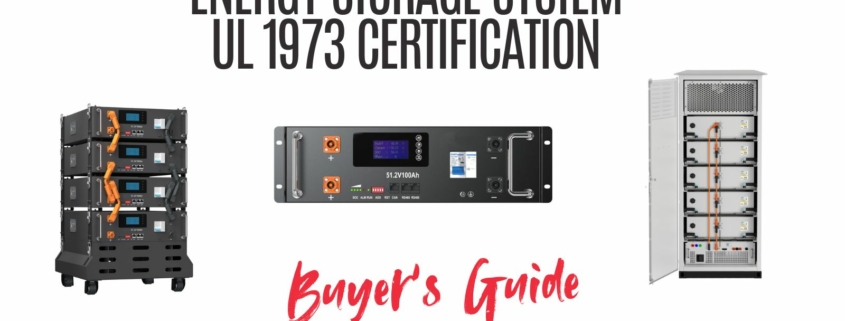
As energy storage technologies power everything from homes to large-scale grids, safety and compliance have become non-negotiable. Among the most important safety benchmarks is UL 1973 certification, the globally recognized standard for stationary batteries and energy storage systems.
This certification validates that a battery has passed rigorous safety and performance tests, ensuring it can operate reliably under real-world conditions. For manufacturers, system integrators, and project developers, achieving UL 1973 certification is not only about compliance—it is about protecting customers, enabling market access, and building trust.
What Is UL 1973 Certification?
UL 1973, formally titled “Batteries for Use in Stationary, Vehicle Auxiliary Power, and Light Electric Rail Applications,” defines the testing requirements for rechargeable batteries used in non-automotive settings.
In simpler terms, if you are producing a Battery Energy Storage System (BESS) or a stationary backup solution, UL 1973 is the certification you need to prove safety.
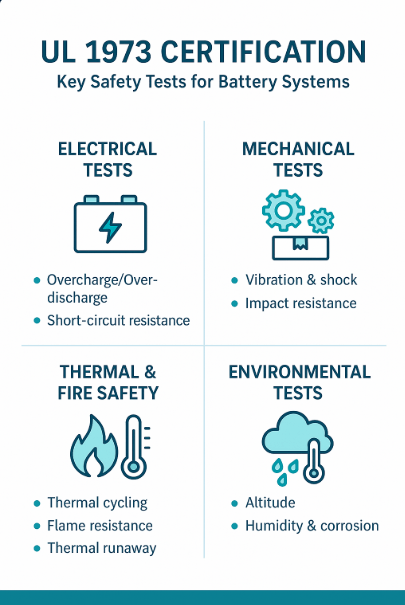
It is a safety certification for stationary and rail-use rechargeable batteries that validates performance under electrical, mechanical, and thermal stress.
Q2. Is UL 1973 mandatory for all batteries?
No, it applies primarily to stationary and auxiliary power systems, not automotive traction batteries (those follow UL 2580).
Q3. How long does certification take?
Typically 6–12 months, depending on battery complexity and lab availability.
Q4. How does UL 1973 relate to UL 9540?
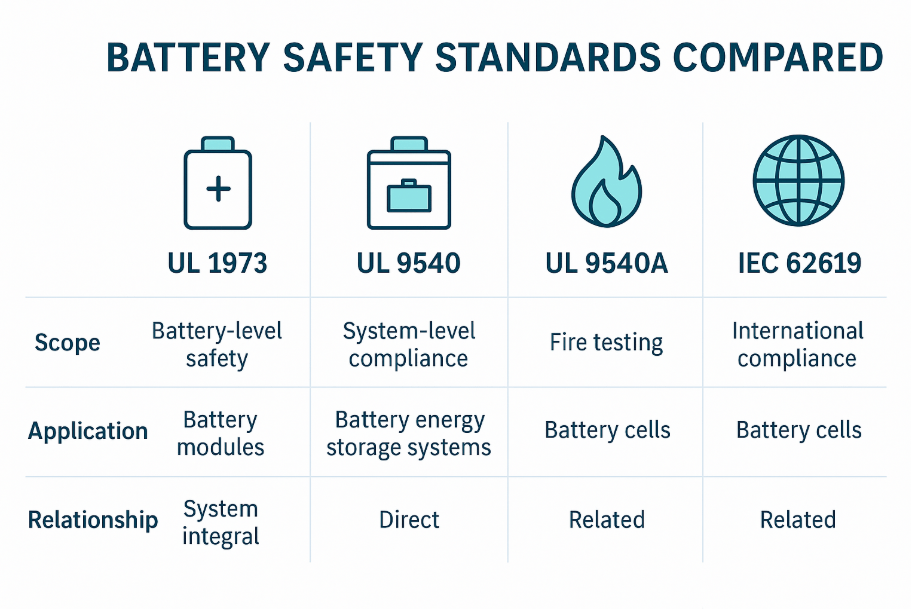
UL 1973 ensures the safety of the battery itself, while UL 9540 covers the entire storage system. Most UL 9540 certifications require UL 1973-approved components.
Q
Final Thoughts
In the competitive energy storage landscape, UL 1973 certification is more than just a box to check—it is your gateway to trust, compliance, and market success. Whether you’re developing a new stationary storage solution or scaling up production, aligning with this standard protects your customers, your business, and your brand.
At Sunlith Energy, we combine technical expertise with compliance experience to help you achieve certification faster and more cost-effectively.