
Fast Frequency Response (FFR): How BESS Stabilizes Grid Frequency in Milliseconds
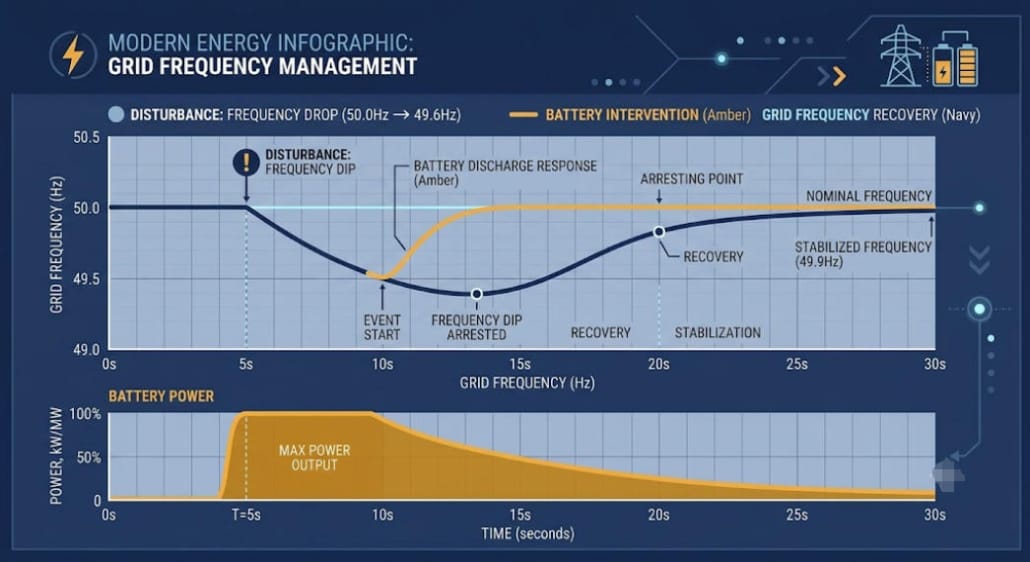
| Quick Answer Fast Frequency Response is a grid ancillary service that automatically injects or absorbs power within milliseconds to a few seconds after a frequency deviation. Essentially, it arrests a frequency drop before automatic load shedding kicks in. Battery energy storage systems deliver Fast Frequency Response faster than traditional generators. Specifically, inverter-based controls detect frequency changes and respond in tens to hundreds of milliseconds. A gas turbine, by contrast, often needs many seconds just to begin ramping. |
What Is Fast Frequency Response?
Fast Frequency Response is the rapid, automatic adjustment of active power output that keeps grid frequency inside safe limits. Typically, it activates after a sudden supply-demand imbalance. When a large generator trips offline or demand spikes without warning, frequency starts to fall immediately. Consequently, grid operators need resources that react before the frequency nadir reaches a level that triggers under-frequency load shedding.
Notably, a widely cited technical review in IEEE Transactions on Smart Grid classifies FFR resources by response speed, deadband, and droop coefficient. Interestingly, it finds battery storage consistently outperforms thermal generation on all three measures.
Traditional frequency response came from the physical inertia of spinning turbines inside coal, gas, and nuclear plants. As renewable generation displaces these machines, however, grid operators lose that natural inertia buffer. This is exactly where Fast Frequency Response and synthetic inertia products step in. In effect, they replace a mechanical property with a fast control loop.
Why Grid Frequency Stability Is Getting Harder to Maintain
Every megawatt of wind or solar that replaces a synchronous generator removes physical inertia from the grid. Britain’s system operator, NESO, currently maintains a minimum system inertia of 120 GVA·s. That is down from 140 GVA·s just a few years earlier, reached in phases through 2024. NESO has proposed lowering the floor further, to 102 GVA·s. However, Ofgem’s official decision on the proposal was inconclusive. In December 2025, it requested further supporting information from NESO, due by March 2026. Consequently, lower inertia means frequency falls faster and further after any given disturbance. As a result, operators have less time to react.
To counteract this, grid codes worldwide are tightening. Increasingly, regulators require new wind, solar, and storage assets to prove FFR capability before they can connect. IEEE Std 2800, published for inverter-based resources, now formally defines four distinct FFR categories. Ultimately, this lets planners match response types to specific grid vulnerabilities.
Meanwhile, data centers and other large, fast-ramping loads add a second source of volatility. Indeed, a single GPU cluster can swing megawatts of demand in milliseconds. That volatility compounds the inertia problem rather than replacing it.
How Battery Energy Storage Systems Deliver Fast Frequency Response
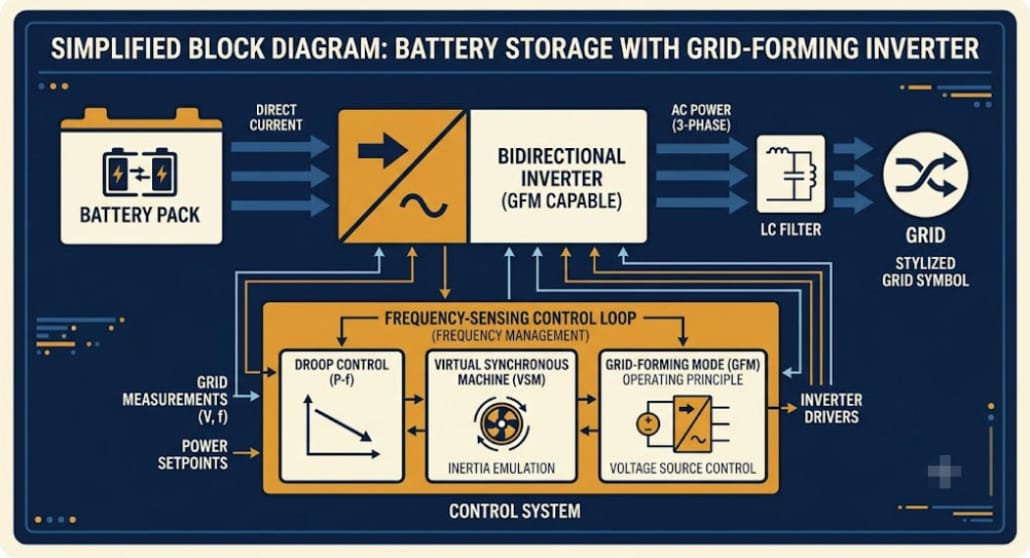
Overall, BESS installations rank among the most effective technologies for Fast Frequency Response. Specifically, their inverters can sense a frequency deviation and change output almost instantly. Typical BESS response times fall between tens and a few hundred milliseconds, well inside the windows most grid operators require.
Three control approaches make this possible. First, droop-based control adjusts output proportionally to the size of the frequency deviation, similar in concept to a generator’s governor response but far quicker. Second, virtual synchronous machine control emulates the inertial behavior of a spinning generator using software rather than a rotating mass. Third, grid-forming inverter control goes further still, letting the BESS set its own voltage and frequency reference instead of simply following the grid.
However, batteries alone do not guarantee good FFR performance. Instead, response quality depends heavily on the control architecture and the state-of-charge headroom reserved for the service. Similarly, it depends on how the inverter is tuned against the local grid’s short-circuit strength. Poorly tuned droop settings can even introduce subsynchronous oscillations. In fact, recent field tests of a 49.5 MW BESS operating in Great Britain documented exactly this issue. For a deeper look at how the inverter stage manages this behavior, see our guide to BESS power conversion system functions.
The Four FFR Types Under IEEE Std 2800
IEEE Std 2800 groups Fast Frequency Response into four categories. Essentially, this helps utilities match resource capability to grid need.
Dynamic FFR (FFR1)
This is bidirectional, droop-based response delivered by BESS and renewable resources with some deloading headroom. Specifically, it scales output continuously with the size of the frequency deviation.
Inertia-Based FFR (FFR2)
Wind turbines with inertial control, or any grid-forming inverter, emulate the release of rotational inertia. In turn, this slows the initial rate of change of frequency rather than only correcting the eventual nadir.
Fixed-Response and Staged FFR (FFR3 and FFR4)
The remaining two categories cover resources that deliver a fixed power block once frequency crosses a threshold. Additionally, they cover staged responses that layer in additional blocks as the deviation deepens. Generally, these types suit demand response and simpler inverter-based assets that cannot modulate output continuously.
Fast Frequency Response Markets Around the World
Market rules for Fast Frequency Response vary by region, and the differences matter for anyone sizing or bidding a BESS asset.
For instance, in Texas, ERCOT folded FFR into its Responsive Reserve Service after major frequency events exposed a gap in fast-acting reserves. For 2026, ERCOT caps the FFR contribution to Responsive Reserve at 450 MW. Specifically, resources providing FFR must respond within roughly a quarter of a second of a frequency excursion.
Great Britain replaced its legacy Firm Frequency Response product with a family of dynamic services: Dynamic Containment, Dynamic Regulation, and Dynamic Moderation. Notably, each targets a different band of frequency deviation. Today, NESO, the system operator, procures these dynamic services because BESS response has become the principal source of FFR-type performance on the GB grid.
Meanwhile, Australia’s frequency control ancillary services market and several U.S. ISO territories run comparable but not identical structures. Generally, they distinguish fast, slow, and delayed contingency response by required speed.
| Market | Product / Service | Response Window | Notes |
|---|---|---|---|
| ERCOT (Texas) | FFR within Responsive Reserve | ~0.25 sec | 450 MW cap on FFR share of RRS (2026) |
| Great Britain (NESO) | Dynamic Containment / Regulation / Moderation | ~1 sec | Replaced legacy Firm Frequency Response |
| Australia (AEMO) | Fast/Slow/Delayed FCAS | ~1-6 sec | Contingency FCAS tiered by speed |
FFR vs. Other Frequency Response Services
Fast Frequency Response is often confused with related grid services. In fact, each one serves a different role in the frequency-recovery sequence.
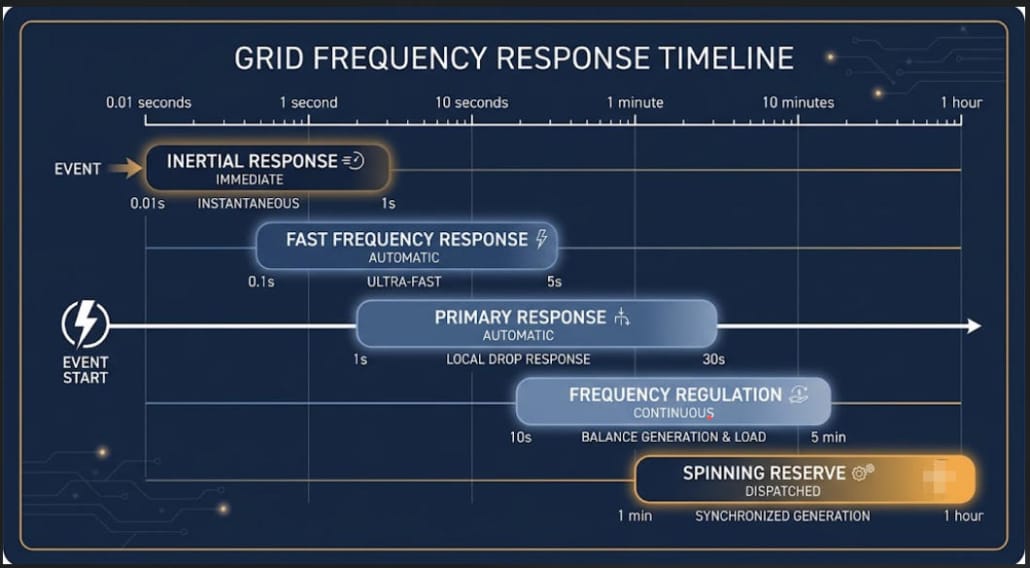
Generally, inertial response happens first, within the first second or two, and resists the initial rate of change of frequency. Then, primary frequency response, sometimes called governor response, follows over several seconds to arrest the nadir. Fast Frequency Response sits alongside or slightly after inertial response, typically completing within one to ten seconds. Frequency regulation, by contrast, operates continuously on a slower cycle to keep frequency near its target. Meanwhile, spinning reserve is the slowest of the group, often taking ten minutes or more to fully deploy. Ultimately, it exists mainly to replace the capacity that FFR and primary response held in reserve.
| Service | Typical Response Time | Primary Role |
|---|---|---|
| Inertial response | < 1-2 sec | Resists initial rate of change of frequency |
| Fast Frequency Response | 1-10 sec | Arrests the frequency nadir |
| Primary / governor response | Several sec | Stabilizes frequency after the nadir |
| Frequency regulation | Continuous | Holds frequency near target in normal ops |
| Spinning reserve | 10+ min | Replaces capacity FFR held in reserve |
Designing a BESS for Fast Frequency Response Duty
Sizing a BESS for Fast Frequency Response duty starts with power capability, not energy capacity. Typically, most FFR events last only seconds to a few minutes.
Even so, the system still needs enough state-of-charge headroom to guarantee bidirectional response at any moment it might be called. Often, operators reserve a fixed SOC band exclusively for FFR duty. Then, they dispatch the remaining capacity for services like peak shaving or energy arbitrage. This layered approach improves the economics without compromising reliability.
Additionally, LFP chemistry suits FFR applications well because of its high cycle life and stable behavior under frequent, shallow cycling. Notably, our guide to understanding BESS specifications covers the C-rate and round-trip efficiency figures that matter most when evaluating a system for this duty.
Key Takeaways
| Point | Detail |
|---|---|
| What it does | Arrests grid frequency drops within milliseconds to a few seconds, before load shedding triggers |
| Why BESS wins | Inverter controls react in tens to hundreds of milliseconds, far faster than thermal generation |
| IEEE Std 2800 | Defines four FFR types: dynamic droop-based, inertia-based, fixed-response, and staged |
| ERCOT rule | Caps FFR contribution to Responsive Reserve at 450 MW; requires ~0.25 sec response |
| GB rule | Dynamic Containment, Regulation, and Moderation replaced the legacy Firm Frequency Response product |
| Sizing driver | Power capability and reserved SOC headroom matter more than total energy capacity |
Frequently Asked Questions
What response time counts as Fast Frequency Response?
Most grid codes define Fast Frequency Response as full delivery within one to ten seconds of a frequency event. However, some markets like ERCOT require an initial response within a quarter of a second. Ultimately, the exact window depends on the operator’s grid code and its severity threshold.
Is Fast Frequency Response the same as synthetic inertia?
No. Synthetic inertia specifically emulates the physical inertia of a spinning generator by reacting to the rate of change of frequency within the first second. FFR is a broader category. Specifically, it includes inertia-emulating responses alongside droop-based and fixed-block responses that arrive slightly later.
Does every BESS qualify for FFR programs automatically?
Not without qualification testing. Instead, grid operators typically require a resource to pass performance tests confirming response time, ramp rate, and accuracy. In addition, the inverter firmware often needs specific grid-code-compliant settings.
How does FFR differ from frequency regulation?
Frequency regulation runs continuously to hold frequency near its target during normal operation. FFR, by contrast, only activates after a significant contingency event. Still, a BESS can typically provide both, but usually not from the same reserved capacity block at the same time.
Can a BESS earn steady revenue from FFR alone?
FFR revenue tends to be volatile, since payments often depend on scarcity and event frequency rather than guaranteed dispatch. As a result, most operators stack FFR with other services, such as regulation or arbitrage, to smooth overall project revenue.
Further Reading
- BESS PCS Functions: Inverter and Power Conversion Explained
- Understanding BESS Specifications
- Peak Shaving with Battery Energy Storage
- C&I vs. Utility-Scale Solar and BESS
- AI Data Center Energy Storage: Why BESS Is Critical




Trackbacks & Pingbacks
[…] In turn, testing scope: commissioning tests verify ride-through, frequency response, reactive power, protection, and power quality directly. See our LVRT and HVRT guide and Fast Frequency Response (FFR) guide. […]
[…] our Fast Frequency Response (FFR) guide for how this works in […]
[…] Fast Frequency Response (FFR) […]
[…] Fast Frequency Response (FFR) […]
[…] Fast Frequency Response (FFR) […]
[…] Fast Frequency Response (FFR) […]
[…] grid interconnection queues are pushing more projects toward temporary bridging power, too. And a growing rental and […]
[…] designers weighing broader grid-support tradeoffs, this same coordination logic also shows up in Fast Frequency Response design. There, too, BESS control settings must stay inside both a grid-code window and the […]
Leave a Reply
Want to join the discussion?Feel free to contribute!