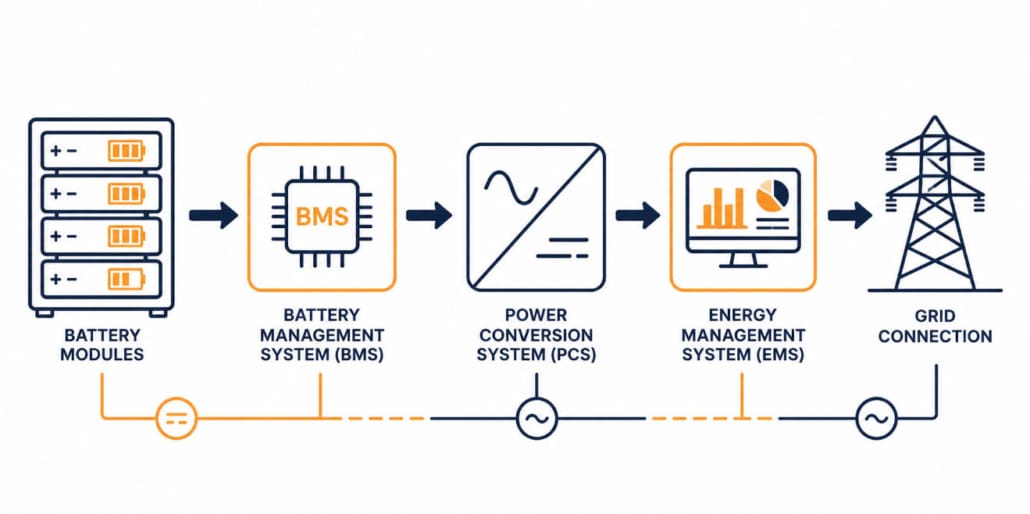
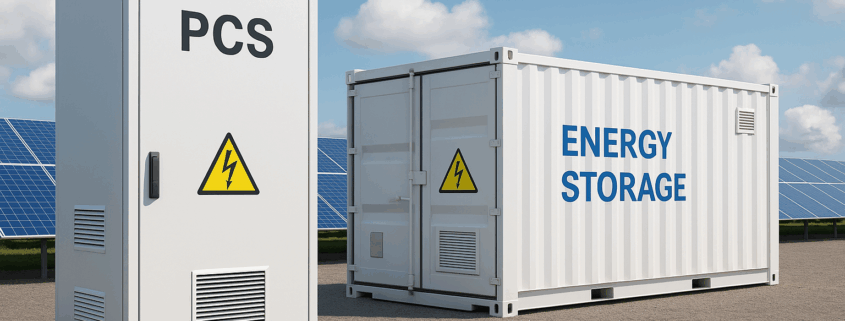
BESS architectures refers to the system design that connects batteries, power electronics, and control systems in a battery energy storage system. A typical BESS architecture includes battery modules, battery management systems (BMS), power conversion systems (PCS), and energy management systems (EMS) that work together to store and deliver electricity efficiently.
Battery energy storage systems are now critical infrastructure for renewable energy integration and grid stability.
What is a BESS Architecture?
A BESS architecture is the overall design and arrangement of the hardware and software components that make up the energy storage system. This includes the batteries, Battery Management System (BMS), Power Conversion System (PCS), control systems, and the way they are integrated and operated.
Why Understanding BESS Architecture is Important
The architecture determines how efficiently a BESS can store and deliver energy. It affects safety, scalability, cost, and performance. A well-designed BESS architecture ensures optimal energy usage, reduces losses, and prolongs battery life.
Key Components in a BESS Architecture
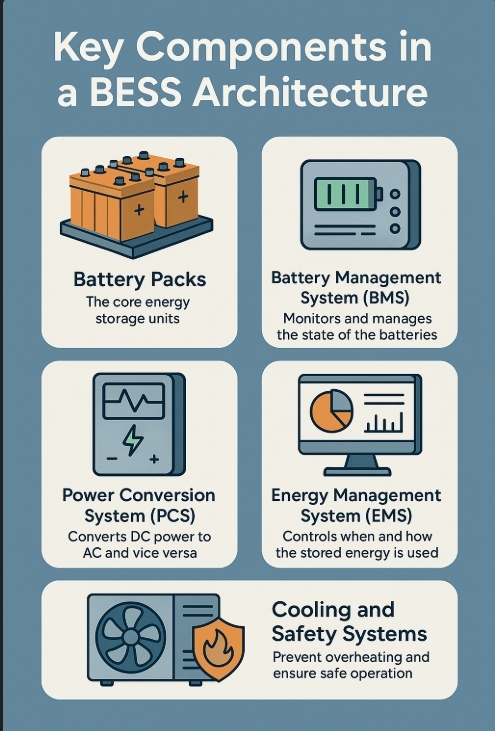
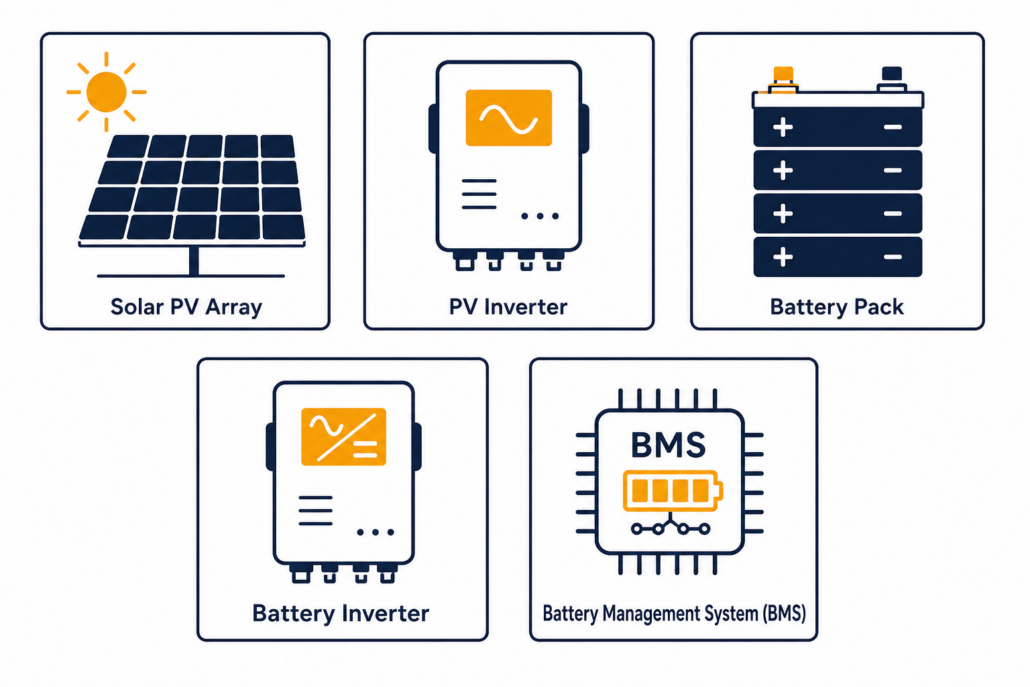
A typical BESS architecture includes:
Battery Packs: The core energy storage units.
Battery Management System (BMS): Monitors and manages the state of the batteries.
A modular architecture allows scaling up the system by adding standardized battery modules. This is common in containerized BESS solutions.
Advantages:
Easy scalability.
Simplified maintenance.
Disadvantages:
Initial setup can be more expensive.
4. Hybrid BESS Architecture
This combines features of both AC and DC coupling. It is ideal for complex systems requiring high flexibility.
Advantages:
Maximizes energy capture.
Adapts to different grid conditions.
Disadvantages:
More complex design and higher upfront costs.
How to Choose the Right BESS Architecture
When selecting a BESS architecture, consider:
Project Size: Small residential vs. large utility-scale.
Energy Goals: Backup power, peak shaving, grid services.
Budget: Upfront cost vs. long-term savings.
Scalability: Future expansion needs.
Consult with experienced energy consultants to ensure the architecture matches your project’s requirements.
What are the Benefits of a Good BESS Architecture?
A well-planned BESS architecture provides:
Higher Efficiency: Less energy lost during storage and conversion.
Better Reliability: Consistent performance over time.
Improved Safety: Lower risk of overheating or failure.
Cost Savings: Optimized use of energy reduces utility costs.
Questions About BESS Architectures
What is the difference between AC-coupled and DC-coupled BESS?
The main difference is where the battery connects to the system. AC-coupled uses a separate inverter, while DC-coupled shares an inverter with solar PV.
Can BESS be retrofitted into existing solar systems?
Modular BESS architectures are ideal for projects that need easy scalability and flexibility. However, they can have higher upfront costs.
Final Thoughts on BESS Architectures
Understanding Battery Energy Storage System architectures is key to building efficient, safe, and future-ready energy storage solutions. Whether you’re installing a residential system or a large grid-connected project, choosing the right BESS architecture can maximize your return on investment and help you get the most from your renewable energy.
Utility-scale Battery Energy Storage Systems (BESS) are becoming an essential part of today’s power grids. As we use more renewable energy like solar and wind, grid operators have to deal with issues such as fluctuating supply and sudden peaks in demand. Utility-scale BESS solves these problems by storing extra electricity when there’s plenty of it and releasing it when it’s needed most. This makes our power supply more stable, efficient, and reliable for everyone.
What is Utility-Scale BESS?
Utility-scale BESS refers to large-scale battery storage installations typically rated in megawatts (MW) or gigawatts (GW). Unlike residential or commercial storage systems, these projects serve the grid directly and can deliver energy for hours or even days, depending on system design.
Key characteristics:
Capacity ranges from tens of MW to several hundred MW.
Located near generation sites or substations.
Provide grid services like frequency response, voltage control, and peak shaving.
How Does a Utility-Scale BESS Work?
A utility-scale battery storage system typically consists of:
Battery modules: Usually lithium-ion, but other chemistries like flow batteries or sodium-sulfur are emerging.
Battery Management System (BMS): Monitors cell performance, state-of-charge, and safety.
PowerConversion System (PCS): Converts DC from batteries to AC for the grid and vice versa.
Energy Management System (EMS): Controls dispatch, optimization, and integration with other grid assets.
One of the primary benefits of utility-scale BESS is rapid response to frequency deviations. Unlike traditional peaker plants, batteries can react within milliseconds, maintaining grid balance.
2. Renewable Integration
Wind and solar are variable by nature. Utility-scale battery storage smooths out fluctuations, stores surplus during high production, and releases energy during lulls — helping achieve higher renewable penetration.
Large battery storage systems can support critical infrastructure during outages and help restart a power grid after a blackout — known as “black start.”
Types of Utility-Scale BESS Technologies
Technology
Features
Typical Use Cases
Lithium-Ion
High energy density, fast response
Frequency regulation, peak shaving
Flow Batteries
Long duration, scalable, deep cycling
Renewable firming, load shifting
Sodium-Sulfur
High temperature, long discharge duration
Base-load shifting, remote microgrids
Advanced Lead-Acid
Low cost, moderate performance
Short-term backup, frequency response
Challenges Facing Utility-Scale BESS
While utility-scale BESS brings immense benefits, some challenges remain:
High upfront capital costs: Though prices are falling, large installations require significant investment.
Supply chain constraints: Dependence on critical minerals like lithium and cobalt can affect availability and cost.
Degradation and lifespan: Batteries degrade over time, impacting performance and replacement cycles.
Regulatory and market barriers: In some regions, market structures don’t fully value storage services yet.
Recent Trends and Global Outlook
According to industry reports, global utility-scale BESS installations are expected to grow exponentially. Markets like the US, China, Australia, and Europe lead the way with supportive policies and ambitious renewable energy targets.
Key trends include:
Hybrid projects combining solar, wind, and storage.
Longer-duration storage technologies (8+ hours).
Second-life batteries and recycling solutions.
Grid services monetization through virtual power plants (VPPs).
Case Study: Notable Utility-Scale BESS Projects
Hornsdale Power Reserve (Australia): 150 MW/193.5 MWh — one of the world’s largest lithium-ion storage projects, providing frequency control and grid support.
Crimson Energy Storage (California, USA): 350 MW/1,400 MWh — supports California’s push for 100% clean energy.
UK National Grid Projects: Multiple installations delivering fast frequency response and capacity market services.
Environmental and Sustainability Considerations for Utility-Scale BESS
Raw Material Sourcing
Mining the raw materials inside a utility-scale BESS — lithium, nickel, and cobalt — carries documented ecological and social costs.
Responsible sourcing standards, including the EU’s due-diligence rules, help address some of these concerns. But the impact isn’t zero.
Manufacturers are shifting toward chemistries with fewer conflict minerals. Lithium iron phosphate, for example, skips cobalt entirely.
Many installations enter a second-life phase first. They power smaller applications like commercial backup or residential storage before final retirement.
This extends the useful life of the materials by several years. It also delays the need for new mining.
Recycling technology is maturing quickly. Modern recovery processes can now reclaim over 90% of the critical minerals inside a spent battery.
That recovered material then feeds back into new cell production. This cuts demand for freshly mined resources over time.
Several major recycling facilities have opened in the US, Europe, and China since 2023. Capacity is scaling to handle the coming wave of retirements from early grid-storage deployments.
Carbon, Land, and Water Impact
The lifecycle math still favors large-scale storage overall. A typical installation offsets far more carbon over its operating life than its manufacturing footprint requires.
Every megawatt-hour it delivers to the grid displaces power that would otherwise come from fossil-fuel peaker plants. Over a 15-20 year lifespan, that adds up to a significant net emissions benefit.
Land use is a smaller, but real, consideration too. These projects need less physical footprint than equivalent solar or wind farms delivering the same capacity.
Siting near existing substations or brownfield sites further reduces the land impact. Many developers now prioritize these locations to minimize new land disturbance.
Water use is minimal compared to other grid technologies. Battery systems need cooling, but nowhere near the volume required by thermal power plants.
That makes large-scale storage a strong fit for water-stressed regions expanding renewable capacity.
Safety and Community Impact
Fire and thermal-runaway risk also factor into the environmental conversation.
Modern battery chemistries and containment designs cut incident rates significantly. Standards like NFPA 855 push this further.
Community and noise impact matter too. Modern inverter and cooling equipment runs far quieter than early-generation hardware.
Most projects now include acoustic buffers and setback distances from residential areas. This keeps neighboring communities largely unaffected by day-to-day operation.
Regulatory Outlook
Regulators are formalizing end-of-life requirements for utility-scale BESS too. The EU’s Batteries Regulation sets clear recycling targets.
Cobalt and nickel must hit 90% recovery by 2027, rising to 95% by 2031. Expect similar rules to spread as installed capacity grows worldwide.
Taken together, these factors paint a nuanced picture. Large-scale storage isn’t environmentally free.
But its net contribution to decarbonizing the grid still outweighs the footprint by a wide margin.
Future of Utility-Scale BESS: What’s Next?
As we aim for net-zero goals, the role of utility-scale BESS will only expand. The focus will shift toward:
Integrating with renewable mega-projects.
Supporting decarbonization of hard-to-abate sectors.
Enabling community energy storage and distributed resources.
Policy support, continued cost reductions, and technological breakthroughs will be crucial to unlocking the full potential of grid-scale energy storage.
Final Thoughts
Utility-scale BESS is more than just a technological solution — it’s the backbone of a flexible, reliable, and low-carbon energy future. By bridging the gap between intermittent renewables and constant demand, these systems are paving the way for a resilient grid that works for everyone.
FAQs about Utility-Scale BESS
Q1: How long can a utility-scale BESS supply power?
Depending on the system’s energy capacity, it can range from minutes (for frequency response) to multiple hours (for peak shaving or load shifting).
Q2: Is lithium-ion the only option for utility-scale BESS?
No, while lithium-ion dominates the market today, flow batteries, sodium-sulfur, and other chemistries are gaining traction for longer-duration applications.
Q3: How is utility-scale BESS different from residential storage?
Utility-scale systems are grid assets providing large-scale services, while residential storage focuses on individual homes’ energy needs.
Q4: What’s the biggest challenge for utility-scale BESS?
High upfront costs and market barriers to monetizing all available services remain significant challenges.
Q5: How does utility-scale BESS support grid stability and frequency regulation?
Utility-scale BESS supports grid stability by detecting frequency deviations and responding within milliseconds, far faster than traditional peaker plants. The system injects or absorbs power almost instantly to keep grid frequency within a narrow target range, preventing outages and helping operators integrate more variable renewable generation without compromising reliability.
Q6: What is a utility-scale battery energy storage system and how does it work?
A utility-scale battery energy storage system is a large battery installation, typically rated in tens to hundreds of MW, that stores electricity from the grid or renewable sources and discharges it when needed. It charges during periods of excess supply and low demand, then releases stored power during peak demand or supply shortfalls.
Q7: What are the main components of a utility-scale BESS?
A utility-scale BESS has four main components: battery modules that store energy, a Battery Management System (BMS) that monitors cell health and safety, a Power Conversion System (PCS) that converts between DC and AC, and an Energy Management System (EMS) that controls dispatch and grid integration.
When it comes to switching to clean energy, solar power is often surrounded by myths and misconceptions. These myths can prevent homeowners and businesses from making smart, eco-friendly decisions. Today, we’re setting the record straight by debunking the top 10 myths about solar energy.
Myth 1: Solar Panels Don’t Work on Cloudy Days
Truth: Modern solar panels are more efficient than ever. While production does drop on cloudy days, panels still generate electricity thanks to diffuse sunlight. Germany, which gets less sunlight than many countries, is a global leader in solar energy adoption.
Myth 2: Solar Energy is Too Expensive
Truth: The cost of solar panels has dropped over 80% in the last decade. With government incentives, tax credits, and financing options, going solar is more affordable than you think — and the long-term savings on your energy bills can be substantial.
Myth 3: Solar Panels Require Constant Maintenance
Truth: Solar panels are designed to withstand the elements. They require minimal maintenance — just occasional cleaning and a professional check-up every few years to ensure optimal performance.
Myth 4: Solar Panels Will Damage My Roof
Truth: When installed by certified professionals, solar panels can actually protect your roof from the elements and extend its lifespan. Installers use mounting systems that do not compromise the structural integrity of your roof.
Myth 5: Solar Energy Can’t Power a Home at Night
Truth: It’s true that solar panels don’t produce energy at night, but battery storage solutions and net metering programs allow you to store or draw energy when the sun isn’t shining. Many households run smoothly on solar day and night.
Myth 6: Solar Panels Don’t Work in Cold Climates
Truth: Solar panels actually perform better in cooler temperatures. Snow can even help by reflecting more sunlight onto panels. Many cold-climate regions, like parts of Canada and the Northern US, benefit greatly from solar.
Myth 7: Solar Will Make My Home Look Ugly
Truth: Solar technology and aesthetics have come a long way. Sleek, low-profile panels and integrated solar shingles are designed to blend with your roof, adding a modern touch that many homeowners find attractive.
Myth 8: Solar Panels Decrease Property Value
Truth: Multiple studies show that solar panels can actually increase property value. Homebuyers appreciate lower utility bills and energy independence, making solar-equipped homes more attractive in the real estate market.
Myth 9: I Won’t Live in My Home Long Enough to See Savings
Truth: Many homeowners recoup their investment in solar within 5–8 years, and homes with solar often sell faster and at higher prices. Even if you move, you could see a return on your solar investment.
Myth 10: Solar Energy Alone Can’t Make a Difference
Truth: Every solar installation reduces reliance on fossil fuels, cuts carbon emissions, and contributes to a more sustainable future. Millions of small actions add up — and solar energy is a crucial part of the global clean energy transition.
Frequently Asked Questions (FAQs) About Solar Energy Myths
✅ Do solar panels work during a power outage?
Most standard grid-tied solar systems shut down during a power outage to protect utility workers. However, if you have a battery backup or an off-grid system, you can still use your solar power when the grid goes down.
✅ Is it true that solar panels lose efficiency over time?
✅ Are solar incentives and tax credits still available?
Yes! Many countries, states, and local governments offer tax credits, rebates, or net metering programs to make solar more affordable. Always check current local incentives when planning your installation.
✅ How do I know if my roof is suitable for solar panels?
A solar professional can assess your roof’s age, orientation, shading, and structure. Ideally, a roof should face south (in the northern hemisphere) with minimal shading for maximum efficiency.
✅ Is solar energy really environmentally friendly?
Absolutely. Solar energy produces zero emissions during operation, significantly reduces your carbon footprint, and requires minimal resources compared to fossil fuels.
Final Thoughts
Don’t let outdated myths about solar energy hold you back. With modern technology, favorable incentives, and proven benefits, there’s never been a better time to switch to solar. Have more questions? Reach out to a trusted solar professional and see how clean, affordable energy can work for you.
The pros and cons of solar energy matter more than ever. Panel prices keep falling, and utility rates keep climbing. This guide breaks down the real benefits and drawbacks of solar power in plain terms. Once you understand the pros and cons of solar energy, you can decide with confidence whether it fits your home.
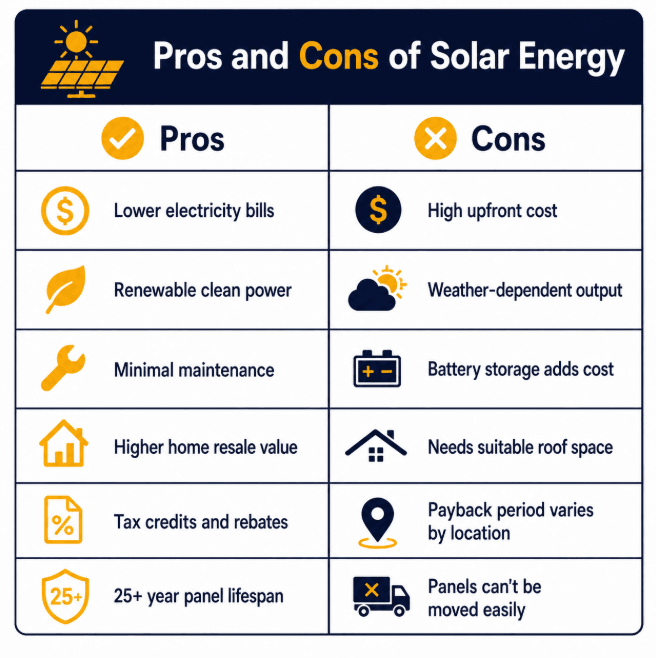
QUICK ANSWER Solar energy’s biggest pros are lower electricity bills, minimal maintenance, and a smaller carbon footprint. Its main cons are the high upfront cost, weather-dependent output, and extra expense for battery storage. Most homeowners still come out ahead over a system’s 25-year lifespan, even after the initial investment.
Pros and Cons of Solar Energy at a Glance
Here’s a quick side-by-side view of the pros and cons of solar energy before we get into the details. Scan the table below to see the trade-offs in seconds.
Pros
Cons
Lower electricity bills
High upfront cost
Renewable, clean power
Weather-dependent output
Minimal maintenance
Battery storage adds cost
Higher home resale value
Needs suitable roof space
Tax credits and rebates
Payback period varies by location
25+ year panel lifespan
Panels can’t be moved easily
Now let’s look at each point in more detail, starting with the upside.
Pros and Cons of Solar Energy: The Advantages
Solar power offers real, measurable benefits for most homeowners. Here are the five advantages that matter most.
Lower Electricity Bills
Solar is a proven way to cut your monthly power costs. Depending on your system size and local rates, you could save thousands of dollars over the system’s life.
Many utilities also offer net metering, so surplus power you send back to the grid earns you a bill credit. Over 20 to 25 years, that credit adds up to a meaningful chunk of savings.
Renewable and Clean Energy
Solar panels convert sunlight into power without burning fuel. The sun delivers more energy in one hour than the world uses in an entire year.
Unlike coal or gas plants, solar panels produce no emissions once they’re installed and running. That makes solar one of the cleanest ways to power a home.
Minimal Maintenance Once Installed
Most solar panels are built to last 25 years or longer. They need very little upkeep beyond occasional cleaning and a yearly inspection to keep the system operating efficiently.
Once your system is installed, it largely takes care of itself. Compare that to a furnace or water heater, which both need regular servicing.
Higher Home Resale Value
Homes with solar panels tend to attract more buyers in most markets. Many sellers recover part of their installation cost through a higher sale price.
Buyers increasingly see solar as a built-in utility discount rather than an extra expense. That perception alone can speed up a sale.
Government Incentives and Tax Credits
Many governments still offer credits, rebates, or grants for home solar installs, according to the U.S. Department of Energy’s Homeowner’s Guide to Going Solar.
These programs can shrink your upfront cost significantly and shorten your payback period. You can calculate your own return on investment before you budget for a system, since availability and value change often.
Pros and Cons of Solar Energy: The Drawbacks
Solar isn’t free of trade-offs, and it’s worth knowing them upfront. Here are the five drawbacks that matter most.
High Upfront Cost
A full system, including panels, inverter, and installation, can still cost thousands of dollars. Prices have dropped sharply over the past decade. Your exact output depends on your local peak sun hours, which can run from under 3 hours a day in winter to over 6 in sunnier regions.
Even so, the initial outlay remains the single biggest barrier for most households. Financing and incentives can soften this, though they don’t erase it.
Weather and Location Dependence
Solar panels need sunlight to generate power. Output drops on cloudy days, during rainy seasons, or in far-northern locations with short winter daylight.
You’ll likely still draw some power from the grid during these low-sun stretches. A well-sized system accounts for this seasonal swing from the start.
Battery Storage Adds Cost
Batteries let you store daytime power for use at night or during outages. But they add real cost to a system.
They also typically need replacing after several thousand charge cycles. Weigh this cost against how you’d size a home battery for your actual backup needs before adding one.
Roof and Space Requirements
Not every roof suits solar. Shading, a steep pitch, or an awkward angle can all cut into a system’s output.
Some homes may need ground-mounted panels instead, which adds cost and requires open land. Checking your roof’s solar panel tilt angle before you buy will catch these issues early.
Pros and Cons of Solar Energy: Payback Period Varies by Location
Your break-even point depends heavily on local electricity rates and available incentives. In areas with cheap grid power, payback can stretch well past a decade.
In high-rate regions, it can happen in under six years. This variation is a core part of any solar decision for a specific address.
Pros and Cons of Solar Energy: Is It Worth It for Your Home?
The pros and cons of solar energy depend on your roof, your rates, and your timeline, not on generic averages. Solar tends to pay off fastest for homeowners with high electricity bills, a sun-facing roof, and plans to stay put for at least ten years.
It’s a weaker fit if your roof is heavily shaded, your local rates are already low, or you plan to move soon. A quick roof assessment and a local rate comparison will tell you most of what you need to know before you commit.
Pros and Cons of Solar Energy: Questions to Ask Before You Install
Ask these four questions before you sign a contract.
First, is your roof’s angle and sun exposure strong enough for good output?
Second, how many years do you plan to stay in the home?
Third, what local rebates or net metering programs apply to you?
Yes. Most homeowners save money over time, though the exact amount depends on system size, local rates, and available incentives.
What is the biggest disadvantage of solar energy?
For most homeowners, it’s the high upfront cost. A full system can run into the thousands, even though incentives and falling panel prices have narrowed that gap in recent years.
How long does it take to break even on solar panels?
Most systems break even in six to ten years, depending on installation costs, local incentives, and how much power your household uses.
Can I run my home on solar power alone?
With enough panels and battery storage, yes. Most homes still stay connected to the grid for backup during extended low-sun periods.
Is solar energy worth it in 2026?
For most homeowners with a sun-facing roof and average or above-average electricity bills, yes. Falling equipment costs and continued incentives have shortened payback periods across most regions this year.
Key Takeaway: Weighing the Pros and Cons of Solar Energy
Knowing the real pros and cons of solar energy helps you make a confident, informed choice. Solar rewards homeowners who plan around its upfront cost and weather dependence with decades of lower bills and a smaller footprint.
Weigh your roof, your rates, and your timeline first, and the right decision becomes obvious.
Ever wondered what Energy Storage PCS actually does? In this post, we’ll break down how it works and where it’s used in real-world energy storage systems.
What is PCS in Energy Storage?
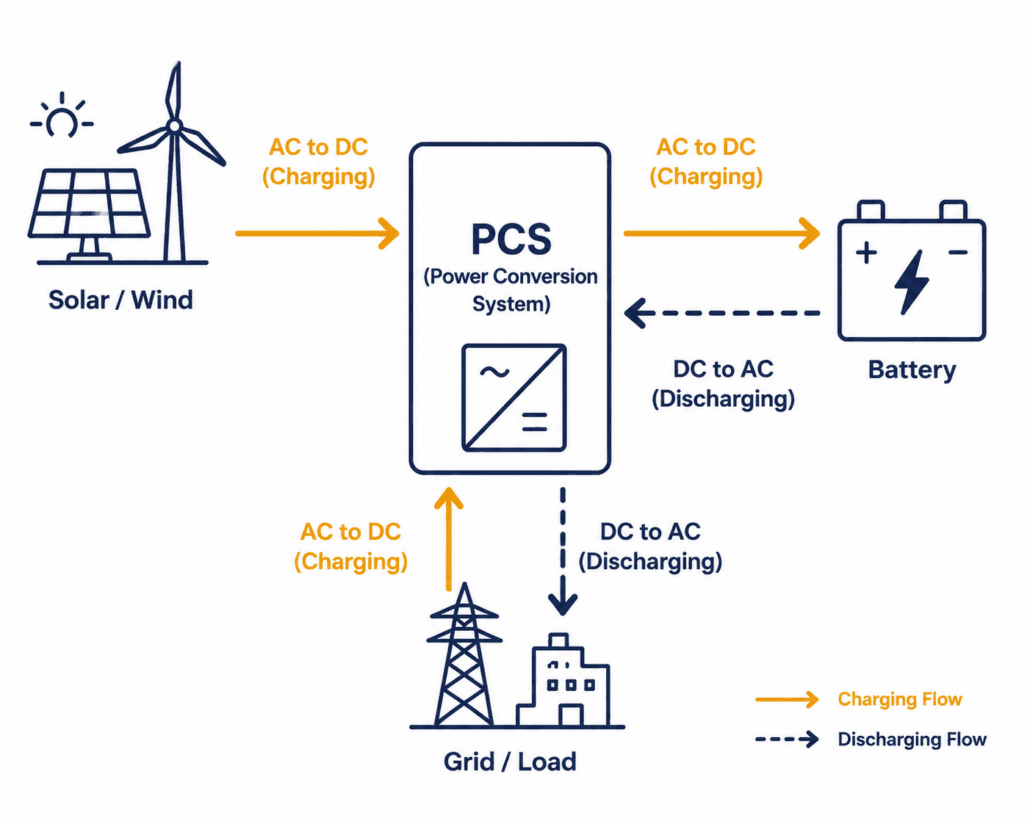
PCS stands for Power Conversion System. It is an essential device in energy storage systems that converts electricity between alternating current (AC) and direct current (DC). It allows batteries to store energy from the grid or renewable sources and then release it back as usable AC power when needed.
In short, PCS is the bridge between your batteries and the electrical grid—managing energy flow, ensuring safety, and improving overall efficiency.
What is Energy Storage PCS and Why It Matters?
Energy storage PCS (Power Conversion System) is the heart of any Battery Energy Storage System (BESS). It is responsible for managing the conversion between AC and DC power, enabling batteries to store energy and deliver it back to the grid when needed. Without a PCS, your energy storage solution is like a car without an engine.
The PCS helps to regulate the flow of electricity, balance energy loads, and ensure maximum efficiency and safety of your battery system. Whether for solar, wind, or hybrid power systems,energy storage PCS plays a vital role in stabilizing renewable energy.
How Energy Storage PCS Works
The PCS acts as a two-way converter. When the energy is generated by solar panels or wind turbines (AC power), the PCS converts it into DC to charge the batteries. When the energy is needed (like during peak hours), it converts the stored DC power back into AC to feed into the grid or power your home or facility.
In simpler terms:
AC to DC conversion for charging the battery.
DC to AC conversion for discharging to the grid or loads.
It also works with smart controllers and EMS (Energy Management Systems) to provide grid-support functions, frequency regulation, peak shaving, and energy arbitrage.
1. Low-Voltage PCS (LV PCS) Used in small-scale or residential BESS. Operates below 1,000V.
2. Medium-Voltage PCS (MV PCS) Used in commercial and industrial systems. Operates between 1,000V to 35kV.
3. High-Voltage PCS (HV PCS) Used in utility-scale and grid-level projects. Supports large containers and centralized ESS plants.
4. Bi-directional PCS This is the most advanced type. It can both charge and discharge efficiently, supporting dynamic grid functions.
Each type serves a unique purpose, and selecting the right PCS depends on your project size, energy goals, and budget.
PCS vs. Inverter: Are They the Same Thing?
People often use “PCS” and “inverter” interchangeably, but a PCS is the broader system. Every PCS contains an inverter, but a PCS also handles charge/discharge control, grid synchronization, protection functions, and often bidirectional power flow — jobs a standalone inverter doesn’t do on its own.
Most modern PCS units are built around a bidirectional inverter core — one that converts power in both directions, DC to AC during discharge and AC to DC during charging, rather than needing separate hardware for each direction.
PCS Architecture: AC-Coupled vs. DC-Coupled Systems
How many PCS units a project needs, and how they’re configured, depends heavily on whether the system is AC-coupled or DC-coupled. AC-coupled systems use a separate battery inverter alongside the solar inverter; DC-coupled systems share one PCS across both PV and battery on the same DC bus.
A PCS can operate in one of two modes. Grid-following units synchronize to an existing grid signal and can’t operate without one. Grid-forming units establish their own voltage and frequency reference, which is what makes off-grid and islanded operation possible.
These reactive power control, voltage ride-through, and frequency response functions are documented in NREL’s research on advanced inverter functions, funded by the U.S. Department of Energy, which explains how grid-support-capable inverters and PCS units help maintain grid stability as more distributed solar and storage comes online.
Grid-forming PCS capability becomes essential once a project needs to operate independently of the utility grid, whether that’s a resilience-focused microgrid or a fully islanded system. Sizing and configuring the PCS correctly for these applications looks different from a standard grid-tied project.
Voltage & Frequency Control: Ensures clean, stable, and reliable electricity output.
Safety & Protection: Prevents overcurrent, overvoltage, and system failures.
Efficiency Optimization: Boosts round-trip efficiency and reduces energy losses.
Smart Control: Works with EMS and BMS to manage operations in real time.
Without a reliable PCS, your BESS will struggle to perform efficiently or safely.
Common Applications of Energy Storage PCS
PCS isn’t just for big power plants. You can find them in:
Home and C&I energy storage systems
Solar plus storage solutions
Microgrids and off-grid systems
EV charging stations
Grid stabilization and frequency regulation projects
Peak shaving and demand charge reduction
Whether you’re a homeowner trying to store solar energy or a utility trying to manage grid fluctuations, energy storage PCS is the backbone of your system.
Choosing the Right PCS for Your BESS
Here are a few questions to ask before choosing a PCS:
Q: What voltage and power level does my application need?
A: Match the PCS to your battery bank’s voltage and your energy load.
Q: Is it compatible with my battery chemistry (LFP, NMC, etc.)?
A: Yes. Always confirm with your supplier or integrator.
Q: Does it offer bidirectional operation?
A: For advanced systems, bidirectional PCS is a must.
Q: What kind of grid functions does it support?
A: Look for reactive power control, frequency response, black start, and islanding support.
Q: How efficient is the PCS?
A: A good PCS will offer 96%–98% round-trip efficiency.
Q: What is a PCS in a BESS?
A: A PCS, or Power Conversion System, is the equipment that converts DC power from the battery to AC power for the grid or loads, and back again during charging. It’s the central control point that manages how energy moves into and out of a battery energy storage system.
Q: Is a PCS the same as an inverter?
A: A PCS includes an inverter but does more than one. Inverters convert DC to AC; a PCS also manages charge/discharge control, grid synchronization, and protection functions, often across bidirectional power flow. See our full breakdown in PCS vs. Inverter: What’s the Difference in an ESS?.
Q: What’s the difference between PCS in AC-coupled and DC-coupled BESS?
A: In AC-coupled systems, the PCS is a standalone battery inverter working independently of the solar inverter. In DC-coupled systems, the PCS is a shared hybrid inverter that manages power from both PV and battery through a single conversion point. See our full comparison in AC-Coupled vs. DC-Coupled BESS: Which Architecture Is Right for Your Project?.
Q: What certifications does a PCS need?
A: Requirements vary by region and grid operator, typically including UL 1741 and IEEE 1547 in the U.S., IEC 62109 and VDE-AR-N standards in the EU, and additional grid codes depending on the interconnection point. See our full breakdown in Worldwide PCS Certification Guide.
Q: Can a PCS operate in grid-forming mode?
A: Yes, depending on its design. Grid-forming PCS units can establish voltage and frequency independently, which is essential for microgrid and island-mode operation. Grid-following units instead synchronize to an existing grid signal. See our full comparison in Grid-Forming vs. Grid-Following BESS.
Top Features to Look for in Energy Storage PCS
If you’re sourcing or integrating a PCS, here are some must-have features:
Modular design for easy expansion
IP54 or higher protection level for outdoor installations
Liquid or forced air cooling for heat management
LCD/Touchscreen display for monitoring
Remote control and IoT connectivity
CE, UL 1741, IEC 62109, and IEEE 1547 grid code certifications
Certification requirements vary significantly by region and grid operator. See our worldwide guide to PCS certification standards for a full breakdown of what’s required in your market.
PCS + EMS integration: Full-stack energy management solutions
These innovations make energy storage more accessible, efficient, and intelligent.
Conclusion: Energy Storage PCS Is the Unsung Hero of Clean Energy
In today’s energy transition journey, energy storage PCS is more important than ever. It acts as a bridge between renewable power and the grid, ensuring smooth, efficient, and safe operations. Whether you are building a small home system or a 100MW utility project, choosing the right PCS will make or break your success.
So, next time you think about a battery storage system, remember—your energy is only as smart as your PCS.
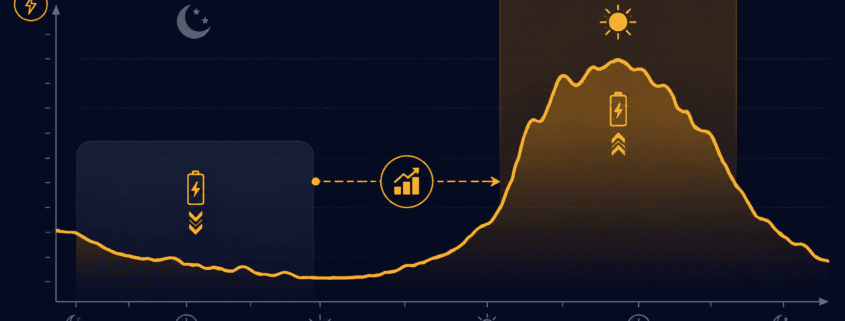
Energy arbitrage is the simplest revenue strategy in battery storage. A battery charges when electricity is cheap. Then, it discharges when electricity is expensive. The gap between those two prices is the spread. Capturing that spread is the entire strategy.
However, the full spread is never pure profit. Efficiency losses shrink it. Battery wear shrinks it further. This guide walks through how the strategy actually earns money, which costs cut into that revenue, and how to calculate the spread a project truly needs. For how this fits alongside other revenue streams, see our C&I BESS economics guide and our peak shaving vs. load shifting comparison.
How the Strategy Works
The pattern repeats daily. First, prices drop overnight, when demand is low. A battery charges during these cheap hours. Then, prices climb during the day. They often peak on hot afternoons, when air conditioning load surges. As a result, the battery discharges during these expensive hours, selling stored energy back at the higher rate.
Market structure shapes how much a project can actually earn. Deregulated markets tend to see more price swings, and those swings are what create opportunity in the first place. Grid congestion adds a second layer of upside. When transmission lines hit their limits, prices can vary sharply by location. So, a battery placed in the right zone can capture that gap too, on top of the daily time-based one.
Three Hidden Costs That Cut Into Your Margin
A visible price gap doesn’t automatically mean a profitable trade. Three factors quietly shrink that spread before it becomes real revenue.
Round-trip efficienc:. No battery returns 100% of the electricity it stores. Lithium-ion systems typically land in the 83–92% range, depending on chemistry, C-rate, and cooling. In other words, 10 kWh charged in might only return 8.5–9.2 kWh usable. Because of this, the sell price has to clear the buy price by more than the visible gap suggests — not just match it.
Battery degradation: Each cycle wears the battery down a little. In fact, one widely cited analysis of MISO market data found that degradation cut arbitrage revenue by roughly 12–46%, depending on the model used. This is easy to overlook, since it’s tempting to model efficiency losses and stop there.
Market fees and upkeep: Wholesale trading usually carries transaction fees. Meanwhile, the storage system itself needs ongoing maintenance. Both come out of the spread before any of it reaches the bottom line.
Put together, these three costs mean the sticker-price spread overstates the real opportunity. So, a strategy needs enough room to absorb all three and still turn a profit.
Calculating the Spread You Actually Need
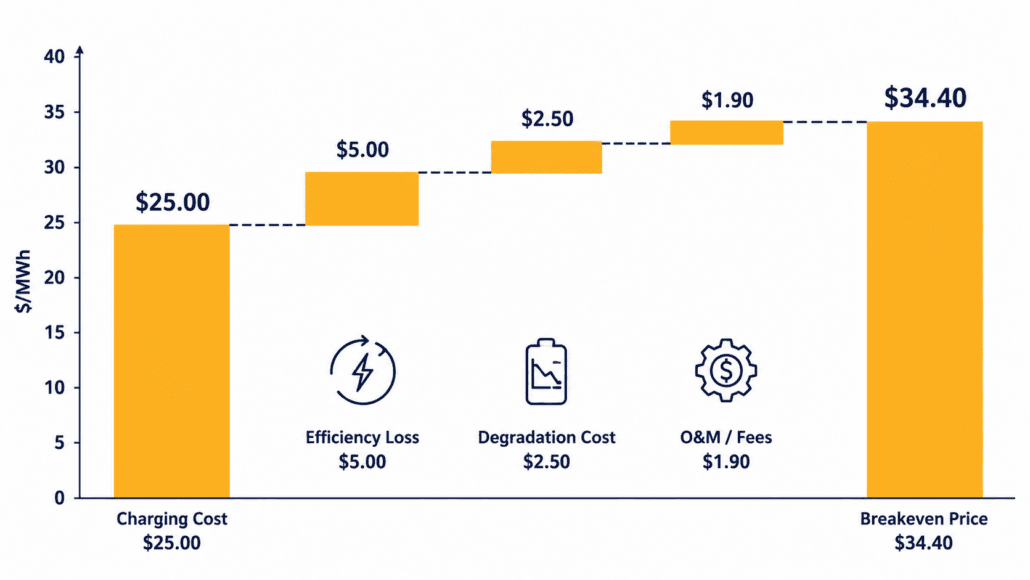
Think of this as your breakeven point — the minimum price gap before the strategy is worth pursuing. Here’s the formula:
Here’s how that plays out in a simple, illustrative example:
Metric
Value
Off-peak charging cost
$25/MWh
Round-trip efficiency
88%
Effective charging cost
$25 ÷ 0.88 = $28.40/MWh
Degradation cost per cycle (illustrative)
$4/MWh
O&M and market fee allocation (illustrative)
$2/MWh
Breakeven discharge price
$28.40 + $4 + $2 = $34.40/MWh
In this example, the battery needs to sell above $34.40/MWh just to break even. That’s well above the $25/MWh most people assume is the real bar. Anything captured beyond that line becomes genuine margin. This is exactly why a headline spread can look attractive on paper, yet still produce thin or negative returns in practice.
What Actually Moves the Market
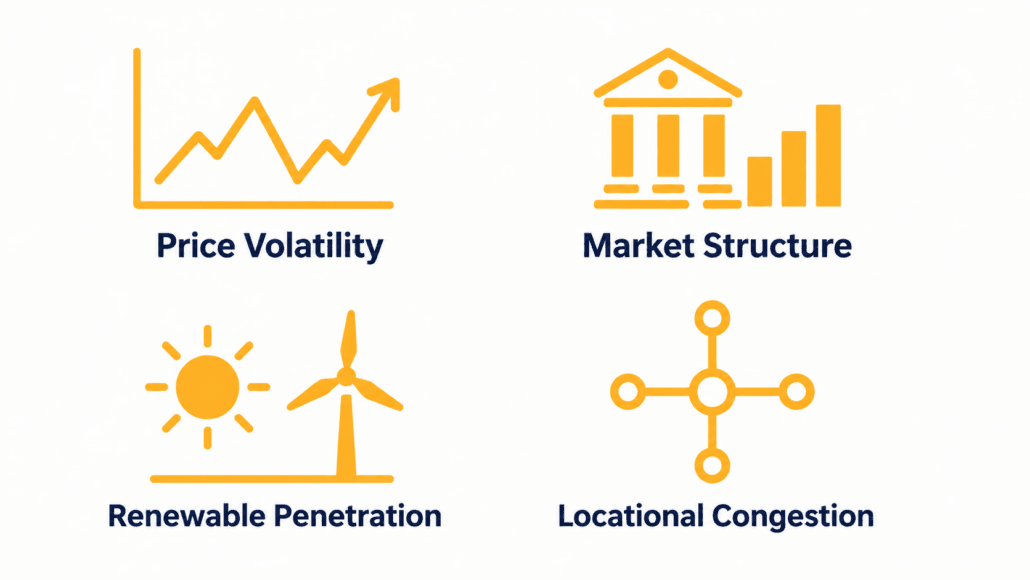
Price volatility: The wider and more frequent the daily swings, the more spread there is to capture. Flat, low-volatility tariffs, on the other hand, produce little to no opportunity.
Market structure: Deregulated wholesale markets generally offer more trading opportunity than fixed-tariff regulated ones.
Renewable penetration: Heavy solar and wind generation can trigger fast, large price swings — sometimes even negative prices during oversupply — which widens the gap available to a well-positioned battery.
Locational congestion: Grid bottlenecks create price differences between zones. Therefore, batteries sited near congestion points can capture that gap too, in addition to the daily one.
Analysts commonly benchmark this opportunity using “top-bottom” (TB) spreads — the gap between a market’s highest- and lowest-priced hours — as a standard way to compare potential across regions and durations. For broader market cost trends, the EIA’s battery storage market analysis is a useful reference point.
Why Most Projects Don’t Rely on This Alone
In practice, few BESS projects lean on a single revenue stream. Instead, layering in demand charge reduction, frequency regulation, or capacity payments spreads risk across multiple sources. As a result, this generally improves overall project economics compared to going it alone. See our peak shaving savings breakdown for how demand charge reduction stacks alongside this strategy, or our BESS cost per kWh and LCOS guide for the full project economics picture.
Merchant projects — ones relying entirely on wholesale price spreads with no fixed contract — carry real risk. Revenue depends on spreads that can shrink if market conditions or rules change. Contracted revenue, or a blended approach, generally reduces that exposure.
Energy Arbitrage Frequently Asked Questions
What is energy arbitrage in battery storage?
Energy arbitrage is the practice of charging a battery when electricity prices are low and discharging it when prices are high, capturing the price difference as revenue.
How much does round-trip efficiency affect energy arbitrage revenue?
Lithium-ion systems typically operate at 83–92% round-trip efficiency. That lost 8–17% means the discharge price must clear the charging cost by more than the visible spread suggests, not just match it.
Does battery degradation really cut into arbitrage profits?
Yes, substantially. Research using historical MISO market data found degradation reduced arbitrage revenue by roughly 12–46%, depending on the degradation model used. It’s one of the most commonly underestimated costs in arbitrage economics.
Is energy arbitrage alone enough to justify a BESS project?
Rarely as a standalone strategy. Most successful projects stack energy arbitrage with demand charge reduction, frequency regulation, or capacity payments to diversify revenue and improve overall project economics.
Next Steps
Ready to model your own numbers? Start with your local wholesale or time-of-use price spread. Then, apply the breakeven formula above, and compare it against your battery’s round-trip efficiency and degradation curve. For the full system cost picture, see our BESS cost per kWh and LCOS guide, or explore how this strategy stacks with other revenue streams in our C&I BESS economics guide.
In this guide, we will explain everything in a simple and easy-to-understand way.
🔍 What Are TOPCon Solar Cells?
TOPCon stands for Tunnel Oxide Passivated Contact. It is a new type of solar cell that increases power generation by reducing energy loss.
These solar cells use a special design that helps move electricity more smoothly. This means you get more energy from the same amount of sunlight.
Unlike older types of cells, TOPCon solar cells use n-type silicon, which does not degrade as fast and works better in all weather conditions.
🧱 How TOPCon Solar Cells Are Built
Here’s how the structure of a TOPCon solar cell looks:
Layer
Function
N-type Silicon Wafer
Main base of the cell, long-lasting
Tunnel Oxide Layer
Ultra-thin layer to stop energy loss
Polycrystalline Silicon Layer
Helps carry electricity smoothly
Anti-Reflective Coating
Catches more sunlight
Metal Contacts
Transfers electricity to the system
Thanks to this advanced structure, TOPCon solar cells can deliver better results than regular monocrystalline or PERC cells.
⚙️ How Do TOPCon Solar Cells Work?
Solar cells work by changing sunlight into electricity. But some of that energy gets lost along the way.
TOPCon cells solve this problem by using a very thin oxide layer and a special contact layer. This combo helps electrons move faster without getting lost.
Here’s a simple explanation:
Sunlight hits the cell.
Electrons are created.
These electrons move through the tunnel oxide.
The special contact layer helps collect them.
Electricity is sent to your home or battery.
Because there’s less waste, TOPCon solar cells are more efficient.
📈 Efficiency of TOPCon Solar Cells
One of the biggest reasons people are excited about TOPCon technology is its high efficiency.
TOPCon panels can reach 22% to 23.5% efficiency.
Standard panels like polycrystalline reach only 15%–17%.
Monocrystalline and PERC usually reach 18%–21%.
That means with TOPCon, you get more power using the same space.
🔄 TOPCon vs PERC vs Other Solar Cells
Let’s look at how TOPCon solar cells compare to other common technologies:
Feature
Polycrystalline
Monocrystalline
PERC
TOPCon
Silicon Type
P-type
P-type
P-type
N-type
Efficiency Range
15%–17%
18%–20%
20%–21.5%
22%–23.5%
Degradation Rate
Higher
Medium
Medium
Very Low
Low-Light Performance
Poor
Average
Good
Excellent
Cost
Low
Medium
Medium
Slightly High
Lifespan
20–25 years
25–30 years
25–30 years
30+ years
As you can see, TOPCon solar cells are one of the best in almost every category.
✅ Key Benefits of TOPCon Solar Cells
Here are the top reasons why more people are choosing TOPCon technology:
1. Higher Energy Output
TOPCon cells are more efficient. You get more power per panel.
2. Better in Cloudy or Low-Light Conditions
Because of the n-type silicon and advanced design, TOPCon works even when sunlight is not strong.
3. Longer Life and Better Stability
These panels degrade very slowly. That means they keep performing well for more years.
4. Lower Temperature Loss
In hot weather, normal panels lose efficiency. TOPCon handles heat better, so you don’t lose as much energy.
5. Bifacial Ready
Many TOPCon panels are bifacial, which means they generate electricity from both the front and the back side. That adds even more power!
❌ Are There Any Drawbacks?
Even though TOPCon is amazing, it’s not perfect.
Here are some minor drawbacks:
Slightly Higher Price – Because of the advanced structure, TOPCon costs more than regular panels.
Newer Technology – Not all installers are familiar with it yet.
More Precise Manufacturing Needed – It takes better equipment and control to make these cells.
Still, for the performance you get, many believe it’s worth the extra investment.
🌍 Where Can TOPCon Be Used?
TOPCon solar cells are perfect for:
Rooftop solar systems (homes and businesses)
Solar farms and utility-scale projects
Projects where space is limited but high output is needed
Areas with high temperatures or frequent cloudy weather
If you’re planning a long-term project and want high return, TOPCon is a great choice.
🏭 Who Makes TOPCon Panels?
Several major companies have already launched TOPCon-based solar panels:
These manufacturers are expanding their production lines, and prices are slowly becoming more affordable.
🧠 Frequently Asked Questions
🔹 Is TOPCon better than PERC?
Yes, in most ways. It offers more efficiency, better performance in heat and shade, and longer life.
🔹 Does TOPCon cost more?
A little, yes. But the extra power and longer lifespan can make up for that cost over time.
🔹 Is TOPCon good for home solar?
Absolutely! Especially if your roof space is limited and you want to get the most energy per panel.
🚀 Final Thoughts: Is TOPCon the Right Choice for You?
If you care about performance, future value, and reliability, then TOPCon solar cells are a smart pick.
They give you:
More energy
Less loss
Longer life
Better value over time
Yes, the initial price is slightly higher—but the long-term gain is much greater.
TOPCon is not just a technical upgrade—it’s a smarter solar decision.
🔧 Need Help Choosing the Right Solar Panels?
As a sourcing and procurement consultant in the new energy field, I help clients select the best-fit solar technology for their project’s location, budget, and performance needs.
Sunlith: Every great idea starts with a question. When we started this journey, ours was simple: “How can we help the world move toward clean, reliable, and smart energy?”
That question led to a name: SunLith. Two short syllables—but packed with deep meaning, bold purpose, and big dreams.
🔋 What Does SunLith Mean?
It’s simple:
Sun – The most powerful, natural, and endless source of energy known to us.
Lith – Short for Lithium, the core material in modern battery technology.
Together, SunLith means blending the power of nature with the brilliance of human innovation.
It’s not just a name. It’s a vision of a world where energy is clean, storage is smart, and the future is bright.
💡 Why the Name Matters
We didn’t want a generic name. We wanted something real. Something that speaks to who we are, what we do, and why it matters.
SunLith reminds us every day:
To stay connected to the Earth and its natural power.
To stay committed to clean technology and better battery systems.
To stay focused on building a sustainable world for the next generation.
If you care about a greener, smarter, and more stable energy future, then the name SunLith belongs to you too.
Frequently Asked Questions (FAQs)
Q1: What does the name “SunLith” mean?
A:SunLith is a combination of “Sun”, representing natural solar energy, and “Lith”, derived from lithium, the element at the heart of modern energy storage. It reflects our mission to merge sustainable energy generation with advanced battery technology.
Q2: Is SunLith only focused on solar energy solutions?
A: Not at all. While solar power inspires our name, SunLith provides a full range of energy solutions—including EV batteries, energy storage systems (ESS), lithium-based power packs, and hybrid microgrids for home, commercial, and industrial use.
Q3: What makes SunLith different from other energy companies?
A: SunLith stands out because we combine cutting-edge lithium technology with a strong commitment to sustainability. We offer customized, smart, and reliable energy systems that go beyond the ordinary—built to perform, last, and protect the environment.
Q4: Does SunLith manufacture its own cells?
A: SunLith partners with top-tier certified manufacturers and performs rigorous quality checks, factory audits, and FAT/QC inspections to ensure every product we deliver meets international standards and client expectations.
Q5: Who are SunLith’s typical clients?
A: We serve B2B clients in the new energy sector, including project developers, EPC contractors, system integrators, and distributors who need energy storage solutions for EV, home, C&I, and utility-scale applications.
Q6: Where is SunLith based?
A: SunLith operates out of Shenzhen, China, with strong ties to leading Chinese battery manufacturers and global markets. We also work closely with clients in India, Southeast Asia, the Middle East, and Europe.
Q7: What is SunLith’s long-term vision?
A: Our vision is to create a cleaner, smarter energy future—where renewable sources are efficiently stored and distributed using intelligent, scalable systems. We aim to be a trusted global name in energy storage solutions.
Q8: Can SunLith help with sourcing and procurement?
A: Yes! SunLith doesn’t just sell products—we act as your buying agent, helping with sourcing, supplier verification, price negotiation, logistics coordination, and end-to-end project support for energy solutions.
Q9: How does SunLith ensure product quality and compliance?
A: We conduct detailed factory audits, verify certifications and test reports, and ensure each system complies with international standards like UN38.3, IEC62619, CE, UL, BIS, and more.
Q10: Is SunLith a good partner for new energy startups or projects?
A: Absolutely. Whether you’re a startup or a large EPC, we provide expert consulting, reliable sourcing, and high-performance energy solutions that give you a competitive edge in the fast-growing green energy space.
🌍 Why We Believe in SunLith
At the end of the day, energy isn’t just about power. It’s about people. It’s about the planet. It’s about the promise of a better tomorrow.
That’s why we named our company SunLith. Because we believe the future is bright, clean, and within reach.
As the world races toward a cleaner future, storing renewable energy efficiently is no longer optional—it’s essential. At the core of this transition is the Battery Energy Storage System (BESS). Among its many forms, the AC Coupled BESS stands out for its flexibility, reliability, and ease of integration. Whether you’re expanding an existing solar setup or starting fresh, this powerful configuration could be the key to true energy freedom. In this post, we’ll uncover what makes AC coupling special—and why it might just be the smarter choice for your energy journey.
AC coupling is a smart, scalable solution often used in retrofit projects, hybrid systems, and microgrids, offering flexibility in design and control.
Core Components of AC Coupled BESS
An AC Coupled BESS typically consists of the following key components:
1. Battery Pack
The heart of the system – stores energy chemically and discharges it as needed. Battery types include:
Lithium-ion (most common)
LFP (Lithium Iron Phosphate)
NMC (Nickel Manganese Cobalt)
Lead-acid (less common today)
2. Battery Management System (BMS)
Monitors and protects the battery cells by managing parameters like voltage, temperature, and charge/discharge rates. Prevents overcharging, deep discharging, and ensures system longevity.
3. Battery Inverter (Bidirectional Inverter)
This converts DC power from the battery into AC for grid compatibility, and vice versa during charging. Also known as a PCS (Power Conversion System) in utility-scale deployments.
4. Energy Meter
Monitors and measures the energy flow to and from the battery, PV system, grid, and loads. Helps in performance monitoring and utility compliance.
5. EMS (Energy Management System)
The brain of the system – it manages how and when the battery charges or discharges based on load demand, time-of-use pricing, grid signals, and PV generation.
6. Grid Connection / Load Panel
Where the system connects to the facility’s electrical infrastructure, enabling energy import/export and onsite consumption.
AC Coupled Battery Storage: How Energy Moves Through the System
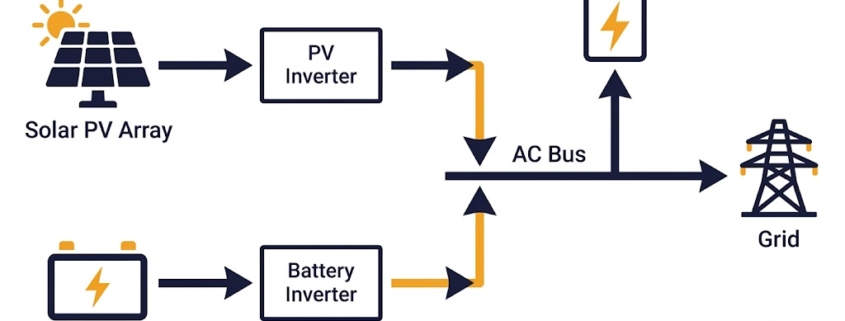
AC-coupled battery storage keeps the battery and the solar PV array on entirely separate circuits until they meet at the AC side of the system. During the day, the solar PV inverter generates AC electricity directly from the array. Any excess AC power not used on-site routes to the battery inverter, which converts it to DC to charge the battery — a process the BMS manages for safety and battery health.
When load demand exceeds generation, such as at night, the battery inverter reverses that conversion: it takes the battery’s stored DC power and converts it back to AC to supply the home or facility. Depending on how the system is configured, it can also import power from the grid or export excess energy back to it, enabling peak shaving, backup power, and participation in demand response programs.
This separation between the solar and battery inverters is what makes AC-coupled energy storage the more common retrofit choice: because the battery inverter operates independently, you can add AC-coupled battery storage to a solar system that’s already running without reconfiguring the existing PV inverter or rewiring the array. The U.S. Department of Energy has funded toolkit development specifically to simplify this kind of retrofit interconnection as battery storage adoption grows alongside existing solar installations.
The Role of the Battery Inverter in AC Coupled BESS
In an AC-coupled BESS, the battery inverter does the same core job as a hybrid inverter in a DC-coupled system, but it works alone rather than sharing duties with the solar inverter. It converts DC power from the battery to AC when discharging, and AC back to DC when charging, and it manages that conversion independently of whatever the solar PV inverter is doing at the same time.
Because the battery inverter operates on its own, AC-coupled systems can size, replace, or upgrade the battery inverter without touching the solar side at all — one of the main reasons AC-coupled storage stays the easier architecture to retrofit or expand in phases.
You can scale solar and battery systems independently. Ideal for adding more storage or generation capacity later.
3. Enhanced Redundancy
Separate inverters mean that if the solar or battery inverter fails, the other can still operate independently.
4. Flexible Control Strategies
AC coupling allows integration of diverse energy sources (wind, genset, hydro) and supports complex control logics using EMS.
5. Supports Microgrids & Off-Grid Applications
Crucial for backup power and remote areas. Works well in microgrids with multiple power sources and fluctuating load demands.
6. Time-of-Use Optimization
Charge batteries when electricity is cheap, and discharge during peak pricing. This helps reduce electricity bills significantly.
7. Grid Services Compatibility
Advanced systems can provide frequency regulation, voltage support, and participate in ancillary service markets.
AC Coupled vs. DC Coupled BESS
The core difference: AC-coupled systems use two separate inverters — one for solar, one for the battery — connected on the AC side. DC-coupled systems share a single inverter, with the battery and PV array on the same DC bus. AC-coupled is generally the easier, more flexible retrofit path; DC-coupled tends to be more efficient and lower-cost for new-build projects.
Commercial and Industrial facilities needing power backup or time-of-use optimization.
Remote microgrids with multiple sources of energy.
Retrofit projects adding batteries to an existing solar system.
Utility-scale grid support installations where power export, voltage regulation, and load shifting are required.
Frequently Asked Questions
What does “AC-coupled” mean?
AC-coupled means the solar PV array and the battery each connect to the grid through their own separate inverter, meeting only on the AC side of the system rather than sharing a DC bus.
What is an AC-coupled inverter?
An AC-coupled inverter is the dedicated inverter that connects a battery to the AC side of a solar-plus-storage system. It operates independently from the solar PV inverter, which is why AC-coupled systems use two inverters instead of one.
Is BESS the same as a PV system?
No. BESS (Battery Energy Storage System) refers specifically to the battery and its supporting hardware. A PV system refers to the solar panels and their inverter. Most solar-plus-storage projects combine both, but they’re distinct pieces of equipment with separate specifications.
What’s the difference between AC coupling and DC coupling?
Can AC-coupled batteries connect to any solar system?
In most cases, yes. Because AC-coupled batteries connect on the AC side through their own inverter, they can typically be added to an existing solar installation without modifying the PV array or its inverter, which is why AC-coupling is the more common retrofit choice.
Conclusion
AC Coupled BESS is a versatile and future-proof energy storage architecture. While it involves slightly more components and costs compared to DC coupling, the flexibility, redundancy, and modularity it offers make it a favorite for professionals designing hybrid systems, microgrids, and energy-resilient facilities.
Whether you’re an engineer, energy consultant, or business owner exploring storage solutions – understanding how AC coupled BESS works is key to making smarter energy decisions.
Need help sourcing or evaluating AC Coupled BESS systems? As a New Energy Consultant with over 13 years in China’s energy sector, I help global clients source reliable BESS products, conduct factory audits, and ensure full compliance with international standards.
As the world shifts towards renewable energy, the need for efficient energy storage systems is greater than ever. Battery Energy Storage Systems (BESS) are at the center of this transformation. But not all BESS setups are the same. One important configuration to understand is the DC Coupled BESS. In this blog post, we will explore what it is, how it works, its key components, and why it can be a smart choice for many renewable energy projects.
What is a DC Coupled BESS?
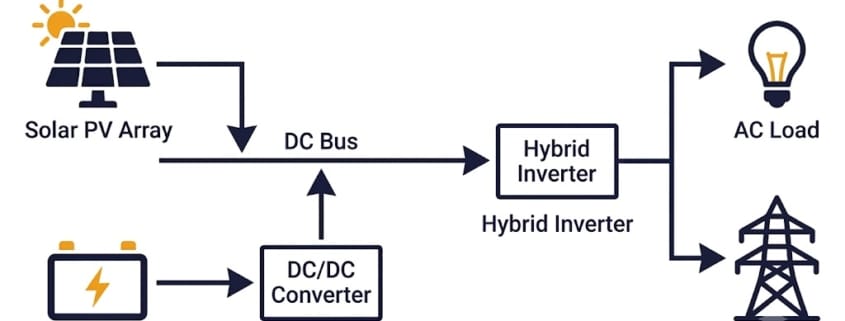
A DC Coupled Battery Energy Storage System (BESS) is an energy storage architecture where both the battery system and solar photovoltaic (PV) panels are connected on the same DC bus, before the inverter. This is different from an AC coupled BESS, where the solar and battery systems are each connected to the AC grid separately via their own inverters.
In simpler terms, in a DC-coupled system, the solar panels and battery share one inverter and connect through a DC/DC converter. This makes the system more efficient, especially in applications where solar generation is paired with energy storage.
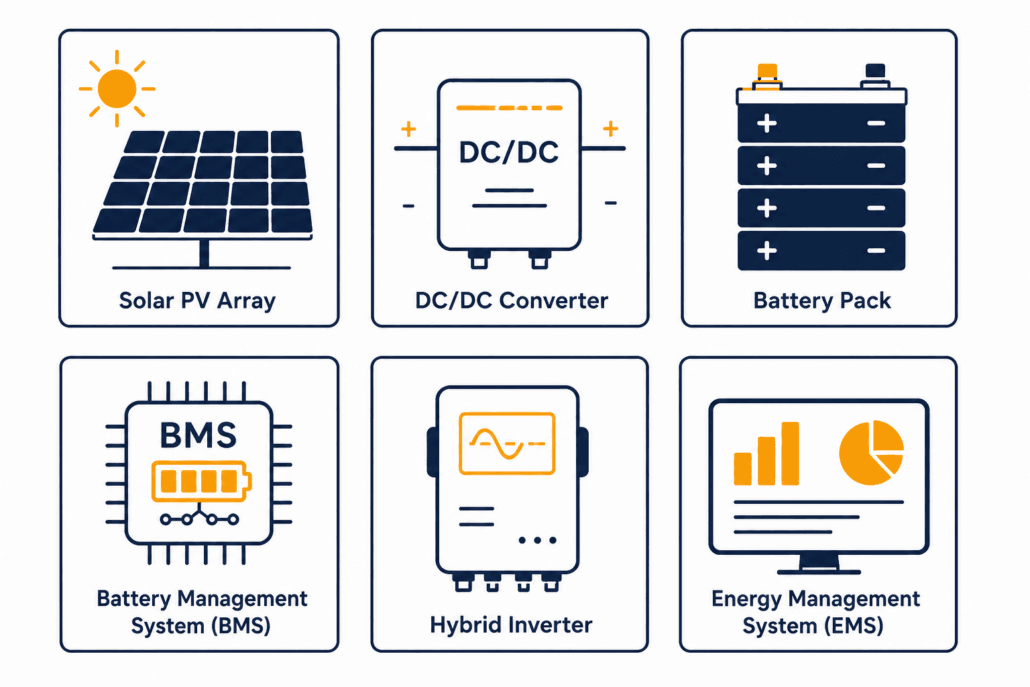
Core Components of a DC Coupled BESS System
A typical DC coupled BESS includes the following major components:
1. Solar PV Array
Captures sunlight and converts it into direct current (DC) electricity.
2. DC/DC Converter
This device regulates the voltage between the PV panels, battery, and inverter. It allows maximum power point tracking (MPPT) and enables energy flow between the PV and battery.
3. Battery Pack
Stores excess solar energy for use during periods of low generation or peak demand. Common chemistries include Li-ion (NMC, LFP) and semi-solid batteries.
4. Battery Management System (BMS)
Monitors and protects the battery cells. It manages parameters like voltage, current, temperature, and SoC (state of charge).
5. Hybrid Inverter (DC to AC)
Converts DC electricity from the battery or solar panels into AC electricity for use in homes, industries, or to feed into the grid.
6. Energy Management System (EMS)
Controls the operation of the entire system, optimizing charging/discharging, solar usage, and grid interaction based on pre-set algorithms and real-time conditions.
DC-Coupled Battery Storage: Why It’s More Efficient
DC-coupled battery storage keeps the solar array and battery on the same DC bus, so they share one inverter instead of each needing their own. That single shared conversion point is what defines DC-coupled energy storage and separates it from AC-coupled designs.
Because the battery in a DC-coupled battery storage system charges directly from the DC bus, it can also capture solar energy that would otherwise be clipped when panel output exceeds what the inverter can push to the grid — a common limitation in high-output PV arrays. That stored energy would simply be wasted in a system without DC-coupled storage in place. NREL’s 2024 Annual Technology Baseline applies a dedicated “Co-location Savings Rate of DC-Coupled Systems” in its own cost modeling for utility-scale PV-plus-battery projects, reflecting the added value this shared-inverter design captures over standalone PV and storage.
The Role of the BESS Inverter (PCS) in a DC-Coupled System
In a DC-coupled BESS, the shared inverter is often called the Power Conversion System, or PCS, in utility-scale and C&I applications. Because the solar array and battery share the same DC bus, this single BESS inverter has to manage three jobs at once: routing DC power between PV, battery, and loads; converting DC to AC at the one point where stored or generated energy leaves the DC bus; and, in some designs, forming or following grid voltage and frequency.
Because DC-coupled systems route everything through one inverter, PCS sizing and certification carry more weight here than in an AC-coupled design, where the load splits across two smaller units.
Here’s a simplified step-by-step overview of how a DC Coupled BESS operates:
During Daytime with Sunlight:
Solar PV generates DC electricity.
DC power goes to the DC/DC converter.
Part of the energy is used directly by loads (via inverter).
Excess energy charges the battery via the same DC bus.
Only one DC to AC conversion occurs when sending power to the grid or loads.
During Night or Cloudy Periods:
Stored energy in the battery is sent through the inverter to supply the AC load or the grid.
Grid-Tied and Off-Grid Modes:
Can function in both modes, depending on the design.
Can seamlessly switch between grid usage, solar generation, and battery power based on EMS logic.
Benefits of DC Coupled BESS
DC coupled systems offer several technical and economic advantages over AC coupled ones:
1. Higher Efficiency
Fewer conversions (DC-AC-DC in AC coupled vs. just DC-AC here).
Reduces energy losses, improving overall round-trip efficiency.
2. Lower Equipment Cost
Only one inverter needed.
Fewer transformers and conversion stages reduce capital expenditure.
3. Maximized Solar Harvesting
Allows solar charging even during grid outages.
Can store excess energy that would otherwise be clipped or curtailed.
4. Improved System Integration
Easier to integrate solar, battery, and EV charging into one system.
Easier to control and manage with centralized EMS.
5. Simpler Grid Interconnection
Since everything passes through a single inverter, grid interconnection rules are simpler.
Reduces the complexity of interconnection studies and permits.
6. Faster Response Time
Direct DC connection between battery and PV allows faster power adjustments in response to load changes or frequency events.
When Should You Choose a DC Coupled BESS?
A DC Coupled BESS is ideal for:
New solar + storage installations where both systems are designed together.
Remote or off-grid locations where grid stability and efficiency are critical.
Microgrid systems requiring smooth integration of multiple power sources.
Commercial and industrial setups looking for energy savings and peak load shaving.
However, if you’re retrofitting an existing solar system, an AC-coupled system is often easier to implement since it doesn’t require touching your existing PV wiring. For the full breakdown of both architectures — cost, efficiency, retrofit fit, and when to choose each — see our complete guide: AC-Coupled vs. DC-Coupled BESS: Which Architecture Is Right for Your Project?
Frequently Asked Questions
What does “DC-coupled” mean?
“DC-coupled” means the solar PV array and the battery connect to the same DC bus, ahead of a single shared inverter, rather than connecting separately on the AC side.
How does DC-coupled energy storage work?
Solar PV generates DC power that flows through a DC/DC converter, where it either charges the battery directly or passes through the shared inverter to supply AC loads or the grid. Because charging and discharging both happen on the DC side, the system converts power to AC only once, which improves efficiency compared to AC-coupled designs.
What does BESS stand for?
BESS stands for Battery Energy Storage System — any system that stores electrical energy in batteries for later use, whether paired with solar, wind, or the grid.
What is a DC-coupled battery?
A DC-coupled battery is a battery wired directly to the same DC bus as the solar array, charging and discharging through a shared DC/DC converter and inverter instead of its own dedicated inverter.
What’s the difference between AC-coupled and DC-coupled BESS?
A DC Coupled BESS offers a more efficient, cost-effective, and integrated approach to combining solar and battery storage. By reducing the number of conversions and simplifying system design, it ensures higher performance and better return on investment, especially in new or greenfield projects.
As energy needs evolve and distributed energy resources grow, understanding these architectures becomes critical. Whether you’re a developer, EPC, or energy investor—DC coupled systems could offer you the next level of performance and reliability.